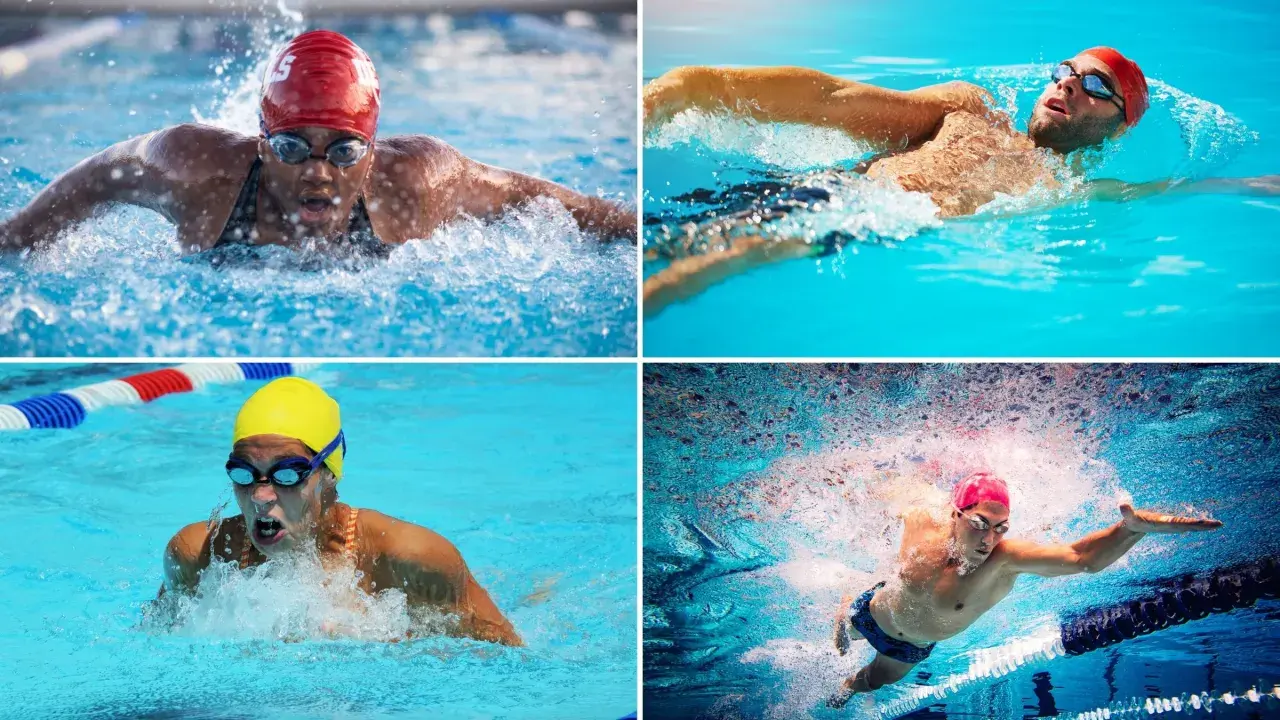
There is no single best stroke for every swimmer, but freestyle is usually the strongest answer for speed and general fitness. What matters more is whether you want to move faster, breathe more comfortably, protect a sore shoulder, or build better race timing. In this article I break down how each competitive stroke behaves, where it shines, where it falls short, and how to choose the one that actually fits your body and your training.
The right stroke depends on what you want from the water
- Freestyle is the fastest, easiest to scale, and the most useful all-purpose stroke for laps and training.
- Backstroke helps when face-down breathing feels limiting or when you want a cleaner body line.
- Breaststroke is slower, but rhythm, control, and recovery make it valuable in the right sets.
- Butterfly delivers the biggest power demand, but it only works well when timing stays intact.
- Turns, breathing, and body position often decide whether a stroke feels efficient or wasteful.
How I define the best stroke for real swimmers
When I judge a stroke, I do not start with ego or tradition. I start with the job it needs to do. A beginner learning confidence in the water, a lap swimmer chasing fitness, and a racer chasing hundredths of a second do not need the same answer.
I usually look at five things: speed, breathing comfort, technical demand, joint stress, and how repeatable the stroke is over the distance you actually swim. If a stroke is fast but makes you panic, it is not the best choice for that session. If it feels comfortable but never gets you moving with any efficiency, it is also a poor fit.
- Speed tells you how much water you can cover in a given time.
- Breathing comfort tells you how calm you can stay while swimming.
- Technical demand tells you how much coordination the stroke requires.
- Joint stress tells you whether the stroke fits your shoulders, back, and hips.
- Repeatability tells you whether you can hold the stroke together for a full workout.
Once those five line up, the answer becomes much clearer, and the comparison with the other strokes starts to matter. That is where the practical breakdown helps.

How the four competitive strokes compare in the pool
Here is the simplest way I compare the four competitive strokes when I am helping a swimmer choose a focus.
| Stroke | What it does best | Main trade-off | Best use case |
|---|---|---|---|
| Freestyle | Fastest overall and easiest to scale from short repeats to distance work | Breathing and body line must stay organized | Speed, general fitness, most workouts |
| Backstroke | Steady breathing and balanced body position | Head and kick control matter a lot | Recovery sets, comfort, medley balance |
| Breaststroke | Rhythm, control, and a more visible breathing pattern | Slowest if timing or kick is off | Technique work, moderate aerobic sets |
| Butterfly | Power and full-body coordination | Most demanding on timing and strength | Short repeats, individual medley, power training |
That table explains why one stroke does not win every conversation. Freestyle dominates most training plans because it gives the best return for the energy you put in. The other three still matter because they teach different movement patterns, different breathing skills, and different ways to stay efficient under pressure.
If you understand that split, the next question is obvious: why does freestyle usually come out on top?
Why freestyle is usually the strongest answer for speed and fitness
Freestyle is the workhorse of the pool. It is faster than backstroke because the arms can produce more propulsion and there is slightly less drag, and it is simpler to learn than the short-axis strokes. It is also the stroke most people can repeat for the longest time without the shape of the stroke falling apart, which is why it shows up everywhere from short sprints to long aerobic sets.
For a U.S. lap swimmer, that matters a lot. In a 25-yard pool, freestyle is the stroke that lets you train volume, speed, and pacing without needing perfect timing on every single repetition. That makes it the most practical all-purpose stroke for most swimmers.
- Body line should stay long and flat near the surface.
- The pull should grab water cleanly instead of slipping through it.
- Breathing should be quick, low, and calm, not a head lift.
- Rotation should help the stroke, not turn it into a roll show.
When backstroke or breaststroke makes more sense
I reach for these strokes when the swimmer needs a different constraint, not when they simply want another way to move.
Backstroke when breathing is the bottleneck
Backstroke is useful when face-down breathing makes swimmers tense. Because the face stays out of the water, breathing is simpler and many swimmers settle into rhythm faster. That does not mean backstroke is easy, though. If the head rides too high or too low, the hips sink and the stroke starts to feel heavy.
The practical cue I like is simple: keep your ears near the surface, your chin gently tucked, and your toes active enough that they leave bubbles. A steady kick from the hips matters more than flashy arm speed. When that balance is right, backstroke becomes a clean way to train posture and confidence without fighting for every breath.
Breaststroke when you want rhythm and control
Breaststroke is slower, but it rewards patience and timing. The recovery happens under water, which is a big reason it is the slowest competitive stroke, yet that same structure can make it feel controlled and almost meditative when it is done well. The real cost is timing: if the pull, breath, and kick drift apart, speed disappears quickly.
Breaststroke also asks for honest mechanics. A scissor kick or extra dolphin kick in competition is illegal, and even in training those errors usually mean wasted force. I like breaststroke for swimmers who need a stroke they can feel clearly, but I do not recommend pretending it is forgiving when the timing breaks down.
Backstroke and breaststroke are often the best place to look when freestyle feels uncomfortable but you still want a purposeful workout. From there, butterfly becomes easier to understand, even if it is still the hardest stroke to sustain.
Where butterfly belongs in a smart training plan
Butterfly is the hardest stroke for many swimmers because so many muscles have to fire together at the same time. When the rhythm is right, it looks smooth and powerful. When the timing slips, it turns into a fight with the water almost immediately. That is why I treat fly as a skill and power tool, not a default mileage stroke.
The strongest butterfly is built on timing, not brute force. The chest drives the breath, the kick follows the body wave, and the pull finishes in a way that keeps the hips from dropping. If you try to muscle your way through it, the stroke usually falls apart before the length is over.
- Use butterfly for short repeats, starts, turns, and medley training.
- Keep the head low and the breath quick instead of reaching forward for air.
- Stop the set when rhythm disappears rather than letting the stroke disintegrate.
- Shorten the repeat if you cannot hold the same motion for a full length.
In practice, butterfly teaches coordination that carries over into the rest of your swimming. It rewards swimmers who can stay organized under fatigue, but it punishes the habit of forcing distance before the stroke is ready for it. That leads naturally to the mistakes that slow every stroke, no matter which one you swim.
The mistakes that slow every stroke
Most swimmers do not lose speed because they lack effort. They lose speed because the stroke gets noisy. The body starts fighting itself, and that is usually where I look first.
Breathing that breaks the line
Breath-holding in freestyle is common and expensive. Exhale underwater, then take the air quickly; do not lift the head to chase the breath. In backstroke, stay relaxed and keep the body long instead of craning upward. In breaststroke and butterfly, take the breath as the body rises, not after the opportunity has already passed.
One of the most useful freestyle cues I use is to keep the turn of the head small. If both goggles keep coming out of the water, the breath is probably too big. That usually means more drag and less speed.
Head position that drops the hips
Looking forward in breaststroke or butterfly usually sinks the hips. In freestyle, the waterline should stay near one goggle, not both. In backstroke, the head should stay neutral enough that the chest can stay open and the hips can stay near the surface.
This sounds small, but it is not. In short-course yards, body position mistakes get magnified because you turn more often, and a slow turn plus a poor body line can cost more than a few extra hard strokes.
Read Also: Master All 4 Swim Strokes - Technique, Drills & Fixes
Timing that steals speed
Breaststroke and butterfly live or die on timing. If the arms and legs do not meet the same moment, the stroke feels jerky and slow. Freestyle depends less on perfect timing, but the catch, kick, and breath still need to live in the same rhythm. Backstroke is more forgiving, yet even there a weak or lazy kick makes the whole stroke sag.
When I see timing problems in breaststroke, I often think about the gap between the pull and the kick. Some coaches use a separation drill that begins with a few seconds between those actions and then shortens the delay until the stroke becomes continuous. That kind of work is boring in the best way: it teaches the body what clean timing feels like before speed gets added.
Once those basics are clean, the question changes from which stroke is best in theory to which stroke should get your attention first in training.
The stroke plan I would use first
If I were building a swimmer from scratch, I would spend most of the time on freestyle, use backstroke to improve balance and breathing, add breaststroke for timing and recovery, and keep butterfly in short, high-quality doses. That is the simplest order, and for most swimmers it is the most honest one.
- Choose freestyle if you want the broadest payoff for speed, fitness, and confidence.
- Choose backstroke if breathing is your bottleneck or you need a stroke that calms you down.
- Choose breaststroke if you want rhythm, control, and a stroke that teaches patience.
- Choose butterfly if you want power and coordination and can protect the shoulders.
The smartest goal is not to crown one stroke forever. It is to know which stroke gives you the biggest return right now, then build from there with clean technique and enough repetition to make it automatic.