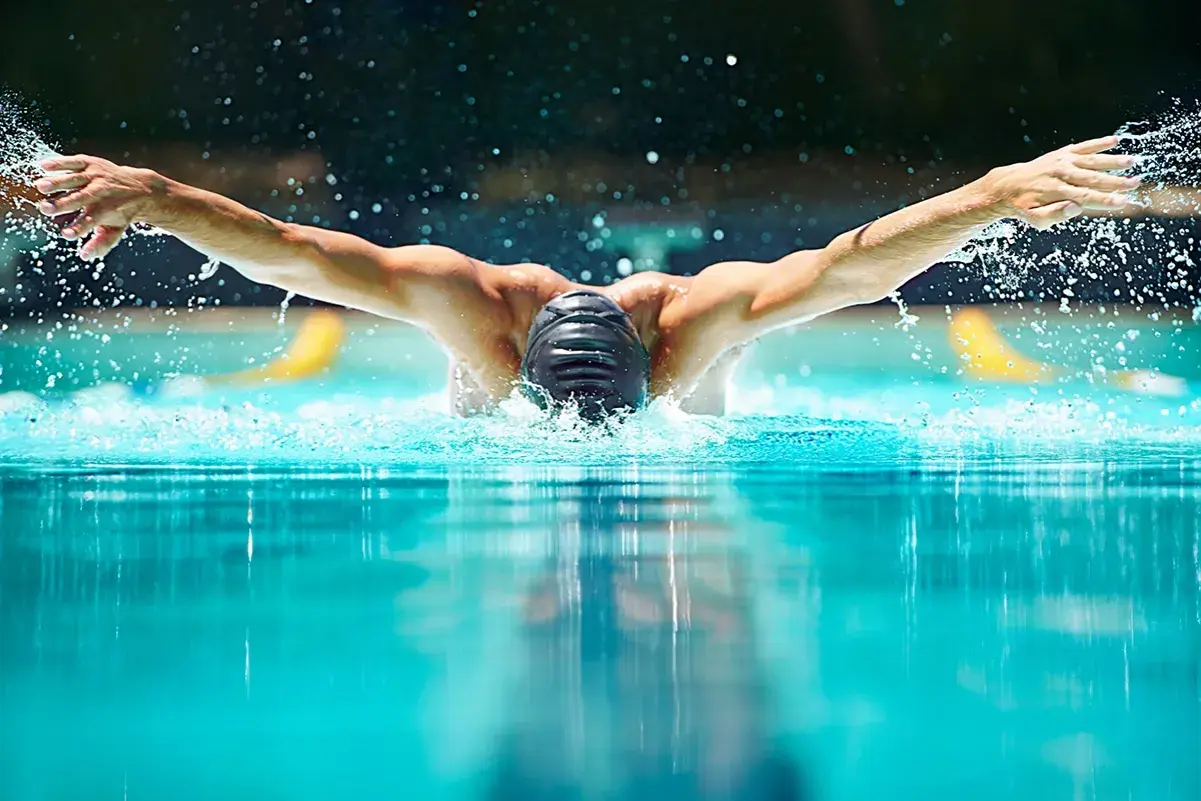
Swimming rewards clean movement more than forced effort. The most useful mobility exercises for swimmers are the ones that improve range of motion without creating so much looseness that your stroke loses shape. In practice, that usually means opening the shoulders, thoracic spine, hips, and ankles so you can reach, rotate, kick, and streamline with less resistance.
The fastest gains come from short, targeted mobility work
- Most swimmers need better shoulder flexion, thoracic rotation, hip opening, and ankle motion more than generic stretching.
- Dynamic work belongs before practice. Longer static holds fit better after training or away from the pool deck.
- A 10-minute routine can cover the joints that affect freestyle, backstroke, breaststroke, and butterfly most.
- If a drill creates pain, pinching, or numbness, it is the wrong tool and should be scaled or replaced.
- Consistency matters more than intensity. Small doses done several times a week usually beat one long session.
Why mobility changes how your stroke feels
I like to separate mobility from pure flexibility. Flexibility is how far a joint can be pushed, while mobility is how much usable control you have inside that range. In swimming, that difference matters. You need enough shoulder reach to set up the catch, enough thoracic rotation to turn cleanly through freestyle and backstroke, enough hip motion to keep your kick efficient, and enough ankle range to point the foot without fighting stiffness.
When one of those pieces is limited, the body steals motion from somewhere else. A stiff upper back can make the lower back twist too much. Tight hips can shorten the kick or pull the knees out of line. Restricted ankles make the feet feel heavy in the water. That is why I treat mobility as a stroke-quality issue, not just a recovery habit. Once you know what changes the stroke, you can stop guessing and work the right areas.
That starts with identifying the joints that usually bottleneck swimmers first.
The body areas I check first in swimmers
I usually check four places first. They account for most of the problems I see in distance swimmers, sprint swimmers, and masters athletes who spend a lot of time at a desk between sessions.
| Area | What limitation looks like | Why it matters in the pool |
|---|---|---|
| Shoulders | Overhead reach causes shrugging, rib flare, or a pinching feeling | Affects catch setup, recovery, and streamline position |
| Thoracic spine | Rotation comes mostly from the lower back instead of the upper back | Affects freestyle roll, backstroke balance, and butterfly rhythm |
| Hips | Deep kick positions feel pinched, blocked, or asymmetrical | Affects breaststroke, starts, turns, and dolphin kick mechanics |
| Ankles | The foot points poorly or the knee-to-wall movement feels tight | Affects kick propulsion, body line, and streamline efficiency |
If you want a quick self-check, reach overhead, rotate your chest left and right, sit into a shallow squat, and drive a knee over the toes toward the wall. Any obvious side-to-side gap tells me where to start. I rarely begin anywhere else, because the body usually gives away the bottleneck early. That leads to the drills that earn their place.

Exercises that give the best return in and out of the pool
The goal is not to collect a long menu of stretches. I want a handful of drills that open motion and also teach the body to use it. These are the ones I keep coming back to.
| Exercise | Main target | How I use it | Best time |
|---|---|---|---|
| Shoulder CARs | Shoulder capsule and scapular control | 3 to 5 slow circles each direction | Warm-up or off-day |
| Wall slides with lift-off | Overhead reach and serratus control | 6 to 8 smooth reps | Before swimming |
| Open books | Thoracic spine rotation | 6 reps each side | Before or after practice |
| Half-kneeling hip flexor rocks | Hip extension and front-of-hip tightness | 8 reps each side | Before or after practice |
| 90/90 switches | Hip internal and external rotation | 6 to 8 controlled switches | Off-day or after practice |
| Knee-to-wall ankle rocks | Ankle dorsiflexion | 8 to 10 reps each side | Before kicking or dryland |
If time is tight, I would rather see one shoulder drill, one spine drill, one hip drill, and one ankle drill than a random full-body stretch marathon. That combination covers most swimmers better than a long list of isolated moves. From there, the next question is when to use these drills and how hard to push them.
How I’d structure a pre-swim and post-swim routine
I separate warm-up mobility from recovery mobility because they do different jobs. Before practice, I want the joints awake, aligned, and ready to move. After practice, I am more interested in downshifting tone and reclaiming range without forcing anything.
| Phase | Goal | Time | What it should feel like |
|---|---|---|---|
| Before practice | Prime the stroke and activate the right patterns | 6 to 10 minutes | Warm, loose, and controlled, not fatigued |
| After practice | Restore range and reduce stiffness | 5 to 15 minutes | Slower breathing and less tension |
This is the pre-swim template I like for most sessions:
- 30 seconds of easy movement to raise body temperature, such as arm swings, marching, or light jump rope.
- 6 wall slides with a small lift-off at the top.
- 6 open books on each side to wake up thoracic rotation.
- 8 half-kneeling hip flexor rocks on each side.
- 8 knee-to-wall ankle rocks on each side.
- 6 to 8 scap push-ups or band external rotations if the shoulders need activation.
That is enough for most training days. On high-volume days, I keep it short and specific. On easier days or at home, I add longer holds for the chest, lats, calves, and hip flexors. I almost never hold a deep passive stretch right before a hard main set, because it tends to make swimmers feel flat rather than ready. From there, it makes sense to tailor the work to the stroke you swim most.
How to adjust the work for freestyle, breaststroke, and butterfly
Different strokes expose different limitations. A freestyle sprinter and a breaststroker do not need identical mobility priorities, and butterfly usually demands the most from the upper back, shoulders, and ankles.
| Stroke | What usually limits it | Best mobility focus |
|---|---|---|
| Freestyle and backstroke | Shoulder flexion, thoracic rotation, and scapular control | Open books, wall slides, shoulder CARs, and controlled overhead reaches |
| Breaststroke | Hip rotation, adductors, and groin tolerance | 90/90 switches, adductor rock-backs, and gentle frog-style positions |
| Butterfly | Thoracic extension, lat length, shoulder motion, and ankle point | Cat-cow, thoracic extensions, lat-opening work, and ankle rocks |
If your volume is freestyle-heavy, I would spend more time on the shoulders and upper back than on a long list of hip stretches. If breaststroke is your problem stroke, I would pay attention to the groin and inside thigh, but I would also be careful not to force end range too aggressively. That is where many swimmers turn a useful drill into an irritated adductor. The next thing to clean up is the mistakes that quietly cancel out the work.
Mistakes that make mobility work less useful
- Going too hard too fast. Mobility is tissue adaptation, not a pain contest.
- Using only static stretching before training. Long holds can make you feel sleepy instead of prepared.
- Skipping control at the new range. If you cannot control the position, the range usually does not transfer well to swimming.
- Ignoring one side. Side-to-side differences are common and worth tracking, especially in shoulders and hips.
- Using mobility to hide pain. A pinch, sharp tug, or numb feeling is not a normal training sensation.
If a shoulder pinches overhead, if a groin twinges during breaststroke kicks, or if numbness shows up, I stop treating it as a standard mobility issue. That is where a coach, physio, or sports medicine pro earns their keep. Assuming the pain is not a red flag, the final step is making the work simple enough to repeat.
The minimum effective routine I’d keep all season
For most swimmers, I would keep the routine boring on purpose: 6 to 10 minutes before practice, 10 to 15 minutes after two or three sessions per week, and one longer 20-minute reset on an easier day. That is enough to maintain range of motion for most people without turning mobility into another training stress.
- Keep one drill for shoulders, one for the thoracic spine, one for hips, and one for ankles.
- Use dynamic work before the pool and slower holds after the pool.
- Track which side feels different, because asymmetry is often the first clue that matters.
I like simple routines because swimmers already have enough to think about. If the mobility work feels complicated, it probably is. The version that lasts is the one you can do on a Tuesday after hard intervals and still be willing to repeat on Friday. If one limitation keeps coming back on the same side, I treat that as a clue about technique, load, or old injury history rather than just a need for more stretching.
