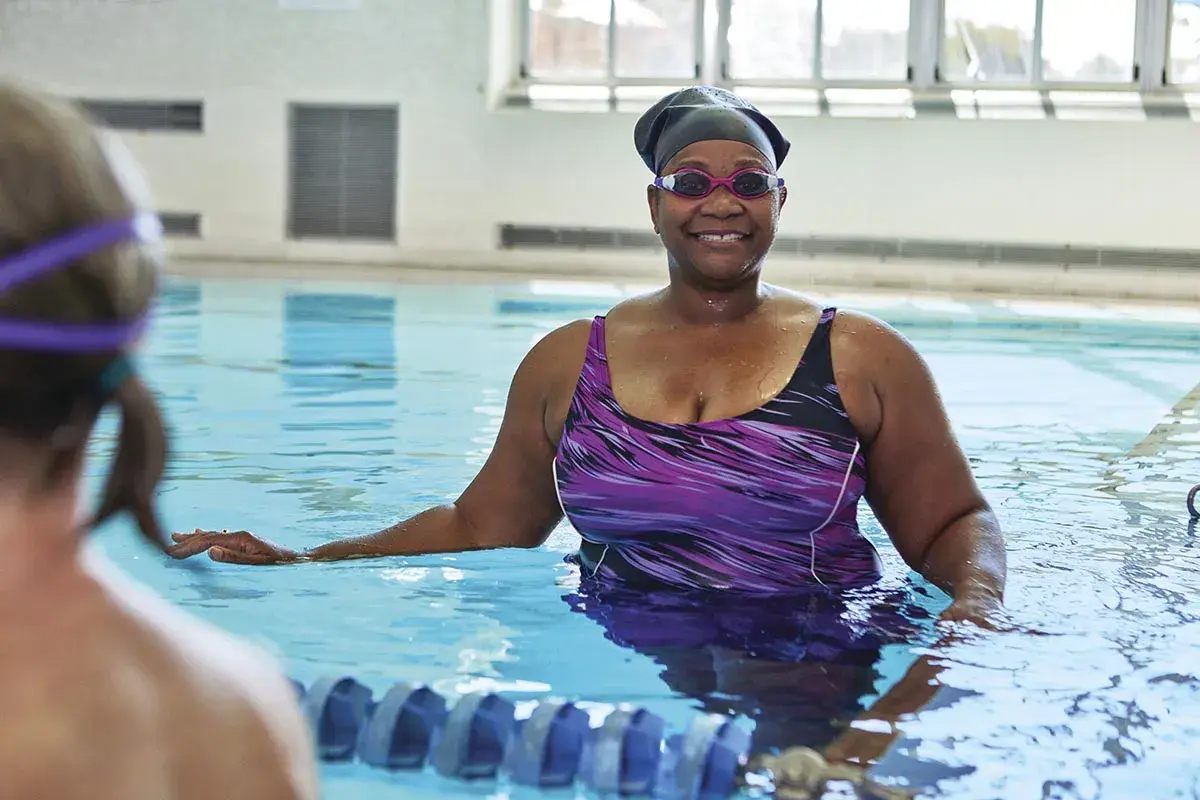
What matters most before you enroll
- Older adults benefit most from lessons that start with comfort, breathing, floating, and basic water safety before stroke work.
- The CDC recommends 150 minutes of moderate aerobic activity a week for adults 65 and older, plus muscle-strengthening and balance work.
- A good program should adapt for arthritis, balance concerns, limited mobility, or fear of deep water instead of forcing a rigid pace.
- Heated pools in the 83 to 90 degrees Fahrenheit range are often easier on stiff joints than cooler water.
- Group lessons, private coaching, and aquatic fitness classes serve different goals, so the best choice depends on your confidence and starting point.
Why swimming works so well for older adults
I like recommending swimming to older adults because it solves a common problem: many people want to stay active, but walking, jogging, or gym machines start to feel hard on knees, hips, shoulders, or the lower back. Water changes the equation. It supports body weight, softens the impact of movement, and still gives you a real workout for the heart, lungs, and muscles.
The CDC says adults 65 and older should aim for 150 minutes of moderate-intensity aerobic activity each week, plus at least 2 days of muscle-strengthening work and balance activity. Swimming can contribute to that weekly target, especially if the lesson includes steady kicking, body position drills, and short repeated efforts instead of just casual drifting around the pool.
There is also a practical quality-of-life angle that gets overlooked. Water-based exercise can help older adults move more comfortably, and it may reduce the risk of falls by improving strength, coordination, and confidence in motion. For people with arthritis, the pool can be a useful place to move without the same joint stress they feel on land. That is why the best lessons for older adults usually focus first on comfort and control, not on how quickly someone can swim a lap. From there, it makes sense to look at the actual lesson structure.
What a senior-friendly lesson should cover
A useful class for older adults should not feel like a children’s swim session with a different label. The pace should be slower, the cues should be clearer, and the instructor should be willing to repeat basics without treating that as a problem. In practice, the first real goal is water confidence, not technique perfection.
Start with the basics that make the pool feel manageable
Before anyone worries about efficient strokes, the lesson should cover how to enter and exit safely, how to breathe comfortably, how to float or recover to standing, and how to move along the wall if needed. The American Red Cross adult program is a good example of this approach: it begins with learning the basics, then moves into skill improvement, and only later shifts toward fitness-focused swimming. That progression makes sense for older adults because it respects the fact that confidence and body control matter just as much as endurance.
Expect technique to be broken into small pieces
I would expect a good instructor to teach in short segments: face in the water, exhale, recover, then repeat. One session may focus on balance and body position; another may add kicking with a kickboard; another may introduce arm action or side breathing. That step-by-step rhythm is especially helpful for people who have not swum since childhood, or who have been away from the pool for years and now feel hesitant.
Read Also: 1:1 Swim Lessons UK Cost - Is Your Quote Fair?
Fitness is a later stage, not the opening move
“Swimming for fitness” should usually come after the swimmer can stay calm, move efficiently, and rest without panic. That matters because a lot of adults mistakenly think they need to be fit before they start lessons. In reality, the lesson is the thing that builds the fitness. A well-run program earns the right to be more demanding only after the swimmer is ready.
Once that structure is clear, the next question is whether the instructor can adapt the lesson to the person in front of them, which is where quality really shows up.
How a good instructor adapts to mobility, fear, and health limits
The best instructors do not teach older adults as if they are all the same. They ask about mobility, prior injuries, joint replacements, balance issues, fear of deep water, and any medical limits that could affect pacing. That is not formality; it is the difference between a class that feels usable and one that feels intimidating.
If I were choosing a teacher for an older swimmer, I would look for these habits immediately:
- They ask what you want from the class before they start giving drills.
- They give short, specific instructions instead of packing too many cues into one explanation.
- They allow frequent rest breaks without making the swimmer feel rushed.
- They are comfortable modifying drills for shallow water, limited shoulder range, or balance concerns.
- They treat fear as normal and work around it rather than trying to “push through” it.
There are also a few red flags. If an instructor pushes submersion too early, dismisses pain or dizziness, or seems annoyed when a swimmer needs repetition, I would move on. Older adults often do best with patient, technical teaching, not motivational pressure. Warm water also matters more than many people realize. For stiff joints, I tend to prefer a heated pool in the 83 to 90 degrees Fahrenheit range, because cooler water can make movement feel guarded and less fluid.
With that in mind, the next step is choosing the lesson format that matches the person’s goals instead of simply picking the nearest available class.

How to choose the right class in the United States
In the U.S., older adults usually have four realistic options: group lessons, private lessons, aquatic fitness classes, or therapeutic water sessions. Each one solves a different problem, so the “best” choice depends on what is getting in the way right now.
| Option | Best for | Main advantage | Tradeoff |
|---|---|---|---|
| Group lessons | Beginners who want structure and a lower price point | Social, steady progression, good for learning basic safety and stroke foundations | Less individual attention and less flexibility for specific mobility needs |
| Private lessons | People with fear, limited mobility, or a very specific goal | Fast feedback and pacing built around the swimmer’s body and confidence level | Usually the most expensive option |
| Aquatic fitness classes | Adults who already feel safe in water but want gentle conditioning | Good for endurance, movement, and low-impact exercise | Often not enough if the person still needs to learn basic swim skills |
| Therapeutic pool sessions | Older adults recovering from injury or managing chronic pain | Comfortable environment for controlled movement | Not always the best place to build full swimming technique |
For most people starting from scratch, I would lean toward either a small group class or a private lesson package. Group lessons are usually better when confidence is moderate and the swimmer wants to learn alongside peers. Private lessons make more sense when fear is high, the swimmer needs a slower pace, or there are movement limits that would be hard to address in a group. Facilities run by established swim programs often use this kind of level-based structure, which makes it easier to keep progress realistic instead of guesswork-based.
Before enrolling, I would ask six blunt questions: How many people are in the class? Will the instructor adjust for arthritis or balance concerns? Is the water shallow enough to stand comfortably? Can I repeat a level if needed? Are flotation tools allowed early on? And what happens if I need extra rest during a session? Those answers tell you far more than a polished brochure ever will. Once the class is selected, the last step is making the first few lessons easier on yourself.
How to prepare so the first lessons go smoothly
The first lesson should feel manageable, not impressive. I usually advise older adults to prepare with the same mindset they would use for any new exercise program: remove friction, lower expectations, and make the basics easy to repeat.
- Bring a swimsuit that is easy to get on and off, plus a towel that you can wrap quickly after the session.
- Use supportive pool shoes if the deck is slippery or if you need extra traction.
- Arrive a little early so you are not starting the lesson already rushed.
- Drink water before and after the session, even if you do not feel sweaty in the pool.
- Tell the instructor about pain points, surgery history, or anything that could limit kicking, arm lift, or balance.
- Plan for the first sessions to be about breathing, floating, and comfort, not long continuous laps.
If a doctor has told you to avoid certain movements, get clearance before you start and share those limits clearly. That matters more than people think, especially with heart conditions, recent joint replacements, or balance issues that could affect how you enter and exit the water. I also think swimmers do better when they commit to a short rhythm, such as one or two lessons a week, rather than treating the pool as a one-off experiment. Repetition is what turns a nervous beginner into someone who feels at home in the water.
After a few sessions, you should expect a shift in what feels difficult. At that point, progress becomes easier to judge, which is where many people finally realize they are doing better than they thought.
What steady progress looks like after the first month
I do not measure success in laps at the beginning. I look for calmer, cleaner movement. If someone has taken lessons consistently for a few weeks, a realistic sign of progress is that they can enter the pool without tension, exhale underwater without panic, and recover to standing or the wall with less effort than before.
- You can float or glide for a few seconds without immediately grabbing the wall.
- You can coordinate breathing with basic movement instead of holding your breath.
- You can repeat short drills without feeling overloaded after every set.
- You understand what your instructor is asking and can correct one mistake at a time.
- You leave the pool feeling worked, but not wrecked.
If those things are happening, the class is doing its job. If not, the answer is not always “try harder.” Sometimes the class is too advanced, the pool environment is wrong, or the instructor is not adapting well enough to the swimmer’s needs. The best programs for older adults create confidence first and conditioning second, because confidence is what keeps people coming back long enough to build real skill. That is the part I would protect most carefully.
A good lesson plan for older adults should feel calm, technical, and repeatable. Start with comfort, choose the right level of instruction, and let progress build in small steps. If the pool environment, the instructor, and the class pace all fit together, swimming becomes more than exercise; it becomes a practical skill you can use for fitness, safety, and long-term mobility.