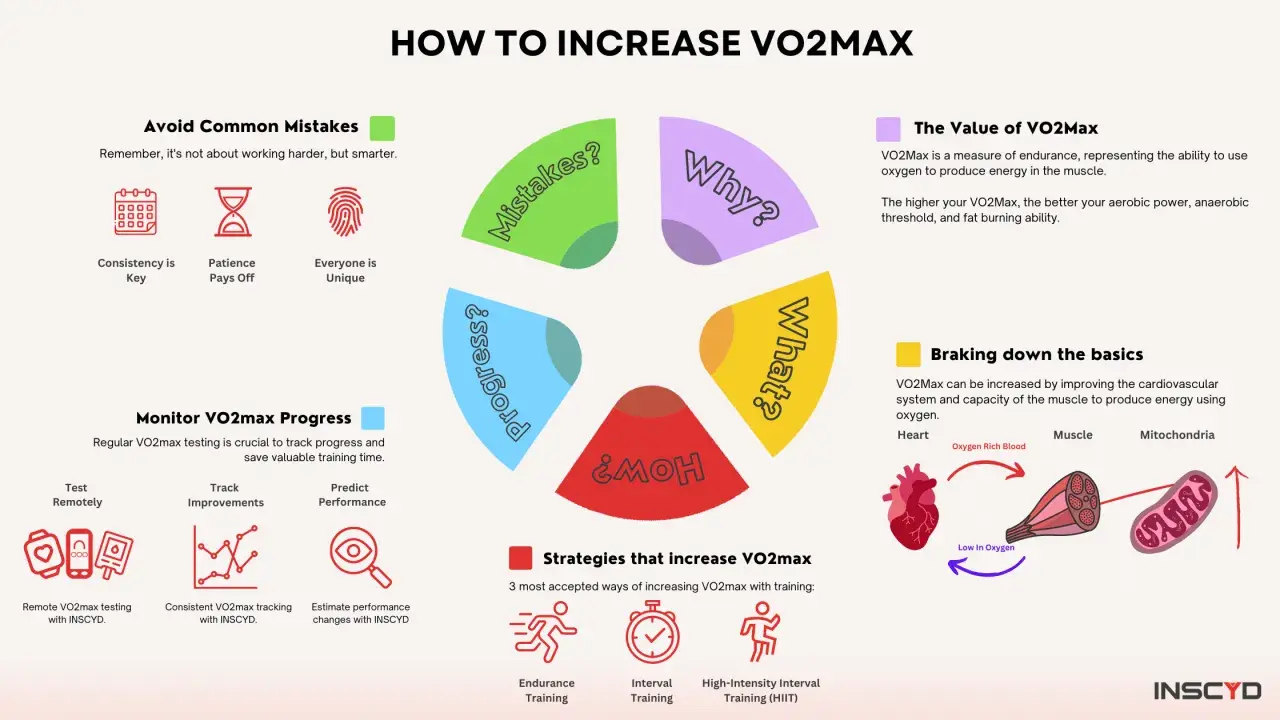
Raising maximal oxygen uptake in the water is not just a matter of swimming harder. The best gains usually come from repeatable high-intensity sets, smart recovery, and stroke mechanics that keep drag under control when breathing gets ugly. In this article I break down what VO2 max training looks like in a swim program, which interval formats are worth using, how to place them in a week, and where swimmers usually waste the work.
What matters most for a stronger aerobic engine in the pool
- Short sprints help speed, but longer hard repeats usually do more for time spent near VO2 max.
- For many swimmers, 60- to 200-yard repeats with short, controlled rest are the most useful starting point.
- One or two hard sessions per week is usually enough; the rest of the week should support them.
- Technique, breathing, and dryland strength decide whether the session builds fitness or just fatigue.
- Watch-based VO2 estimates are trend tools, not a lab test.
What actually drives oxygen uptake higher in the pool
Maximal oxygen uptake is the ceiling for how much oxygen your body can deliver and use during hard work. In swimming, that ceiling is shaped not only by the heart and lungs, but also by body position, breathing rhythm, and how well the stroke holds together when the effort gets uncomfortable. That is why two swimmers can finish the same set and get very different training effects from it.
Swimming also has a slower oxygen-uptake response than running or cycling, so a set that feels brutal for 20 or 30 seconds may still be too short to spend meaningful time near the top of the system. The goal is not just to feel wrecked; it is to accumulate enough time near the ceiling that the body has a reason to adapt. When I program hard pool work, I think in terms of repeatable quality, not one giant hero rep.
That is the real value of VO2 max work in the pool: enough intensity to challenge the system, enough control to repeat it, and enough technique left at the end of the rep that the next one still matters. Once that idea is clear, the next question is which set formats actually create that exposure.

Pool sets that reach the right intensity
There is no single perfect interval set, but there are a few formats that consistently make sense for swimmers. I think of them as tools for different jobs: some are better for speed, some for aerobic power, and some for staying close to race-like effort without falling apart.
| Set type | Example | Why it works | Best use |
|---|---|---|---|
| 25-50 second sprints | 12 x 25 with generous rest, or 8 x 50 on a relaxed send-off | Useful for speed and neuromuscular sharpness, but often too brief to spend much time near maximal oxygen uptake | Speed days, starts, turns, or as a small add-on after warm-up |
| 60-90 second repeats | 10 x 75 or 12 x 100 on a moderate interval | Long enough for oxygen uptake to rise while still demanding clean mechanics | The best all-around choice for many masters swimmers and triathletes |
| 2-4 minute repeats | 6 x 200 or 4 x 300 at a strong, repeatable pace | Builds more total time close to the ceiling and teaches pacing under pressure | Aerobic power blocks and race-fitness phases |
| Mixed ladders | 50-100-150-100-50 or a descending 200/150/100/50 | Keeps the session mentally manageable while still letting intensity climb and fall in a controlled way | Variety days when you want purpose without monotony |
In one study on trained swimmers, the faster 105% of vVO2max work reached high oxygen uptake sooner, but the slightly easier 95% version kept athletes there longer. The practical lesson is simple: I want a pace that is hard enough to move oxygen use, but not so violent that the swimmer leaves the zone after one rep. For many athletes, a solid 60-second effort is a better stimulus than a 30-second blast.
That choice matters even more once you decide how to stack the work across the week.
How I would build the week around hard repeats
I usually treat hard aerobic power work as a one- or two-day ingredient, not the whole diet. For most swimmers, one true interval session per week is enough to start; two works only when the rest of the program is controlled and recovery is real. In the U.S., the ACSM baseline for adults is 75 to 150 minutes of vigorous aerobic activity per week, plus muscle-strength work on two or more days, and I think of that as the floor that supports hard pool sessions, not a replacement for them.
Here is the structure I like for most recreational swimmers, masters swimmers, and triathletes:
- If you swim three times per week, make one day hard, one day aerobic, and one day technique-focused.
- If you swim four to five times per week, add one threshold or race-pace day and one recovery or skill day.
- Keep at least 48 hours between the hardest repeat sessions when you can.
- Most sessions do not need to be long; 45 to 60 minutes is enough if the main set is well designed.
A simple week might look like this: easy technique on Monday, interval work on Tuesday, recovery swim on Wednesday, aerobic or threshold work on Thursday, dryland or easy swimming on Friday, and a second quality pool session on Saturday. If you only have 30 minutes, I would still protect the main set rather than forcing extra volume into the workout. Quality is the point.
Once the schedule is in place, the next limiter is not usually motivation. It is whether the stroke can actually hold up when the breathing gets heavy.
Technique, breathing, and dryland work that keep the set honest
A better engine only matters if the stroke can use it. In the pool I look first at body line, a clean catch, and a breathing pattern that does not turn hard swimming into panic swimming. A front snorkel can help isolate position and the catch, small fins can keep speed from collapsing, and paddles should stay modest if shoulder tolerance is not perfect. None of that replaces fitness, but all of it helps the work land where it should.
- Exhale continuously underwater so you are not stacking up unnecessary tension before every breath.
- Keep head movement small; a lifted head drops the hips and quietly adds drag.
- Use a snorkel for technique or tempo work, not as a crutch on every hard set.
- Keep paddles modest and stop them if the shoulder feels unstable or the catch gets sloppy.
- Do two short strength sessions per week if possible: rows, pulldowns or pull-ups, split squats, dead bugs, Pallof presses, and hip mobility are enough to make a difference for many swimmers.
I also treat wearable data carefully. U.S. Masters Swimming is right to warn that VO2 max readings on watches can be off, so I use them only as trend lines, not as lab values. If pace is slipping, stroke count is jumping, and recovery is getting worse, that matters more than the number on the screen.
All of that sounds simple, but a lot of hard sets still fail because of a few predictable errors.
The mistakes that keep VO2 work from paying off
Most bad interval work is not bad because the set is too short. It is bad because the stimulus is wrong. I see the same mistakes over and over, and each one quietly reduces the training effect.
- Going all-out on rep one and fading by rep three. If the pace collapses, the session stops being aerobic power work.
- Resting too much. Full recovery turns a VO2 set into a sprint test.
- Resting too little. If you never get back to a meaningful pace, the set becomes sloppy threshold swimming.
- Ignoring easy swimming around the hard work. The ceiling rises faster when there is a base underneath it.
- Chasing the number on the watch instead of the feel in the water. Trend data is useful; panic data is not.
- Stacking another hard day before the last one has settled. More intensity is not the same thing as better adaptation.
When those errors are removed, the programming itself gets much simpler. You do not need a dozen exotic sets. You need a repeatable structure that nudges the body without breaking the stroke.
What I would run for the next four weeks
If I were rebuilding a swimmer’s aerobic ceiling, I would keep the plan intentionally plain. The point is to get enough high-quality work to force adaptation, then recover enough to repeat it well the next week.
- Week 1 - 2 rounds of 6 x 75 at a strong, controlled pace with 20 to 30 seconds of rest, plus an easy cooldown. The goal is to learn the pace, not chase a hero split.
- Week 2 - 8 x 100 at the same effort, with slightly tighter rest if the first week felt manageable. Keep the stroke count steady and resist the urge to sprint the first two reps.
- Week 3 - 5 x 200 at a repeatable hard pace, aiming to hold the same split all the way through. This is the week where pacing discipline matters most.
- Week 4 - Reduce the hard volume by about 30 to 40 percent, keep one sharp session, then test with a hard 400 or 500-yard swim, or with the same repeat set from Week 1.
If the swimmer is newer, I would shorten the repeats rather than forcing more intensity. If the swimmer is experienced and recovering well, I would keep the same structure but make the pace a little cleaner before I make it faster. That is the part many people miss: the best aerobic work in swimming is rarely the most dramatic session in the logbook. It is the one you can repeat, recover from, and build on without letting technique collapse.
