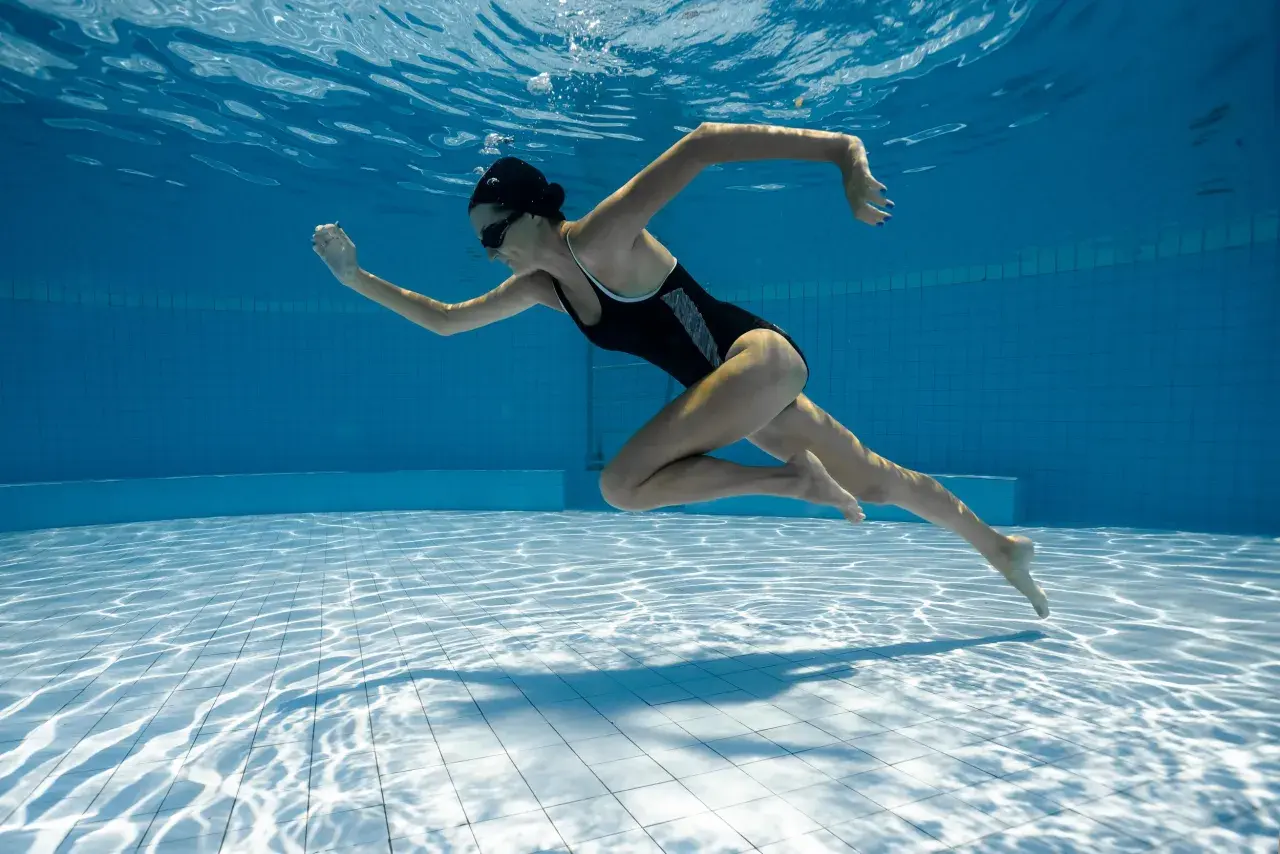
This guide breaks down what water-based training actually does for your body, why it can be useful for swimmers, and how to turn a casual pool session into real conditioning. I focus on the parts that matter most in practice: joint-friendly cardio, muscular endurance, session structure, basic gear, and the safety details that people in the United States often overlook.
The fastest route to better pool fitness is a simple, progressive water workout
- Water supports your body weight, so the impact is lower than on land, but the resistance is still high enough to build conditioning.
- It is a strong fit for beginners, older adults, swimmers cross-training for endurance, and anyone managing joint stress.
- A good session is not random movement in chest-deep water; it has a warm-up, a main set, and a cooldown.
- For swim training, the best pool work improves posture, leg drive, core control, and shoulder stability without adding too much pounding.
- Simple equipment is usually enough. You do not need a full bag of accessories to get an effective workout.
- Safety still matters: hydration, pool rules, and honest intensity control are part of the program, not an afterthought.
What this kind of pool training actually is
At its core, this is rhythmic exercise performed in water, usually in shallow or chest-deep lanes, sometimes in deeper water with a flotation belt. The appeal is straightforward: the water reduces impact while adding resistance in every direction, so the same movement can feel both easier on the joints and more demanding on the muscles. I think that combination explains why it works for such different people. A beginner may use it to build basic cardio without beating up the knees. A competitive swimmer may use it for recovery, aerobic volume, or dryland-style conditioning that is easier on the shoulders than repeated land jumps. Mayo Clinic notes that aquatic exercise can support heart health, muscular endurance, and joint-friendly movement, and that is exactly the pattern I see most often in practice.It is also more flexible than many people expect. You do not need to be an expert swimmer to benefit from it, and not every session has to look like a class with music and choreography. Walking patterns, interval work, running in place, and resistance drills all count when they are organized well.
The real question is not whether the water is “hard enough.” It is whether the workout is structured enough to push the system you want to improve. That leads directly to how it helps fitness and swim performance.
How aqua aerobics helps swimming and general fitness
The main training effect comes from water’s resistance. Every push, pull, kick, and change of direction asks your muscles to work against drag. Because drag increases with speed, a fast movement can feel disproportionately harder than the same effort on land. That is useful for building muscular endurance, especially in the legs, hips, and shoulders.
For swimmers, the transfer is not perfect, but it is real. Pool conditioning can reinforce a tall body position, stronger trunk control, and better stamina in the parts of the stroke that tend to fade late in a set. I would not use it to replace actual swim practice, but I would absolutely use it to extend total weekly work without adding more pounding.
It also has a few advantages that land cardio does not:
| Training factor | In the pool | On land | What it means in practice |
|---|---|---|---|
| Impact | Low | Moderate to high | Easier on knees, hips, and ankles |
| Resistance | High in every direction | Mostly gravity-based | Better for sustained muscular work |
| Heat load | Lower | Higher | Can feel easier to tolerate, but intensity still matters |
| Balance demand | Moderate, depending on depth | Often higher | Useful for controlled rehab and older adults |
| Skill requirement | Varies | Usually lower | Technique still matters, but the barrier is manageable |
The CDC also highlights water-based exercise as helpful for people living with conditions such as arthritis, diabetes, and heart disease. That does not mean the pool is automatically right for everyone, but it does explain why this style of training sits in a sweet spot between rehabilitation and fitness work.
One limitation is worth stating plainly: because the water cools you down and masks impact, people often underestimate how hard they are working. If your breathing is easy and your posture falls apart, the session is probably too light to drive much adaptation. That is why the next step is learning how to build the workout itself.

How to build a session that actually improves fitness
A useful pool session follows the same logic as any good workout: prepare the body, apply a clear training stimulus, then bring the effort down gradually. I like to think in minutes, not just in movements, because time under controlled effort is what makes the difference.
Read Also: Swimmer Body vs. Gym Body - Which Physique Is Right For You?
A practical 30-minute template
- Warm-up, 5 to 7 minutes: easy water walking, arm sweeps, gentle side steps, and relaxed breathing.
- Main set, 12 to 18 minutes: intervals that alternate effort and recovery, such as 45 seconds hard, 30 seconds easy.
- Skill or strength block, 5 to 8 minutes: targeted work like deep-water running, lateral shuffles, or push-pull drills with light resistance tools.
- Cooldown, 5 minutes: slower walking, gentle mobility, and calm breathing until your pulse settles.
If you want a simple progression, start at a perceived effort of 4 to 5 out of 10 for the warm-up and 6 to 7 out of 10 for the work intervals. That should feel challenging but still controlled. By the end of the session, you should be tired in a clean way, not so gassed that your movement turns sloppy.
For swimmers, I usually prefer one of two formats. The first is steady aerobic work: longer continuous movement at moderate intensity. The second is interval work: short bursts that raise breathing rate and mimic the repeated effort of a swim set. The second option tends to be more useful when the goal is performance, while the first is often better for recovery or rebuilding base fitness.
If you are new to it, resist the urge to turn every minute into a sprint. In water, quality beats chaos. Good posture, full-range movement, and repeatable effort levels matter more than dramatic splashing.
The pool moves that give the best return
Not every drill deserves the same amount of attention. Some movements are better at raising heart rate, while others are better for balance, hips, or shoulder endurance. I would build most sessions from a small set of reliable patterns.
- Water walking or jogging: Best for getting started, warming up, and building a baseline aerobic rhythm.
- Cross-country ski motion: Strong for coordination, trunk control, and steady cardio without impact.
- Lateral shuffles: Useful for hip stability and side-to-side control, which many land workouts ignore.
- Vertical jacks: A good heart-rate driver if you keep the tempo honest and the landing controlled.
- Deep-water running: Excellent for athletes who want higher intensity without joint pounding.
- Arm presses with foam dumbbells: Builds shoulder and upper-back endurance, but the load should stay light enough to keep the stroke smooth.
- Flutter kicks or knee drives: Helpful for core engagement and lower-body endurance, especially when paired with a wall or flotation belt.
The best choices depend on your goal. If you want general fitness, rotate through several patterns. If you want better swim support, lean more heavily on body-line control, hip drive, and shoulder stability. If you are recovering from a flare-up or a long break, keep the movements simple and repeatable rather than trying to impress yourself with intensity.
There is also a hidden benefit here: variety keeps people compliant. A workout that feels too repetitive usually dies after two weeks. A session that has a few clear movement families, on the other hand, is much easier to repeat consistently.
The gear that helps and the gear you can skip
Most people overbuy the first time they start pool training. In reality, you only need a few useful items, and the right choice depends on depth, comfort, and your training goal.
- Aquatic shoes: Helpful on slippery decks and for people who want more grip during shallow-water work.
- Flotation belt: Very useful for deep-water running and for anyone who wants to keep the feet off the floor.
- Foam dumbbells: Add upper-body resistance, but they are not mandatory for a good session.
- Kickboard or noodle: Good for support, recovery, and modified drills, especially for beginners.
- Goggles: Optional for some classes, but useful if chlorine irritates your eyes.
I would skip anything that makes the workout clumsy. If a tool changes your body position so much that you cannot move cleanly, it is probably doing more harm than good. Simple equipment is usually enough to raise the difficulty without turning the session into a fight with the pool.
For swimmers, the biggest gear mistake is using too much resistance too soon. The water already provides load. You do not need to double it with heavy accessories unless you have a clear reason and enough experience to control form.
Safety and pool standards that matter in the United States
Pool fitness is low-impact, not risk-free. The main safety issues are usually boring but important: hydration, pool hygiene, deck traction, and honest self-monitoring. The CDC’s Healthy Swimming guidance exists for a reason, and I would take it seriously even if the workout itself feels gentle.
- Hydrate before and after: Cool water can hide sweat loss, so you may not notice dehydration until later.
- Check the pool environment: Slippery decks, poor visibility, or overcrowded lanes can change the risk profile quickly.
- Respect the depth: Deep-water drills are fine only if you have the buoyancy support and comfort to stay in control.
- Know your limits: If you feel chest pain, dizziness, unusual shortness of breath, or sharp joint pain, stop.
- Get clearance when needed: People with heart issues, uncontrolled blood pressure, balance problems, or recent surgery should not guess their way through a new routine.
In public facilities, I also like to watch for the basics: clear lane rules, sensible crowding, and maintenance that looks consistent rather than improvised. That is not overcautious. It is how you protect the training habit from preventable interruptions. Once the safety side is handled, the only remaining question is how to make this sustainable week after week.
A simple four-week way to make it stick
If I were starting from zero, I would not chase complexity. I would aim for two to three sessions per week and keep the first month focused on consistency, not heroics.
- Week 1: Two sessions of 20 to 25 minutes. Keep the effort moderate and learn the basic movement patterns.
- Week 2: Two or three sessions of 25 minutes. Add one short interval block, such as 6 rounds of 30 seconds work and 30 seconds easy.
- Week 3: Three sessions of 25 to 30 minutes. One session can be slightly harder, but the other two should stay controlled.
- Week 4: Three sessions of 30 to 35 minutes. Add either a few more rounds, a slightly faster pace, or a small amount of resistance equipment.
The rule I use is simple: increase only one variable at a time. Add duration, or intensity, or resistance, but not all three together. That keeps the body adapting instead of getting beat up. If your shoulders, lower back, or hips feel worse rather than better, hold the same workload for another week before progressing.
That is the part people often miss. Pool training works best when it behaves like a real program, not a novelty class. Build it with intention, keep the effort honest, and use it to support the rest of your swim training rather than replacing it. When you do that, the pool becomes a very efficient place to build fitness without paying the usual price in impact.
