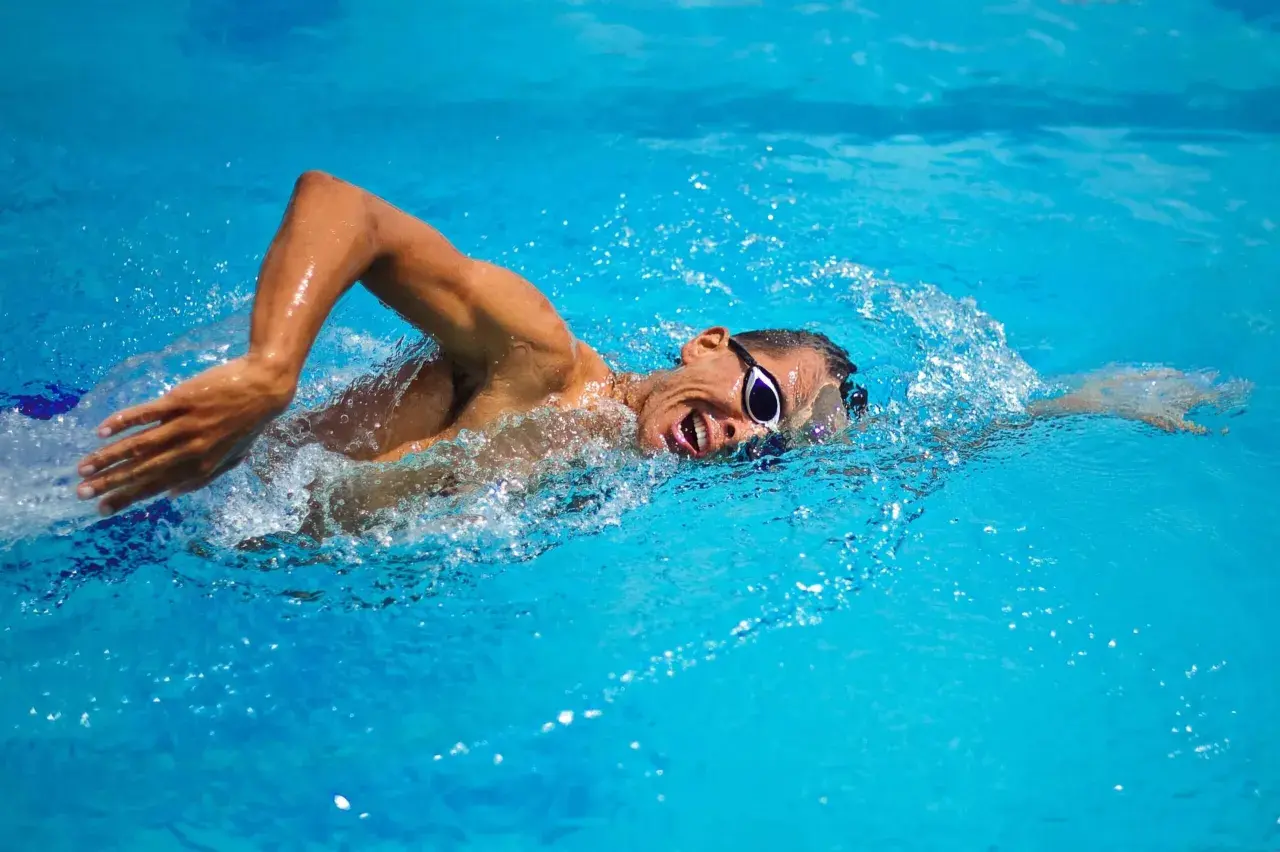
Breathing to both sides is one of the simplest freestyle changes with the biggest technical payoff when it is taught well. Bilateral breathing can improve balance, make open-water swimming easier to manage, and expose weak spots in your rotation, but it is not a rule that every swimmer has to force in every set. In this article I will break down what the pattern changes, when it helps, how to learn it without wrecking your stroke, and when a preferred-side breath is still the smarter choice.
What you should know before changing your breathing pattern
- Breathing to both sides is mainly a tool for symmetry, control, and adaptability, not a badge of advanced swimming.
- A three-stroke rhythm is useful for training, but it is not automatically the best choice for racing or high-intensity work.
- The biggest technical win comes from keeping the head low and letting the body rotate, instead of reaching for air.
- Open-water swimmers benefit the most because they need options for chop, sun, and sighting.
- If the off-side breath breaks your posture or causes pain, progress more slowly and keep your main sets practical.
What bilateral breathing changes in freestyle
In freestyle, the breath is not just an air grab. It affects body rotation, head stability, timing, and even how evenly your shoulders work through the stroke. When I coach swimmers, I treat the breathing pattern as part of the stroke mechanics, not as a separate skill bolted on at the end.
The goal is simple: rotate enough to breathe without lifting the head, disrupting the line, or letting the hips sink. If that sounds obvious, it is, but I still see swimmers miss it all the time. The head goes up, the mouth rushes for air, the lead arm crosses the center line, and the whole stroke gets busy. That is usually where the trouble starts.
| Pattern | What it does | Best use | Trade-off |
|---|---|---|---|
| Every 3 strokes | Alternates sides in a steady rhythm | Technique work, aerobic sets, open-water prep | Slightly less air than breathing every 2 |
| Every 5 to 7 strokes | Forces more control and patience | Drills, stronger swimmers, short controlled repeats | Can feel restrictive if the pace is hard |
| By length | Right side on one length, left side on the next | Easy pool tracking and early skill building | Less race-like than a fixed stroke count |
I like this way of thinking about it because it removes the drama. The count is only the container. The real question is whether your stroke can stay long, calm, and balanced while you use it. Once that is clear, the next step is deciding when the skill is worth the oxygen cost and when it is not.
When it helps and when it slows you down
Breathing to both sides has real upside, but it also has a real cost. The upside is symmetry, control, and flexibility. The cost is that you may take in less oxygen, especially if you force a three-stroke rhythm during hard efforts. That trade-off matters more than most swimmers expect.
| Situation | Why it helps | When I would not force it |
|---|---|---|
| Open water | Lets you breathe away from chop, sun, or spray and keeps sighting options open | When the pace is high and you need the most oxygen possible |
| Pool racing | Can help you stay aware of nearby swimmers and keep your stroke more even | Short sprint efforts where a preferred-side breath preserves tempo |
| Masters and fitness swimming | May reduce repetitive stress and make one-sided habits less sticky | If neck mobility or shoulder comfort makes the pattern ugly or painful |
| Technique blocks | Exposes timing problems, over-rotation, and weak body line | When the main purpose of the set is pure speed or race-specific pace |
I do not think of this as an either-or decision. Many strong swimmers practice both sides in training and still race with a preferred-side breath when speed demands it. That is a sensible compromise, and honestly, it is often the smartest one. The useful question is not whether you can do it at all, but whether you can use it without paying too much for it.
If you want the skill to survive outside the easy lane, the way you learn it matters more than the idea itself.
How to learn it without wrecking your stroke
I usually start with easy swimming and a low-pressure rhythm. Forcing a new breathing pattern in a hard main set is a bad way to teach the nervous system anything useful. The body first has to learn that it can rotate, breathe, and keep moving without panic.
- Start in warm-up and cool-down. Keep the pace relaxed so the body can focus on posture instead of survival.
- Use a simple pattern first. Alternate by length before you ask for a three-stroke rhythm. If you swim short-course yards, one length on one side and the next length on the other side is easy to track.
- Exhale underwater. The inhale should be quick and quiet. Holding your breath underwater almost always makes the breath feel rushed and messy.
- Keep one goggle in the water. That is a good sign that you are rolling, not lifting. If both eyes are fully out, the head is probably coming too high.
- Use fins or a pull buoy if needed. They help preserve body position while you learn the new timing. I use them when a swimmer’s legs sink the moment the breath changes.
- Film a few lengths. It is easier to spot a head lift, a cross-over, or a scissor kick on video than it is to feel it in the water.
A good cue is to think “rotate first, breathe second.” If the neck is doing all the work, the stroke is already late. Once the basic motion is smooth, drills can sharpen it much faster than repetition alone.
Drills that make the skill stick
The best drills do not just repeat the movement. They isolate the part that usually breaks. For two-sided breathing, that usually means rotation, timing, and head control.
| Drill | What it teaches | Common mistake |
|---|---|---|
| Bobs | Rhythmic exhale underwater and fast inhale at the surface | Holding air too long and then gasping |
| Stroke and roll | Breathing through body rotation instead of lifting the head | Twisting the neck without rotating the torso |
| Six-kick switch | Balance on each side and clean side-to-side rotation | Letting the hips fall when changing sides |
| Snorkel contrast | Shows what a still head and stable line feel like | Swimming too lazily with the snorkel and ignoring timing |
| Restricted breathing repeats | Comfort under a bit of air stress without panic | Turning the drill into a breath-hold contest |
What I like about this group is that it covers both comfort and control. Bobs teach the breath itself. Stroke and roll teaches the rotation. The six-kick switch shows whether the body stays balanced when the side changes. If you only do one drill, you get only one part of the answer. Used together, they build a much cleaner movement pattern.
Once the drills are in place, the next problem is not learning the movement. It is stopping the old habits from sneaking back in.
Common mistakes that make the technique feel harder than it is
Most swimmers do not fail because the idea is too difficult. They fail because a few small errors add up fast. The good news is that most of those errors are easy to spot once you know what to look for.
- Lifting the head instead of rolling. This breaks body line and usually drops the hips. Fix it by keeping one goggle in the water and rotating the body, not just the neck.
- Holding the breath underwater. That creates pressure and makes the inhale feel urgent. Fix it by exhaling continuously and finishing with a smooth final blow before the next breath.
- Forcing the off-side too early. If the stroke falls apart, the drill is too hard for that moment. Fix it by swimming easier, using fins, or alternating by length before moving to a fixed stroke count.
- Crossing over at entry. A cross-over means the hand enters across the center line, which can twist the body and waste propulsion. Fix it by keeping the hand on its own track.
- Scissor kicking to save balance. A scissor kick is the split-leg kick many swimmers use when they feel unstable. It is usually a symptom, not a solution. Fix the rotation and the kick often cleans itself up.
- Ignoring pain or restriction. If the neck or shoulder protests, do not bully it. Work the skill more gradually and keep your main training pattern practical.
The pattern should feel controlled, not heroic. If it feels like you are wrestling for air, you are not learning efficiency. You are rehearsing tension. That is why the race context matters so much, because the right breathing pattern changes with the job you are asking the body to do.
How I would use it in pool racing, triathlon, and open water
I do not use the same breathing pattern for every swimmer or every event. I start with the goal of the session and let that decide how much symmetry I ask for. That keeps the skill useful instead of turning it into a dogma.
| Context | How I would use it | Why |
|---|---|---|
| Pool technique work | Alternate sides by length or use a three-stroke rhythm on easy repeats | Best setting for learning without sacrificing pace |
| Short pool races | Use whatever pattern keeps the stroke fast and stable, even if that means breathing to one side | Oxygen and tempo usually matter more than symmetry here |
| Triathlon or open water | Keep both sides available so you can breathe away from chop, sun, or nearby swimmers | Flexibility is a race skill, not just a training skill |
For pool racing, I think of two-sided breathing as a weapon I keep sharpened in practice and reach for only when it helps the race plan. For open water, I see it as insurance. The water can turn ugly in one length, and if you only know one side, you are forced to fight the course instead of adapting to it. That difference is why so many swimmers find the skill more valuable in the real world than they expected.
If you want one rule to keep, make it this: use the breathing pattern that protects posture first, then speed, then comfort.
A simple rule set that keeps the skill useful
Here is the version I trust most with swimmers I coach and with myself in the pool:
- Learn both sides in warm-up, drills, and easy aerobic swimming.
- Use the pattern that preserves speed and oxygen when the set gets hard.
- Let body line and stroke quality decide more often than habit does.
- Back off if the off-side breath creates neck strain, shoulder discomfort, or obvious timing faults.
That balance is the whole point. The best swimmers are not the ones who force a rigid count in every situation. They are the ones who can change the count without losing posture, calm, or pace. If you build the skill that way, it becomes useful instead of fussy, and that is where it earns its place in your freestyle.
