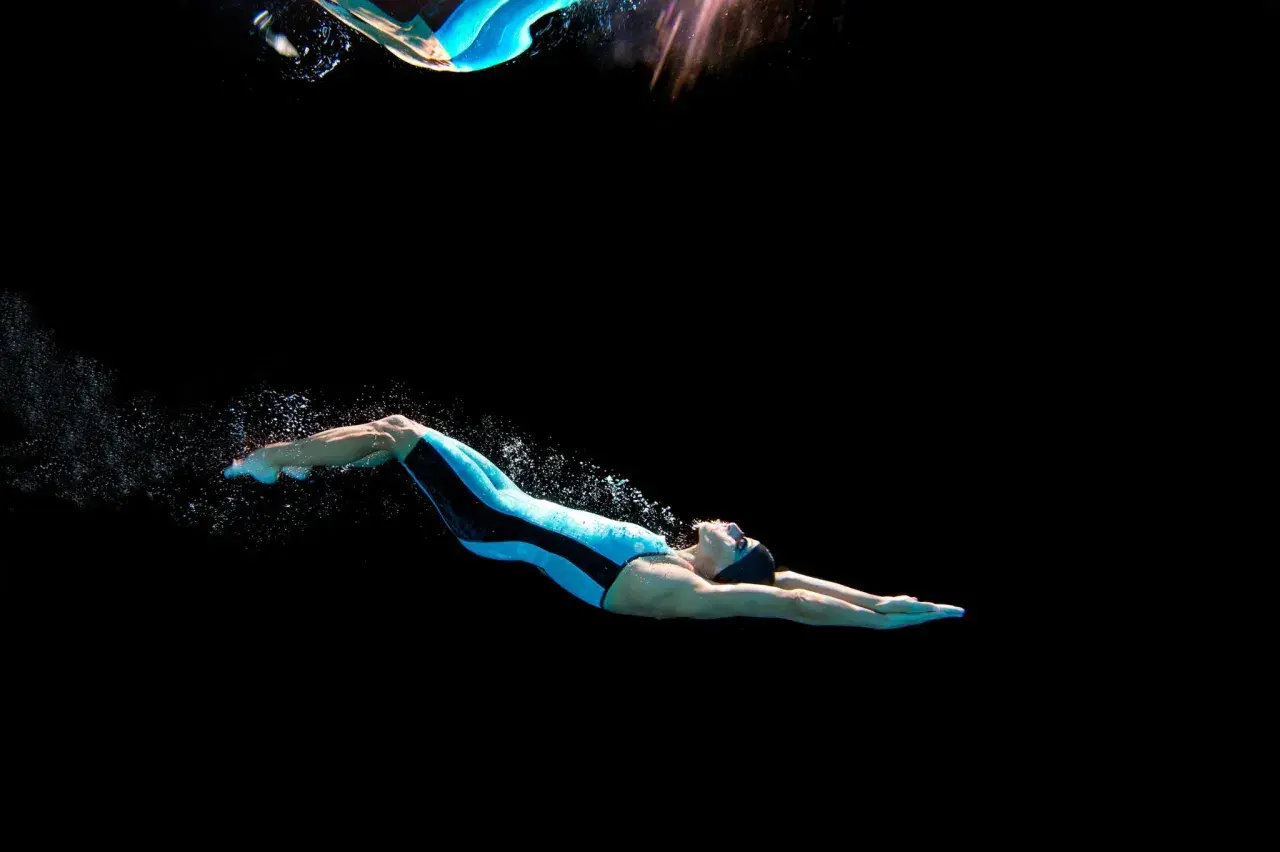
The fastest version starts with body line, not leg power
- Keep the body long and tight off the wall; the kick only works when the push-off is streamlined.
- Think hips-first undulation, with the knees following rather than driving the motion.
- Use a compact, fast range of motion; oversized kicks usually create drag instead of speed.
- In racing, underwater speed matters most after starts and turns, but the breakout must stay clean.
- Flexible ankles, core control, and calm breathing make the movement easier to repeat under pressure.
What the underwater kick really does in the water
At its best, this movement is a speed-preservation tool. After a start or turn, the swimmer is already in a narrow, low-drag position, so a well-timed wave through the body can carry that momentum farther than an immediate breakout. I look at it as a way to convert wall speed into free distance before the first stroke even begins.
The motion itself is simple to describe but harder to do well: both legs move together, the torso undulates, and the feet finish the action with a quick snap. The power does not start at the feet. It starts higher up, travels through the hips, then reaches the lower legs and ankles. That detail matters because swimmers who try to “kick harder” from the knees usually create a bigger splash, not a faster body line.
What makes this skill useful is the combination of speed and efficiency. Underwater, the swimmer is not fighting surface chop, and the body is already streamlined. That is why a good underwater phase can feel almost effortless when it is right, even though it requires a lot of coordination behind the scenes. Once that idea makes sense, the next step is learning the mechanics that keep the motion compact and fast.How I teach the movement step by step
When I coach this skill, I start with shape before speed. If the body line is wrong, there is nothing to fine-tune later.
Set the streamline first
Hands stacked, arms tight, biceps brushing the ears, ribs controlled, and toes pointed. The swimmer should feel long from fingertips to feet. I want the chest and hips to stay close to the same line; if the head lifts early or the lower body sags, the water punishes it immediately.
Let the wave travel, don’t force it from the knees
The best cue I use is “chest, hips, feet.” The wave begins with a stable upper body, then travels down the trunk. The knees bend only enough to let the wave pass through. If the knees become the main hinge, the kick turns into a bicycle motion and the swimmer loses the clean front-to-back flow that makes the skill efficient.
Read Also: Float Better - Master Buoyancy for Safer, Easier Swimming
Finish with the feet
The feet are the last part of the chain, and they matter a lot. The snap should come from the ankles and the tops of the feet pressing water backward. Tight, pointed feet are not cosmetic here; they are part of the propulsive surface. If the ankles are stiff, the swimmer can still kick, but the movement will feel blunt and expensive.
That sequence is simple enough to teach, but the real payoff comes from putting it in the right race context, which is where the rules become practical.

Where it shows up in each stroke and what the rules mean
In sanctioned pool racing, the underwater phase after starts and turns is limited to 15 meters in freestyle, backstroke, and butterfly. That makes this skill a speed tool, not a place to disappear for half the pool. The goal is to leave the wall faster and surface in control, not to chase underwater distance for its own sake.
| Stroke | How the kick is used | Practical focus |
|---|---|---|
| Butterfly | The kick is part of the stroke itself, with simultaneous leg action throughout. | Keep the rhythm connected to the pull and breath so the wave does not stall. |
| Freestyle | Used after starts and turns before the breakout. | Use it to preserve momentum, then surface without lifting the head early. |
| Backstroke | Often one of the biggest payoffs because swimmers stay long on the back underwater. | Keep the line tight and avoid letting the knees break the surface too soon. |
| Breaststroke | Only a single underwater kick is allowed before the first breaststroke kick after a start or turn. | Use the pullout to gain speed, then transition cleanly into the stroke cycle. |
That rule set changes the strategy more than most beginners expect. The fastest swimmer is not the one who stays underwater the longest; it is the one who uses the underwater phase at the right time, then surfaces with a stroke that is already moving. Once you know where it belongs, the next step is training it in a way that builds speed without making the rest of practice messy.
Drills that make it faster without wasting pool time
I prefer drills that give immediate feedback. If a drill does not make the swimmer feel the line, the timing, or the pressure on the water, I usually move on.
- Push-off to breakout repeats - Do 6 to 8 push-offs to 10 to 15 meters and focus only on the shape of the body and the first stroke. This is the cleanest way to connect wall speed to surface swimming.
- Vertical kicking - Use 3 rounds of 20 to 30 seconds. It teaches rhythm and water pressure without the comfort of forward glide, so every mistake shows up quickly.
- Side-line kicks - Work on each side for short repeats. This helps swimmers feel the hips leading the wave instead of collapsing the knees.
- Short fin work - A few quality reps with short-blade fins can sharpen timing and foot pressure. I use fins as feedback, not as a crutch.
- Breakout timing reps - Push off, take 3 to 5 kicks, then surface with a controlled first stroke. This is useful for swimmers who either pop up too soon or stay down too long.
If you can only keep the pattern clean for 5 or 6 strong kicks, that is enough for practice. I would rather see a swimmer stop before the shape falls apart than keep extending a rep that has already turned into survival mode. From there, the main risk shifts from bad technique to the habits that quietly slow swimmers down.
The mistakes that slow it down
Most problems come from trying to force speed instead of letting the shape create speed. The kick looks dramatic when it is wrong, but it looks almost quiet when it is right.
| Mistake | What it looks like | What I tell swimmers to fix |
|---|---|---|
| Kicking from the knees | The legs bicycle and the hips stop driving the wave. | Start from the trunk and let the knees follow the motion instead of leading it. |
| Making the kick too large | The knees break the line and the swimmer creates extra drag. | Keep the movement compact and fast; bigger is not better here. |
| Lifting the head too early | The breakout stalls and the body angle gets steep. | Hold the head neutral until the first stroke is ready to begin. |
| Stiff ankles | The feet feel flat and the water barely moves. | Work on mobility and use fins occasionally to feel a better foot position. |
| Too many fatigue reps | The motion gets sloppy and the timing disappears. | Stop the set before quality drops; underwater work should stay precise. |
There is one more trap I see often: swimmers assume that more underwater time always means better performance. It does not. A quiet, efficient breakout is worth more than a long underwater phase with a late, awkward first stroke. That is the difference between a useful skill and a habit that only looks impressive from the deck.
What I keep in practice so the skill actually sticks
When I want this skill to hold up in real training, I keep the prescription simple. A few quality push-offs in warm-up, a short technical underwater set in the middle of practice, and one or two breakout-focused reps at the end is usually enough. I would rather see 8 sharp efforts than 20 tired ones, because fatigue is where swimmers start guessing instead of feeling.
- Use the kick together with starts and turns twice a week so it stays linked to race skills.
- Pair it with core work, glute activation, and ankle mobility; those three support the body line better than random leg volume.
- Use a snorkel when you want to isolate body position, and use short fins when you want to sharpen rhythm.
- Do not rely on a kickboard for this specific skill; it helps leg conditioning, but it does not teach the same streamline.
- Keep rest long enough that every rep looks like a skill rep, not a conditioning struggle.
That is also where a little discipline pays off. USA Swimming’s development pathway starts with a stable streamline before adding more underwater kicking, and that order matches what I see in the pool every day. When the line is tight, the motion is compact, and the breakout is timed well, the skill stops feeling like a trick and starts becoming free speed.