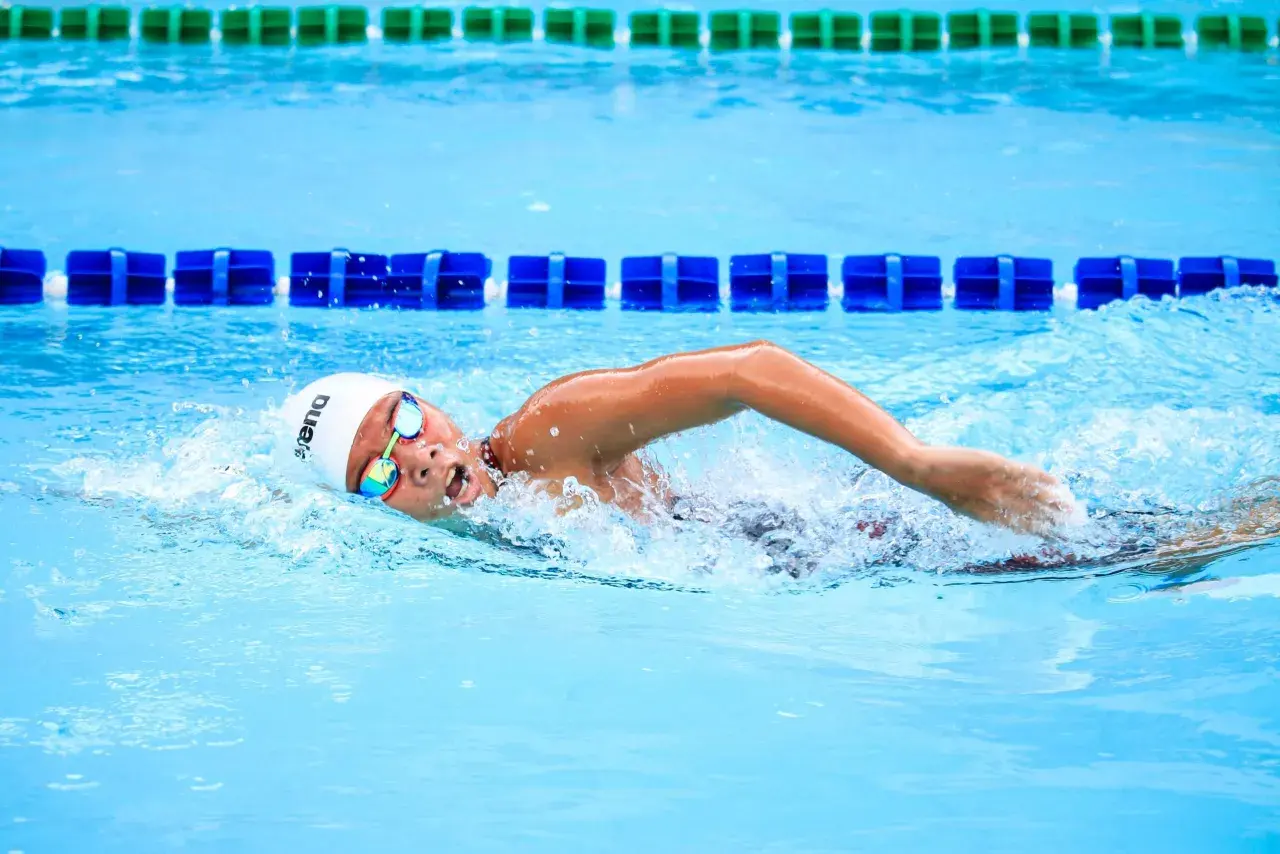
The American crawl is the stroke most swimmers rely on when they want speed, efficiency, and a repeatable rhythm in the pool. In this guide, I break down what the stroke is, how the body line, catch, kick, and breathing fit together, and which drills and gear choices actually help when you want better lap times or easier distance swimming.
The essentials you need before you start fixing your freestyle
- The crawl is built on a long, quiet body line and alternating arm action, not on frantic arm speed.
- Breathing should come from body roll and a small head turn, not from lifting the face forward.
- A narrow flutter kick stabilizes the stroke; it is not there to spray water.
- The fastest gains usually come from reducing drag, then sharpening the catch and timing.
- Simple drills and a few pieces of gear can help, but they only work if the full stroke still looks like swimming.
What the crawl stroke actually is
In U.S. pool culture, coaches often say freestyle, even when they mean front crawl. That distinction matters because freestyle is the race category, while the stroke is the arm-over-arm pattern swimmers use almost by default in laps, triathlon, and open water.
Why does it dominate? Because it is efficient, scalable, and easy to pace. When the stroke is working, the body stays long and balanced at the surface, the arms alternate so there is always one recovering while the other is pulling, and the swimmer can keep moving without the stop-start feel of other strokes.
In competition, there is also a rule-based reason it shows up everywhere: after the start and each turn, swimmers may stay underwater only up to 15 meters before surfacing. That pushes racers back into a surface stroke quickly, and front crawl is the obvious choice.
Once that basic shape is clear, the next question is what actually creates speed in the water.

The mechanics that create speed without wasting effort
When I strip the stroke down to its essentials, I look for four things: head position, catch, kick, and recovery. The mistake most swimmers make is trying to muscle the stroke faster before those pieces are lined up.
A useful mental model is simple: long first, then strong. Long means the head stays neutral, the hips stay near the surface, and the body rolls just enough to let the shoulder clear the water. Strong means the hand and forearm anchor the water early so the arm can move past it instead of slipping through it.
| Element | What good looks like | What usually goes wrong |
|---|---|---|
| Body line | Head neutral, hips high, body rolling as one unit | Looking forward, hips dropping, legs dragging |
| Catch | Forearm sets early and holds water | Dropped elbow and a hand that slips downward |
| Kick | Small, narrow flutter kick that supports balance | Bicycle kick, bent knees, and too much splash |
| Recovery | Relaxed arm over the water, elbow leading naturally | Tense, wide recovery that adds drag |
The kick deserves special attention. In my experience, many swimmers think the kick is supposed to drive the whole stroke, but it is usually better to treat it as a stabilizer with some propulsion on top. A 2-beat, 4-beat, or 6-beat rhythm can all work depending on distance, pace, and body type, but the motion should stay compact and continuous rather than loud and splashy.
When those four pieces fit together, breathing becomes much easier. That is where most swimmers feel the next breakthrough.
Breathing that keeps the stroke stable
Breathing is where many good-looking strokes fall apart. The goal is not to get your mouth completely out of the water; it is to turn just enough for a quick inhale while the opposite goggle stays in the water and the hips keep rolling.
I tell swimmers to exhale continuously underwater. If you hold the breath, the inhale comes late, the head lifts, and the stroke loses its line. A clean breath feels almost boring: turn, sip air, return the face down, keep moving.| Breathing pattern | Best use | Tradeoff |
|---|---|---|
| Every 2 strokes | Beginners, hard intervals, anxious breathers | Can become one-sided if you never practice both sides |
| Every 3 strokes | Bilateral breathing practice and balance work | Can feel tight until the timing settles in |
| Every 4 strokes or more | Short sprints or race-specific work | Easy to under-oxygenate if you overuse it |
For most adult swimmers, I like starting with every 2 or 3 strokes and then mixing in bilateral breathing during easier lengths. That gives you enough air to stay relaxed while still teaching the body to rotate evenly. In open water, it also helps with waves, glare, and sighting because you are not locked into only one side.
Once breathing settles down, the big gains usually come from removing the technical habits that quietly slow people down.
The mistakes that slow swimmers down fastest
I see the same problems over and over, and none of them are fixed by trying harder.
- Looking forward to breathe instead of rotating sideways. That drops the hips and creates drag immediately.
- Crossing the hand over the center line on entry. It makes the body snake and wastes each pull.
- Kicking from the knees with too much bend. The kick should start from the hip and stay compact.
- Pulling straight down instead of back. That lifts the body but does not move you forward efficiently.
- Rushing the recovery with a tense arm. That usually means the underwater pull has lost quality.
- Swimming with a breath-hold. If you do not exhale underwater, the whole stroke gets stiff.
The pattern behind all of those errors is the same: too much effort, not enough shape. When swimmers calm the stroke down, the water tends to give them more speed than they expected. From there, drills can clean up the details without teaching a fake motion.
Drills that actually transfer to better swimming
I prefer drills that preserve the same body line you want in the full stroke. If a drill looks good on its own but falls apart the moment you swim normally, it is not helping enough.
| Drill | What it improves | How I use it |
|---|---|---|
| Side kick | Balance, breathing, and body roll | 4 x 25 on each side at an easy pace |
| Catch-up freestyle | Extension and timing | Slow the stroke enough to feel one hand reach fully before the next starts |
| Fingertip drag | Relaxed recovery | Let the fingertips skim the surface on the way forward |
| Single-arm freestyle | Rotation and catch timing | 4 x 25 each arm, with the non-working arm held forward |
| Closed-fist freestyle | Forearm feel for water | Short repeats, then return to normal stroke and keep the same pressure on the water |
I usually keep drill work short, often 4 to 8 lengths per drill, because quality drops fast when swimmers turn it into a long grind. The point is to reset one skill at a time, then bring that feeling back into the whole stroke. That is the part many people skip, and it is why their drills look better than their swimming.
Helpful gear can support that process, but only if you use it to solve a specific problem instead of hiding one.
Gear that helps the crawl feel cleaner
Equipment should make practice more productive, not replace technique. For most swimmers, a few well-chosen tools are enough.
| Gear | Why I use it | What to watch for |
|---|---|---|
| Goggles | They let you keep the head neutral and breathe calmly | A poor fit leaks and makes you lift your head too much |
| Swim snorkel | It keeps the face down while you work on body line and catch | It can hide breathing flaws if you rely on it too often |
| Short fins | They help ankle position and let you feel better rhythm | Big fins can hide a weak kick and overcook the tempo |
| Pull buoy | It isolates the upper-body pull and helps you focus on alignment | It makes the hips float in a way real swimming does not |
| Tempo trainer | It helps you control stroke rhythm and pace | Faster tempo is not automatically better technique |
My rule is simple: if the tool helps you feel the same stroke better, keep it in the session. If it lets you swim badly with less effort, limit it. That difference matters more than people think, especially when the goal is long-term improvement rather than one easy workout.
The version of the crawl worth practicing first
If I had to rebuild a swimmer’s front crawl from scratch, I would start with body line, breathing, and timing before I touched speed. Those three pieces make every other part of the stroke easier to use.
- Swim 4 x 25 easy with eyes down, a quiet kick, and a long body line.
- Add 4 x 25 breathing every 3 strokes, keeping one goggle in the water.
- Do 4 x 25 side kick or catch-up to reset balance and reach.
- Finish with 4 x 25 at normal stroke, keeping the same calm exhale and body roll.
That sequence looks simple, but it is usually enough to show where the real problem lives. Once the line, breath, and catch all hold together, faster swimming stops feeling like a fight and starts feeling like a skill you can repeat.