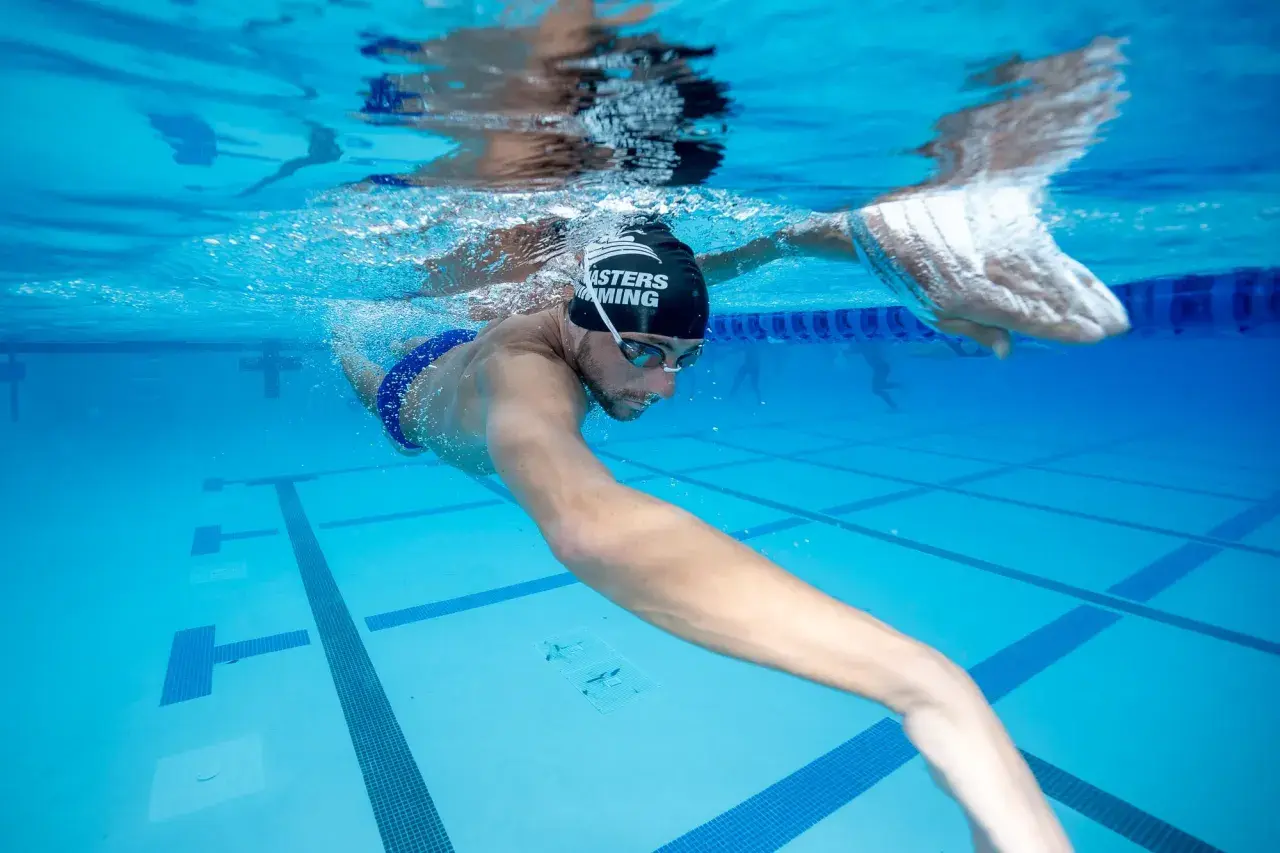
The catch up swim drill is a simple freestyle exercise, but it teaches a surprisingly specific skill: keeping the stroke organised in the front of the body so you do not rush the catch or cross over the centre line. I use it when a swimmer needs better timing, steadier balance, and a cleaner hand entry, especially in metre-based pool work where technique often slips once fatigue builds. This article breaks down what the drill is for, how to swim it properly, the mistakes that blunt its value, and how to place it inside a real training session.
The drill works best when timing, not hesitation, is the goal
- It trains front-quadrant freestyle, where one arm stays extended while the other finishes and recovers.
- It is most useful for balance, entry line, and learning a cleaner catch.
- The drill should slow the stroke down, but it should not become a long pause at the front.
- Short repeats such as 4 to 8 x 25m or 50m are usually enough for one session.
- If your freestyle is already very slow and over-glided, you may need a different drill or more tempo work.
What the catch-up drill really trains
At its best, this drill teaches front-quadrant freestyle, which simply means one hand is still forward while the other arm is finishing the stroke and returning over the water. That extra overlap gives you time to notice where the hand enters, how the body rotates, and whether the catch begins from a stable position rather than a rushed one. Coaching notes from U.S. Masters Swimming frame it the same way: the drill helps swimmers line up entry with the shoulder and learn a better catch depth, which is why it remains such a dependable technical tool.
I see the biggest gain in swimmers who lose shape when they speed up. They cross over the centre line, drop the elbow early, or start pulling before the front arm has settled. The drill does not magically fix all of that, but it slows the stroke just enough to make the problem visible. Once that is clear, the next step is learning the simplest repeatable version.
How to swim it without turning it into a pause
The key mistake is assuming the drill means “wait longer”. It does not. The goal is to keep the stroke connected while creating a clean overlap at the front. I tell swimmers to think of it as touch and go, not stop and go.
- Push off in a long line and exhale steadily into the water.
- Start freestyle with one arm extended in front and the other arm completing a normal stroke.
- Recover the working arm over the water and let it “catch up” to the lead hand.
- Begin the next stroke only when the hands have met or nearly met at the front.
- Keep the entry just outside shoulder width, not across the middle of the body.
- Use a light, steady kick so the hips stay near the surface.
- If you breathe, turn the head without lifting it and return the face to the water quickly.
The drill should feel controlled, but it should not feel frozen. If the body stalls, the lesson is lost and the stroke becomes a glide drill instead. That is why the next thing I look at is the set of faults that quietly undo it.
The most common mistakes and the fixes that actually work
| Mistake | What it does | Better cue |
|---|---|---|
| Waiting too long at the front | Turns the drill into dead water and breaks rhythm | Keep moving; just slow the timing down |
| Crossing the hand over the centre line | Pulls the shoulder off line and hurts balance | Enter just outside the shoulder |
| Dropping the elbow early | Weakens the catch and encourages slip | Set the forearm before you push back |
| Kicking too hard | Creates rotation noise and hides the real problem | Use a small, steady kick |
| Trying to swim it fast | Removes the technical benefit | Swim smooth first, then reapply the same shape in full stroke |
If a swimmer says the drill feels awkward, I usually check the body line before I blame the arms. A weak core position or a drifting kick can make the front end feel chaotic even when the hand action is fine. Once those mistakes are under control, the question becomes where the drill belongs inside the session.
Where it fits in a training session
I treat the drill as a technical reset, not a main-set power builder. It works best early in a session, after the body is warm enough to move well but before fatigue starts flattening the stroke. For most swimmers, 8 to 12 lengths of drill work is enough in one pool session.
| Swimmer type | Practical set | What to focus on |
|---|---|---|
| Beginner or returning swimmer | 6 x 25m catch-up with 15-20 seconds rest | Balance, patient front arm, easy breathing |
| Club swimmer | 4 x 50m drill, then 4 x 50m normal freestyle | Carry the same entry line into full stroke |
| Triathlete or masters swimmer | 8 x 25m drill, then 4 x 50m steady freestyle | Keep the catch organised when tempo rises |
There are also times when I would not lean on it heavily. If a swimmer already over-glides, swims with a very low stroke rate, or needs race-pace work, the drill can slow them down too much. In that case, I would keep it brief and move quickly to normal swimming with a cleaner rhythm. If the drill feels too blunt, the next best move is often a related variation.
Useful variations when the standard version is too easy or too slow
Catch-up is only one way to teach front-end control. The right variation depends on what the swimmer needs most: timing, rotation, catch feel, or recovery shape. I tend to switch drills when the swimmer understands the idea but needs a sharper feedback loop.
| Variation | Best for | Why I would choose it |
|---|---|---|
| One-arm freestyle | Catch path and body rotation | It isolates one side without forcing a full pause |
| Fingertip drag | Relaxed recovery and elbow control | It keeps the stroke moving while cleaning up the recovery |
| Closed-fist freestyle | Forearm feel in the catch | It removes hand “help” and makes water pressure easier to sense |
| Snorkel-assisted drill work | Body line and entry without breathing disruption | It lets the swimmer focus on the front end without head movement |
In coaching terms, these drills are cousins, not replacements. They overlap, but each one exaggerates a different part of the stroke. That matters because the drill only has value if it changes the full swim that follows.
What should change after a few sessions in the pool
The best sign is not that the drill looks neat for its own sake. It is that the full stroke starts to change: the hand enters cleaner, the pull starts with less slip, and the swimmer feels more stable when breathing. Stroke count may become steadier over 25m or 50m, but I would not chase lower counts blindly; the real win is better control with less waste.
If nothing changes after three or four sessions, I would not keep repeating the drill as if volume alone will solve it. That usually means the limiter is elsewhere, often in body position, kick timing, or how the swimmer breathes. In that case, reduce the amount of catch-up work, add a drill that attacks the real fault, and then return to full stroke with a fresh cue. That is the most honest way to use it, and it is usually the fastest way to see progress.