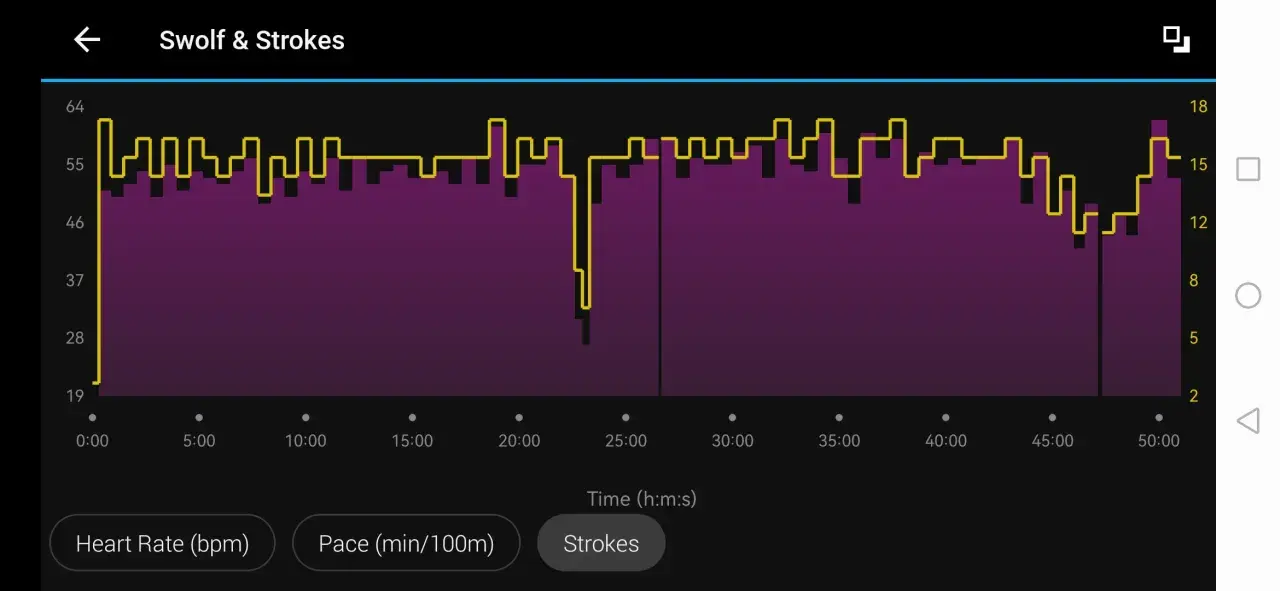
SWOLF is one of the clearest ways to judge how efficiently you move through the water, but the number only becomes useful when it is read in context. The same score can mean different things in a 25-yard pool, a 25-meter pool, freestyle, or breaststroke, so the real question is not just the number itself. That is the real answer to what is a good SWOLF: a score that is low for you, in the right pool, for the right stroke.
The score only matters when you compare like with like
- SWOLF is your time for one length plus your stroke count for that same length.
- Lower is usually better, but only when you keep the same pool length, stroke, and test setup.
- For freestyle in a 25-yard pool, many recreational swimmers live around the 40s, strong swimmers often sit in the 30s, and elite swimmers can go lower.
- One bad length tells you almost nothing; a trend over several swims tells you far more.
- The fastest way to improve is usually better body position, cleaner turns, and fewer wasted strokes, not just trying to swim harder.
How SWOLF is measured and why the number can mislead
Garmin's swim manuals define SWOLF as the sum of the time for one length and the number of strokes for that length. If you swim 25 yards in 20 seconds and take 14 strokes, your SWOLF is 34. If you cover the same length in 18 seconds with the same 14 strokes, the score drops to 32, which is better because you moved faster without adding extra arm cycles.
That sounds simple, but there are two catches. First, stroke count is only meaningful if your watch or manual count is set to the correct pool length. Second, SWOLF changes with stroke type and with how much rest or wall help you get between lengths. In open water, Garmin normalizes the metric to 25 meters, which is useful for the device but still not a magic way to compare every swim on earth.
I treat SWOLF as an efficiency check, not a verdict on fitness. Once you understand the math, the next step is figuring out what a good range looks like in practice.
What a good score looks like in practice
For a 25-yard pool and freestyle, I use the bands below as a practical guide, not a universal standard. They are most useful when you compare your own swims over time under the same conditions.
| SWOLF band | How I read it | Typical context |
|---|---|---|
| 50 and above | Still developing efficiency | Beginner, returning swimmer, or a set done with fatigue and lots of wasted motion |
| 42-49 | Solid recreational level | Fitness swimmers who are moving well but still have room to clean up body line and turns |
| 35-41 | Good to very good | Confident adult swimmers, masters athletes, and swimmers who hold their form under repeat work |
| 30-34 | Strong and efficient | Competitive age-group or masters swimmers with tidy mechanics |
| Below 30 | Excellent | Very efficient freestyle in a short-course pool, especially when the pace is still fast |
If you swim mostly 25-meter pools, expect the number to move around a bit because the lap is longer and the wall pattern changes. The important part is consistency: same pool, same stroke, same test.
From here, the bigger question is why two swims that feel similar can produce different scores.
Why your score changes from one swim to the next
A SWOLF number can drift for reasons that have nothing to do with your actual form. Some of them are mechanical, some are technical, and some are just device noise.
Pool length and wall work
In a 25-yard pool, turns and push-offs matter more than most swimmers realize. A strong streamline and a clean breakout can drop the score without changing your stroke, while a sloppy turn can raise it even if the rest of the length feels fine.
Stroke choice and body size
Freestyle usually gives the most useful SWOLF data because it is easier to repeat, but body size still matters. A taller swimmer often covers more water per stroke, which can lower the number, yet that does not automatically make the swimmer more effective at every pace or distance.
Read Also: Water Aerobics Before and After - Real Results & Timeline
Fatigue and tempo
As fatigue rises, stroke count often climbs first, then pace drops. That is why SWOLF is valuable in repeat sets: it shows when your technique starts to leak before the workout totally falls apart. A watch can capture that trend, but it cannot tell you why it happened without some judgment from you.
Once you know the sources of noise, the number becomes much easier to improve on purpose.
How to lower it without forcing a worse stroke
The goal is not to chase a lower score by swimming choppier or over-gliding. I want a lower SWOLF that comes from moving better water, holding posture longer, and keeping your pace honest.
| Adjustment | What it can improve | What to watch |
|---|---|---|
| Cleaner body line | Less drag and fewer wasted strokes | Don't sink the hips just to lengthen the glide |
| Better catch and pull | More distance per stroke | Don't overpower the water with a dropped elbow |
| Consistent turns | Lower split time with the same stroke count | Don't let one great wall push hide a weak stroke |
| Small tempo increase | Faster laps without a big stroke-count spike | Too much tempo can make the stroke frantic |
When I coach this kind of work, I like repeat sets such as 8 x 50 or 10 x 25 on steady rest. That lets you compare apples to apples and see whether the score is improving because your stroke is cleaner or just because you happened to have a fresh rep.
A useful rule: if the score drops by one or two points while pace stays steady and the stroke still feels smooth, that is real progress. If it drops only because you are shortening the stroke and losing speed, the number is lying to you.
That is also why SWOLF should sit beside a few other swim metrics, not replace them.
How to read SWOLF trends like a coach
The best way to use SWOLF is as a trend line over several swims, not as a one-day ranking. I look at the average from a repeat set, keep the stroke and pool constant, and compare it with stroke count, pace, and how the set felt.
| Metric | What it tells you | Why it matters |
|---|---|---|
| SWOLF | Overall efficiency per length | Combines speed and stroke economy in one number |
| Stroke count | How much distance you get per cycle | Helps reveal whether technique is getting cleaner or sloppier |
| Pace | How fast you actually move | Confirms whether a lower score is helping or just slowing you down |
| Stroke rate | How quickly you turn over the arms | Shows whether you are trading glide for tempo in a controlled way |
If SWOLF improves but pace falls off sharply, I usually suspect over-gliding or a workout that is too easy to challenge the stroke. If pace improves while SWOLF rises a little, that can still be the right answer in a race-pace set, because efficiency and speed do not peak at exactly the same moment.
For swimmers in the United States, the cleanest comparison is to keep a separate 25-yard baseline and ignore the temptation to mix it with pool lengths from other facilities. Once that habit is in place, the score becomes far more useful.
The benchmark I trust most is the one that stays honest over time
The most useful SWOLF number is the one that survives repeat swims, not the one that looks flashy for a single length. If your score is drifting lower over four to six weeks in the same pool, on the same stroke, with the same rest pattern, you are probably improving the parts that matter: body position, timing, and control.
When the number stalls, I usually look first at turns, breathing, and whether the set is asking for speed or economy. That approach keeps SWOLF useful as a training tool instead of turning it into a vanity metric, which is exactly how I like to use it in real swim workouts.