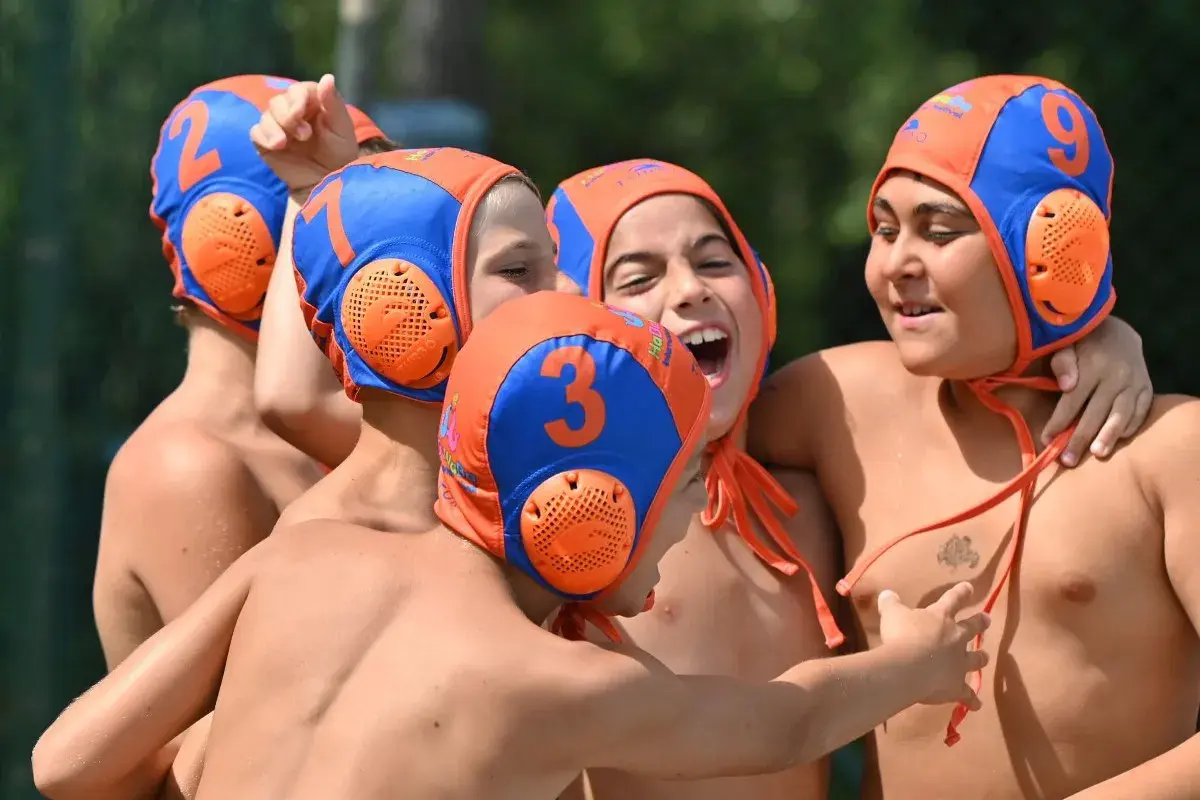
HaBaWaBa is not just another youth tournament. It is a development-focused water polo festival built around competitive games, team culture, and the confidence young athletes gain when they play in a bigger international setting. For swimmers, coaches, and parents in the United States, the real question is whether it fits a player’s age, stage, and goals.
The main facts to know before you plan a trip
- HaBaWaBa is a youth water polo festival, not a swim meet or a diving event.
- The 2026 program is split into age-specific blocks, with U9/U11 and U13 competition windows.
- The event is centered at Bella Italia & EFA Village in Lignano Sabbiadoro, Italy.
- The culture is team-first: fair play, social development, and learning matter as much as results.
- For U.S. families, it makes the most sense for club players who already handle contact, sprint work, and travel well.
- Diving matters here as a body-control skill, not as a judged discipline.
What HaBaWaBa really is
I think the easiest way to understand HaBaWaBa is to stop treating it like a standard bracket and start treating it like a youth development environment. The name comes from Happy Baby Water Ball, which is a surprisingly accurate description of the original idea: keep the sport playful enough that kids want to stay in it, while still giving them a real competitive stage.That is why the event feels different from a normal weekend tournament. The matches matter, but so do the habits that form around them: how players support each other, how they recover between games, and how they handle pressure when the score swings. I like that structure because it rewards the things that usually predict long-term growth, not just the things that look impressive in one box score. That philosophy becomes clearer once you look at how the 2026 edition is organized.

How the 2026 format works
According to HaBaWaBa.com, the 2026 edition is split into two main blocks: the International Festival for U9 and U11 teams from June 14 to June 21, and the U13 tournament from June 21 to June 28. Both take place at Bella Italia & EFA Village in Lignano Sabbiadoro, which keeps the event’s live-together, play-together atmosphere intact.
| Block | Who it is for | Why it matters |
|---|---|---|
| U9 and U11 International Festival | Mixed, boys, and girls teams at the younger development stage | Built for kids who are learning speed, spacing, and basic decision-making |
| U13 tournament | Older youth players who can handle more tactical detail | Better suited to stronger contact tolerance and faster reading of the game |
| Bella Italia & EFA Village | All participating teams | A village-style venue makes the week feel immersive rather than fragmented |
That age split is more important than it sounds. Younger teams usually need simpler rules, shorter tactical cues, and more repetition, while U13 players can absorb more structured game plans and situational coaching. If you are planning around the event from the United States, read the age block first and the destination second, because the player’s readiness matters more than the postcard version of the trip. That is also where the event’s culture starts to separate it from a normal youth meet.
Why it feels different from a regular youth meet
HaBaWaBa is built to keep the focus on the group rather than the individual. HaBaWaBa.com notes that the festival does not hand out individual trophies or top-scorer awards; the only individual prize is the Golden Baby for the youngest athlete. That detail tells you almost everything about the event’s values. The point is not to create early stars and then rank everybody else behind them. The point is to get kids attached to the sport and to each other.
That is a much healthier message than many adults admit. A young player remembers a brilliant pass, a good defensive rotation, or a hard-fought comeback far longer than a medal ceremony. I would rather a child leave with a stronger sense of team identity than with a false idea that one weekend defines ability. The difference shows up clearly when you compare the festival with a typical youth tournament.
| Feature | HaBaWaBa | Typical youth tournament |
|---|---|---|
| Main goal | Development, fair play, and international exposure | Bracket results, placement, and ranking |
| Daily rhythm | Teams often live and socialize together | Many teams arrive, play, and leave the same day |
| Awards | Team-first culture with very limited individual recognition | Medals, all-tournament picks, and scoring awards are common |
| What players learn | Adaptation, composure, and group problem-solving | Game management and result pressure |
That team-first model is exactly why the festival has a strong reputation among coaches who care about long-term development rather than one-off results. It also explains why many U.S. clubs view it as a meaningful benchmark instead of just another trip. That is where the American context becomes important.
Why U.S. clubs should pay attention
For American families, I use USA Water Polo’s Splashball age band, 5 to 12, as a practical reference point. It is a clean reminder that there is a real difference between learning the sport and being ready for a larger, travel-heavy event. HaBaWaBa usually makes more sense once a player can already handle repetition, contact, and the emotional ups and downs of multiple games in a short span.
That does not mean younger players should be pushed away from it automatically. It means the event works best when the club has already built a base: swimming comfort, basic ball control, and enough leg endurance to stay stable through a week of games. From a U.S. club perspective, the trip is also a stress test for the entire program. Can the team communicate, recover, and stay organized away from home? If the answer is yes, the festival becomes a useful development tool. If the answer is no, a local or regional step may be the smarter move first.
I would not send a brand-new player to this event just for the sake of saying they went international. I would send a player who is ready to learn from volume, variety, and pressure. That line becomes easier to judge when you look at the water polo skills that really matter inside the games, including the kind of diving and body control that swimmers often underestimate.
Where diving skills actually help in water polo
This is where the crossover gets interesting. In water polo, diving is less about board technique and more about the mechanics of getting off the surface cleanly, controlling the body in the air and in the water, and recovering after contact or a stretched pass. If you come from a diving background, the biggest advantages are usually spatial awareness, core tension, and comfort with unusual body angles. Those traits transfer well. The judging criteria do not.
What transfers from a diving background
- Body line helps players enter the water with less drag and more speed.
- Core control makes it easier to stay balanced when a defender bumps or pulls.
- Spatial awareness helps with off-balance catches and quick reactions in traffic.
- Confidence in the air and underwater makes transitions feel less chaotic.
Read Also: Water Polo Training - Master the Game Faster
What does not transfer directly
- Water polo does not reward aesthetic entry positions the way diving does.
- Approach speed matters, but only if it leads to a useful action immediately after entry.
- Players cannot linger on form; they have to turn body control into a pass, shot, or defensive recovery.
In a HaBaWaBa game, the fastest athlete is rarely the one with the prettiest entry. It is the one who regains shape quickest and is ready for the next pass or counterattack. That distinction matters because it tells coaches what to train, and it tells swimmers and divers what to keep and what to leave behind. The next question is how to prepare without burning out young athletes before they even arrive.
How to prepare without overloading young players
The smartest teams arrive fresh, not cooked. I would rather see a young player do a short, focused prep block than a long, grinding camp that leaves the legs heavy and the mood flat. The goal is to sharpen timing, not to squeeze out one more layer of fatigue.
| Focus | Simple pre-trip work | Why it matters |
|---|---|---|
| Sprint work | Two short sessions a week with repeated 10 to 15 meter efforts | HaBaWaBa games are fast and transition-heavy |
| Leg endurance | Eggbeater holds and quick changes of pace, 30 to 45 seconds at a time | Players stay stable in contact and keep their upper body free |
| Passing under fatigue | Short catch-pass-release sets after a hard swim | Decision speed matters more than long possession time |
| Recovery | More sleep, better hydration, and a lighter taper in the final 3 to 4 days | Fresh legs and clear heads matter more than last-minute fitness gains |
For gear, I would keep the list brutally simple: a reliable mouthguard, two suits, a team cap, a spare cap, sandals, sunscreen, a water bottle, and a recovery snack that players will actually eat. If the coach allows it, a light warm-up layer and training fins can help between games. I would also pack a backup plan for heat, rain, and long waits between matches, because tournament days are often more about timing and patience than about the game itself. That is the part most families forget to plan for.
What to do after the final whistle
The trip only pays off if you turn it into the next step. When the week ends, I would not start with medals or final scores. I would start with three questions: what improved, what still breaks under pressure, and what one habit should carry into the next month of training?
- Write down one technical habit per player that held up under game stress.
- Identify one team pattern that improved, such as communication on defense or faster counterattacks.
- Decide whether the next target should be local league play, a regional circuit, or another international trip.
That is how I would frame HaBaWaBa for a U.S. club: not as a one-off souvenir, but as a benchmark that shows what the group already owns and what still needs work. If the players leave with better habits, stronger team language, and a clearer sense of the game, the trip has done its job.