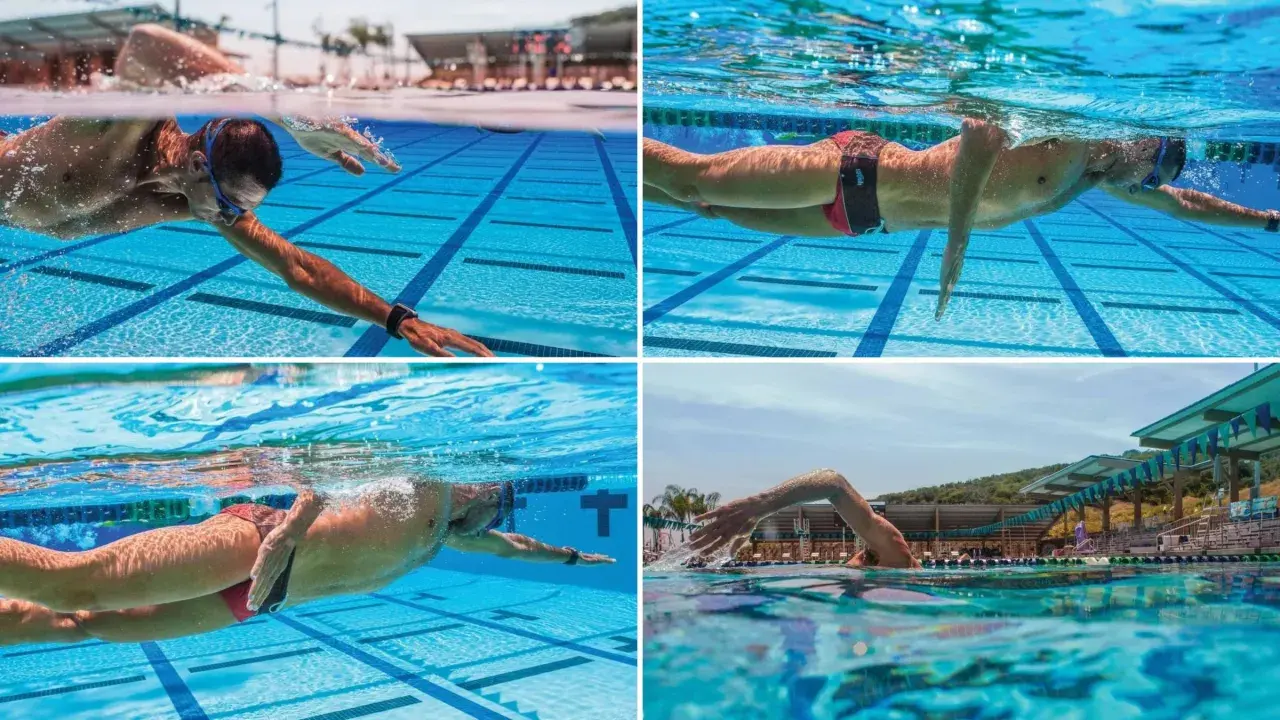
The 4 swim strokes each demand a different blend of body line, timing, breathing, and power. Once you understand what separates front crawl, backstroke, breaststroke, and butterfly, it becomes much easier to train with purpose instead of just logging metres. This guide breaks down how each stroke works, what it is best used for, and the mistakes that slow swimmers down most often.
The four strokes reward different strengths in the water
- The 4 swim strokes each have a different rhythm, so the same cue will not fix every stroke.
- Front crawl is the fastest, most efficient all-rounder and usually the best place to build base fitness.
- Backstroke helps with balance, rotation, and relaxed breathing because your face stays clear of the water.
- Breaststroke is all about timing: the kick drives the stroke, and the glide only works if it is controlled.
- Butterfly is the most demanding, but it is excellent for body connection, power, and coordination.
How the four strokes compare in practice
Swim England’s teaching standards still frame front crawl, backstroke, breaststroke and butterfly as the four core techniques, and that is the cleanest way to think about them if you swim in the UK. The real difference is not just speed; it is the way each stroke asks your body to organise breathing, balance, and propulsion.
| Stroke | Best known for | Where swimmers usually go wrong | Why it matters |
|---|---|---|---|
| Front crawl (freestyle) | Speed, efficiency, and easy scaling from short sprints to long sets | Crossing over the centreline, lifting the head to breathe, letting the kick get too wide | It is the best all-round stroke for fitness, pace, and open-water confidence |
| Backstroke | Breathing freedom, body awareness, and steady rhythm | Hips sinking, head moving too much, turning the shoulders without real rotation through the torso | It exposes body-line problems quickly and helps build a cleaner posture in the water |
| Breaststroke | Timing, leg power, and controlled glide | Rushing the kick, sweeping the arms too wide, lifting the head too late or too early | It rewards precision more than raw strength |
| Butterfly | Whole-body rhythm, core strength, and coordination | Trying to muscle the stroke with the shoulders, breathing too high, losing the wave in the body | It develops power and discipline, even when you only swim it in short repeats |
Read that table as a training map, not a ranking chart. Once the trade-offs are clear, the next step is learning what good execution actually feels like in each stroke.
Freestyle is the stroke that carries most swimmers
In everyday UK coaching, I call this front crawl, because that is the term most clubs use; freestyle is the race category, and front crawl is the stroke most swimmers choose. It is the most efficient all-round stroke when it is done well, which is why it usually becomes the foundation of lap swimming, open-water work, and triathlon training.
What matters most: keep the head still, lengthen the body, and let the hips ride near the surface. If you breathe every two or three arm cycles, exhale continuously underwater so the breath does not disrupt the pull.- Enter the hand in line with the shoulder, not across the centreline.
- Catch the water early with a high elbow and pull back in a long path to the hip.
- Kick from the hips, not the knees, so the legs support the body instead of fighting it.
- Use a front snorkel or short fins in drills if breathing is breaking your body position.
The most common mistake I see is a swimmer lifting the head to breathe, which drops the hips and shortens the stroke. Once that habit is gone, the rest of the pool work becomes much easier to organise, and that leads naturally into backstroke, where body line is just as important but breathing feels different.
Backstroke rewards balance more than brute force
Backstroke looks relaxed when it is good, but it punishes small faults quickly. The winning shape is simple: head still, hips near the surface, and rotation driven by the torso rather than by a frantic arm windmill.
What matters most: keep the body long and flat, with a slight slope from shoulders to hips so the kick stays underwater. If the hips sink, drag climbs immediately and the stroke feels heavy even when the arms are moving well.
- Let one shoulder roll up as the other presses down; that rotation helps the catch.
- Keep the recovery arm loose so it clears the water without tension.
- Look upward and keep the neck relaxed rather than trying to hold your head rigid.
- Use backstroke as an active recovery stroke during mixed sets because breathing stays easy and rhythm matters more than raw power.
Backstroke is often the stroke where swimmers first notice whether they are stable through the core or just hanging on with their arms, which makes it a useful bridge into breaststroke, where timing becomes the main test.
Breaststroke is a timing problem, not a strength contest
Breaststroke is the most technical of the common strokes for many recreational swimmers because the kick, pull, breath, and glide have to land in the right order. Swim England’s coaching material repeatedly stresses that the leg action drives a large share of the propulsion, and in practice that means a good kick matters more than a big arm sweep.
What matters most: keep the body nearly horizontal, let the kick finish cleanly, and avoid rushing into the next pull before the body has settled. A useful cue is pull, breathe, kick, glide, but the glide should be controlled, not lazy.
- Bring the heels up toward the seat rather than pulling the knees too far forward.
- Turn the feet out and snap the legs together to finish the kick.
- Keep the arms compact; a huge sweep usually creates drag without adding much speed.
- Lift the head only as the arms recover, then return to a long line quickly.
The most common error is over-gliding or under-gliding. Too much glide kills momentum, but too little glide throws away the recovery you just earned. Once that rhythm clicks, butterfly starts to make more sense, because both strokes depend on timing as much as raw effort.
Butterfly turns power into rhythm
Butterfly looks dramatic because everything happens together: both arms recover over the water, the body undulates in a wave, and the breath has to fit into a very short window. It is demanding, but when the timing is right the stroke feels smoother than many swimmers expect.
What matters most: think from the chest and core first, not the arms. The body should rise and fall in a connected wave, and the kick should support the arm cycle rather than trying to rescue it.
- Keep the hands entering at shoulder width so the pull stays efficient.
- Use a small dolphin kick from the hips, with the feet relaxed and pointed.
- Breathe low and quick; lifting too high breaks the line and sinks the hips.
- Practise butterfly in short repeats, such as 4 x 25m with full rest, before you extend the distance.
Butterfly is the stroke most swimmers respect after a few hard lengths, but it also teaches better body connection than almost anything else in the pool. That makes it worth training even if you never plan to race it, which is why the next step is learning how to practise all four strokes without turning every session into random effort.
How to train all four strokes without wasting a session
The fastest way to improve is to give each stroke one clear job. I prefer short, repeatable sets because they expose technique flaws before fatigue hides them.
- Start with 5 to 10 minutes of easy mixed swimming to settle your breathing and shoulders.
- Choose one technical cue per stroke, then repeat it over short distances such as 4 x 25m or 6 x 50m.
- Use drills and full swims together. For example, pair one drill length with one full-stroke length so the skill transfers immediately.
- Keep butterfly and breaststroke doses smaller if technique breaks down, and use more front crawl or backstroke volume to hold your conditioning together.
A few pieces of gear make this work better: short fins help you feel body position, a pull buoy isolates the arm path, and a front snorkel removes breathing noise during crawl drills. You do not need all three, but each one can save a session when your form is fading.
One balanced 1,200 to 1,600 metre session can look like 200 easy swim, 6 x 25m drills on 20 seconds rest, 4 x 50m stroke focus, 4 x 25m build, and 100 easy cool-down. That is enough volume to practise, but not so much that technique collapses.
If you swim three times a week, I would usually split the emphasis across two technical sessions and one conditioning session rather than trying to hammer every stroke every day. That keeps the work specific and stops the weaker strokes from falling behind the moment the set gets hard.
What matters most if you want the main four to improve together
When swimmers improve one stroke, the others usually benefit as well, because body line, breathing discipline, and timing carry over from lane to lane. That is why I never treat the four main strokes as separate islands; I treat them as connected skills that reinforce each other.
If you only have limited pool time, I would prioritise front crawl for conditioning, backstroke for balance, breaststroke for timing and leg efficiency, and butterfly in small, high-quality doses. That mix gives you the broadest technical base and the best chance of swimming faster without feeling like every session is a fight.
In practice, the real win is not memorising the names of the strokes. It is learning how each one changes your body position, where the water should feel supportive, and when to back off so quality stays high. That is the difference between swimming lots and swimming well.