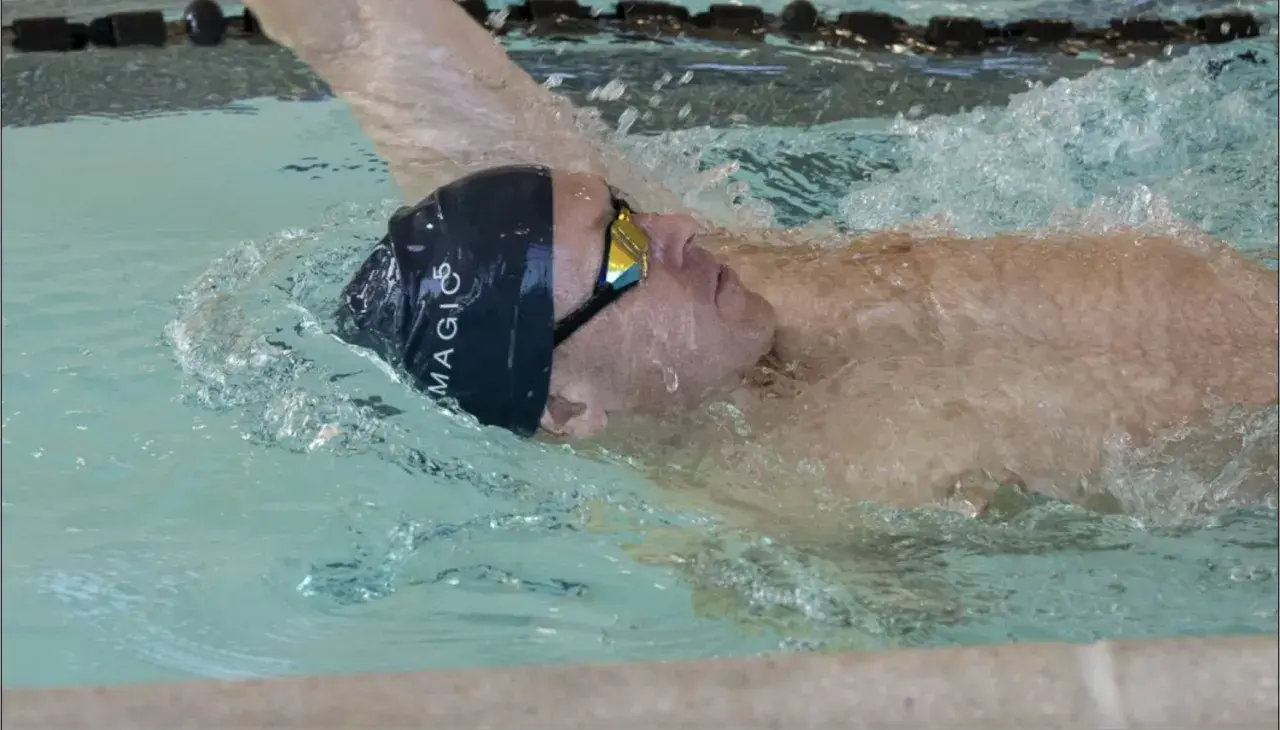
A clean backstroke flip turn is one of the easiest places to buy free speed in a race or a hard interval set. The best version is compact, continuous and legal: you roll early, keep the motion tight, plant the feet with intent, and leave the wall in a better line than you entered it. In this article, I break down the movement, the timing, the common mistakes, and the drills that make the turn reliable instead of awkward.
The fastest version is compact, continuous and controlled
- The turn should feel like one uninterrupted action, not a stop, twist, and restart.
- Current World Aquatics rules allow the shoulders to rotate past vertical during the turn, as long as the motion stays continuous and you leave the wall on your back.
- You can be fully submerged during the turn and for up to 15 metres after each wall, so the breakout matters as much as the flip itself.
- In most competition pools, the backstroke flags sit about 5 metres from the wall, which makes them your most useful timing cue.
- If the tumble turn still feels unstable, a clean open turn can be the smarter training choice for now.
The turn is about preserving speed, not starting over
The mistake many swimmers make is treating the wall like a reset button. A fast backstroke turn is really a speed-preservation skill: you arrive with momentum, convert that momentum into rotation, and get out again with less loss than the swimmer next to you. The legal part is straightforward, too. The wall has to be touched with some part of the body, the shoulders may rotate past vertical toward the breast during the turn, and you must leave the wall on your back.
That matters because it changes the way I coach the skill. I do not want a pause on the chest, a hesitant glance at the wall, or a big, loose somersault. I want one continuous movement where the body stays organised the whole time. Once that idea clicks, the rest of the technique becomes much easier to build.
With that foundation in place, the next step is learning the exact movement sequence.

The movement sequence I coach first
I usually teach the turn as four jobs: set the approach, roll, tuck, and launch. Trying to think about everything at once usually makes swimmers late or messy, so I prefer a simple sequence that can be repeated under fatigue.
Set the last stroke early
The last two arm actions should prepare the body for rotation, not rescue a bad line at the wall. If you are still reaching and searching for the line when you are almost on the flags, you are already late. Start organising the turn one stroke before it feels necessary.
Roll onto the breast without drifting
The first rotation should come from the shoulders and trunk, not from throwing the head. Swim England coaches cue a powerful shoulder roll with a small, active pulling action from the recovering arm so the swimmer keeps moving while turning. That cue works because it keeps the motion alive instead of letting speed leak away.
Tuck hard and finish the somersault
Once the body is on the breast, the turn should become compact immediately. Chin to chest, back rounded, eyes down, and the exhale controlled. The tighter the tuck, the cleaner the rotation. If the hips lag behind the shoulders, the feet arrive late and shallow, and the whole turn gets slow.
Read Also: Butterfly Breathing - Master Timing & Efficiency
Plant, streamline and kick out cleanly
The feet should land at the wall together, with the body still organised and the head hidden between the arms. I like the cue “hide the head between the arms” because it keeps the streamline long as you leave the wall. The push should feel like the body is driving away in one line rather than kicking out in pieces.
Once the sequence is clear, timing the approach becomes much easier.
How to time the approach without guessing
Most swimmers do not miss the turn because they cannot somersault. They miss it because they arrive at the wall at the wrong moment. In a 25 metre pool, the backstroke flags are usually the last reliable visual checkpoint, and in a 50 metre pool they matter just as much because the turn still depends on an accurate approach count.
| Training cue | What it does | Why it matters |
|---|---|---|
| Use the flags | Start setting the turn before you reach them | Prevents a late, cramped rotation |
| Count your strokes | Learn your own flags-to-wall count at easy and race pace | Removes guesswork when the pace changes |
| Keep the head neutral | Let the shoulders and trunk do the work | Protects line and balance into the wall |
I ask swimmers to learn two counts: one for controlled swimming and one for faster repeats. If the counts are wildly different, the setup is not stable yet. A good turn should be repeatable without needing a perfect mood, perfect pace, or perfect lane.
Even then, a few predictable errors can still steal speed, so it helps to name them plainly.
Mistakes that waste speed or break the rule
The fastest way to improve this skill is to stop repeating the same avoidable errors. These are the ones I see most often:
- Waiting too long to start the roll. If the rotation begins at the wall instead of before it, the turn gets rushed and shallow.
- Separating the pull from the turn. The arm action and the rotation have to feel linked; otherwise the body stalls on the chest.
- Lifting the head to find the wall. That breaks the line and makes the tuck less compact.
- Planting the feet too wide or too shallow. Both reduce the force you can drive through the wall.
- Leaving the wall on the side or chest. You must return to the back before you surface into normal backstroke.
- Trying to make the turn look big. A dramatic flip is not the goal. A small, fast, organised turn is.
If you fix just two of those, the turn usually improves a lot. If you fix all of them, the difference is obvious. Once those mistakes are under control, drills can make the motion automatic.
Drills that make the turn feel automatic
I prefer short, focused drill sets over endless full-length attempts. The skill improves faster when each repeat has one clear purpose.
- Flags-to-wall count repeats. Swim from the flags to the wall and count every stroke. Repeat until the number is stable enough that you can trust it at pace.
- One-stroke roll and turn. Start a few metres out, take one final stroke, roll immediately, and complete the turn without a long glide. This teaches continuity.
- Wall tuck from a push-off. Push off on your back, swim a short distance, then practise the compact tuck and plant without the distraction of the full approach.
- Backstroke repeats with one cue only. For example, focus only on “chin down” or only on “hide the head”. One cue is usually enough for a quality set.
If you use short fins, keep them for only a few repetitions at a time. They can sharpen bodyline, but they also hide a weak tuck if you rely on them too much. That also makes it easier to decide when a simpler open turn is the better call.
When a simple open turn is the smarter option
A tumble turn is not always the best answer. If a swimmer is still learning backstroke body position, keeps missing the wall, or feels disorientated on the roll, a clean open turn is often the better training choice. It is slower on paper, but it may produce better quality repetitions and far fewer messy exits.
| Situation | Better choice | Why |
|---|---|---|
| You are learning backstroke | Open turn | It is easier to organise the body and build confidence |
| You keep arriving late | Open turn for now | It keeps the wall action legal and controlled while timing improves |
| You already own the timing | Tumble turn | It usually gives the better speed return |
| You feel shoulder discomfort or crowd pressure | Open turn | It is simpler and can reduce unnecessary stress |
I do not treat that as a downgrade. I treat it as the right tool for the swimmer in front of me. Once the open turn is clean and repeatable, the faster backstroke turn becomes much easier to learn without chaos in the lane.
With that choice clear, the last step is making the turn hold up in real training.
How I would build it into the next two weeks of training
For the first week, I would keep the work short: six to eight repeats, full rest, one technical cue, and a strong emphasis on the same approach count every time. That is enough to remove guesswork without turning the set into survival swimming.
For the second week, I would add a little fatigue. Not a huge amount, just enough to see whether the turn still holds together when the arms are tired and the breathing pattern is less comfortable. If it falls apart under that pressure, the problem is usually timing or compactness, not effort.
The turn does not need to look dramatic to be fast. It just needs to be early enough, tight enough, and continuous enough that the wall feels like part of the stroke instead of a reset.