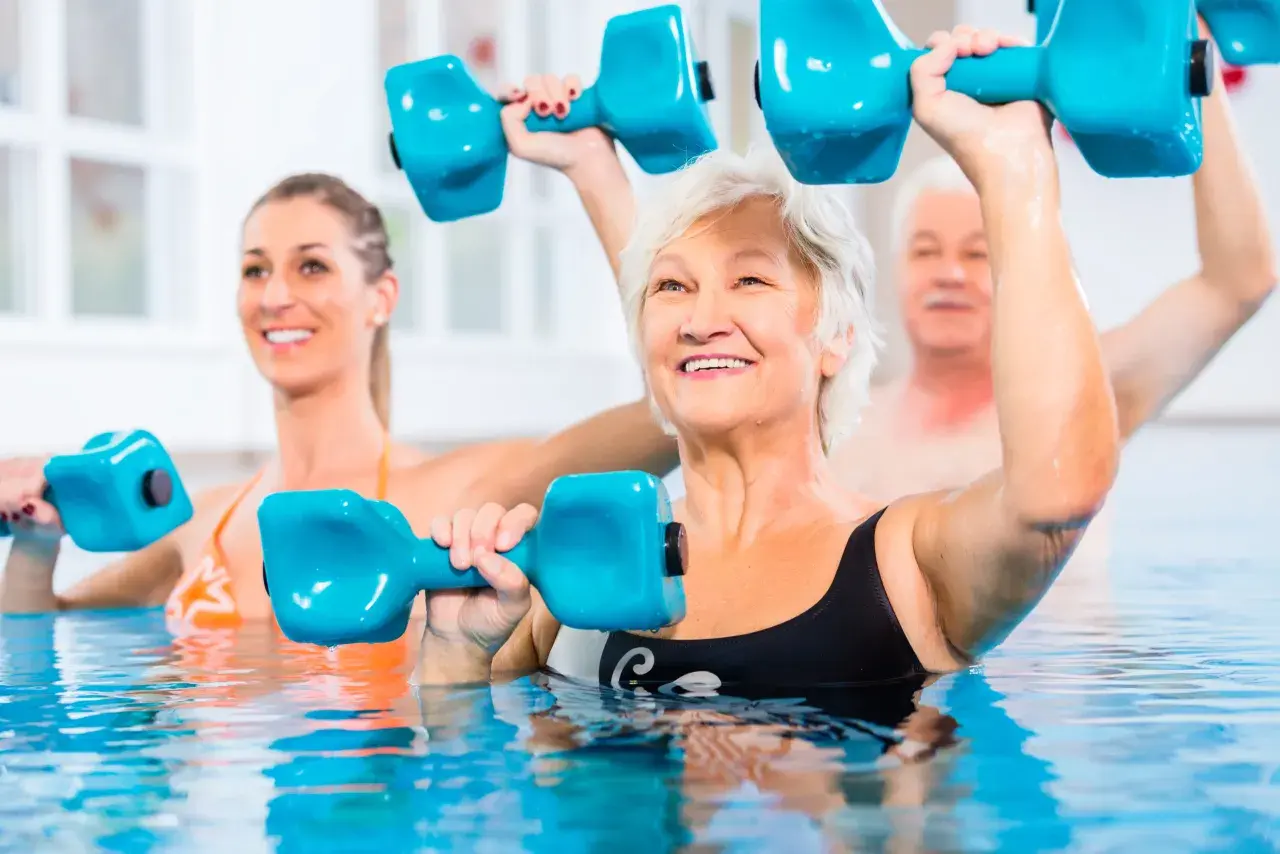
Pool exercises give you an unusually efficient mix of cardio, resistance, and joint-friendly movement, which is why they work so well for both swim training and general fitness. In water, every step, kick, and pull has to move against drag; Harvard Health notes that water creates roughly 12% to 14% more resistance than air, so simple movements become real conditioning work. In this article, I break down which movements matter, how to organize them into useful sessions, what gear is actually worth carrying, and how to avoid the mistakes that waste time.
Key takeaways before you get in the water
- Water adds resistance without the same impact you get on land.
- The best sessions mix technique, aerobic work, and controlled rest.
- Walking, jogging, kicking, intervals, and deep-water running all solve different problems.
- Small pieces of gear can help, but they should support good mechanics, not hide weak ones.
- Two or three focused sessions a week are enough to make noticeable progress.
Why water training changes the equation
The first thing I remind swimmers is that the pool is not just a softer version of the gym. Buoyancy takes some load off the joints, but the drag of water forces the body to work harder through each movement, which is why even simple drills can build real fitness. That combination makes aquatic work useful for beginners, returning athletes, and experienced swimmers who need conditioning without pounding their knees, hips, or lower back.
I also like the pool because it tends to be easier to repeat. The CDC notes that swimming can improve mood, and that matters more than people admit: if a workout feels manageable and rewarding, it is far more likely to become a habit. For many adults, especially in the U.S. where access to lap time can be limited, the pool is one of the few places where cardio, mobility, and recovery can live in the same session. Once you understand that training effect, the next step is choosing the movements that deserve space in the workout.

The exercises that earn a place in real sessions
I do not treat every pool movement as equal. Some drills build conditioning, some sharpen technique, and some are better for recovery or mobility. The best sessions usually combine two or three of them instead of trying to do everything at once.
| Exercise | Best use | Main benefit | Common mistake |
|---|---|---|---|
| Water walking or jogging | Beginners, recovery days, joint-friendly cardio | Raises heart rate without impact | Leaning forward and shuffling instead of moving with intent |
| Vertical kicking | Leg endurance and body control | Builds steady effort without wall assistance | Using huge knee bends that turn the drill into splashing |
| Deep-water running | Cardio without pounding | Lets you work hard while staying off the floor | Poor posture and wild arm movement |
| Lap intervals | Swim fitness and pacing | Improves endurance and repeat speed | Turning every repeat into an all-out sprint |
| Sculling and stroke drills | Feel for the water and catch mechanics | Sharpens hand placement and body awareness | Rushing through the drill without attention to detail |
| Aqua strength moves | Shoulders, core, hips | Adds resistance through a safer range of motion | Using momentum instead of control |
If I had to narrow that list for most people, I would start with water jogging, lap intervals, and one technique drill. That trio covers conditioning, movement quality, and enough variety to keep the session from feeling repetitive. From there, the question becomes how to structure a workout so it actually produces the result you want.
How I structure a session so it transfers to fitness and speed
The biggest mistake I see is treating a pool visit like random movement. Good sessions have a shape, even if they are short. I usually build them around four parts: warm-up, main set, skill block, and cooldown.
- Warm up for 5 to 10 minutes with easy swimming, water walking, or light kicking. The goal is to raise temperature and loosen the shoulders and hips, not to impress anyone.
- Use the main set for the actual work. This is where intervals live. I like repeats of 25, 50, or 100 meters or yards, depending on the pool and the swimmer. Work at a moderate to hard effort, then rest enough to keep form intact.
- Add a short skill block if technique is part of the goal. One or two drills can be enough. In swimming, quality matters more than volume when you are trying to change stroke mechanics.
- Finish with a cooldown of easy movement. Five minutes is enough on most days. I use it to bring the heart rate down and leave the water feeling better than when I entered.
When people ask me how hard the main set should feel, I use rate of perceived exertion, or RPE, which simply means how hard the effort feels on a 1-to-10 scale. For most fitness-focused pool sessions, an RPE of 6 to 8 is the sweet spot: challenging enough to drive adaptation, but not so hard that technique falls apart after the first few repeats. Once the structure is clear, the next decision is what gear is worth bringing along.
Gear that helps and gear that only adds noise
In a crowded community pool, simplicity usually wins. A few tools can make training more effective, but only when they solve a real problem. I am skeptical of gear that makes a workout feel harder without making it better.
| Gear | What it helps with | What to watch for |
|---|---|---|
| Kickboard | Leg sets and body position | Can irritate the shoulders if you grip it too tightly or use it too long |
| Pull buoy | Upper-body focus and alignment | Can hide a weak kick if it becomes a crutch |
| Fins | Speed, ankle mobility, and better body line | Easy to overkick and let bad mechanics sneak through faster |
| Snorkel | Head position and stroke concentration | Useful for drills, but not a substitute for real breathing skill |
| Webbed gloves or paddles | Extra resistance for experienced swimmers | Best used only when technique is already stable |
| Water shoes | Grip and comfort in shallow or slippery areas | Not necessary for every lane workout |
My rule is simple: if the equipment improves body position, feedback, or control, it probably earns a place in the bag. If it only makes you tired faster, it is probably less useful than another well-planned set. That leads straight into the mistakes that quietly drain progress.
Common mistakes that quietly sabotage progress
Most underperforming pool workouts fail for predictable reasons. The pool itself is forgiving, but your technique, breathing, and pacing are not. Once those slip, the session turns into busy work.
- Swimming every repeat too hard. Constant redlining creates sloppy form and makes it impossible to hold useful pace.
- Ignoring the difference between effort and quality. A hard session is not automatically a good one if the strokes fall apart.
- Using only one movement pattern. If all you ever do is swim laps, you miss opportunities to build legs, core control, and general capacity.
- Letting gear do the work. Fins and buoy aids can help, but they should not become a mask for poor mechanics.
- Forgetting to breathe well. Breath-holding spikes tension quickly and shortens the amount of useful work you can do.
- Skipping recovery habits. Shoulders, calves, and hips still need attention after pool sessions, especially if you train often.
I also see swimmers who never track anything. If you do not note distance, time, rest, or how the session felt, it becomes hard to tell whether you are improving or just getting tired in a different way. The simplest fix is to give the week a shape, which is the next piece I would put in place.
A weekly rhythm that fits most schedules
For most adults, consistency beats volume. Two to three well-planned sessions a week are enough to improve endurance, technique, and confidence in the water, especially if the rest of the week includes walking, mobility work, or strength training on land. I would rather see a swimmer do three focused 35-minute sessions than one heroic workout and two missed opportunities.
| Weekly frequency | Best setup | Who it suits |
|---|---|---|
| 2 sessions | One technique-focused session and one conditioning session | Busy adults, beginners, and cross-training athletes |
| 3 sessions | Technique, aerobic intervals, and mixed strength or speed work | Most swimmers who want steady progress |
| 4 sessions | One easy recovery session, one threshold set, one speed session, one drill-heavy swim | More experienced swimmers with solid recovery habits |
If you only have two sessions, I would make one of them easy enough to reinforce technique and one hard enough to raise the training signal. If you have three, the middle session is where I would keep the pace honest but controlled, because that is usually where fitness gains are built. That rhythm is simple, but it works because it respects the body’s need for stress and recovery in the same week.
The details that make pool work pay off
The swimmers and fitness clients who improve fastest are usually not the ones who grind the hardest. They are the ones who keep the session measurable, repeatable, and honest. They know when to push, when to back off, and when a drill is no longer doing useful work.
- Track distance, time, and rest instead of relying on memory.
- Keep one set in reserve so technique stays sharp.
- Use easy sessions to practice body position and breathing.
- Revisit the same benchmark workout every two to four weeks to check progress.
When I look at pool work through that lens, it stops being random exercise and becomes a clear training tool. That is where the real return shows up: better conditioning, cleaner movement, and workouts that you can actually repeat week after week without burning out.