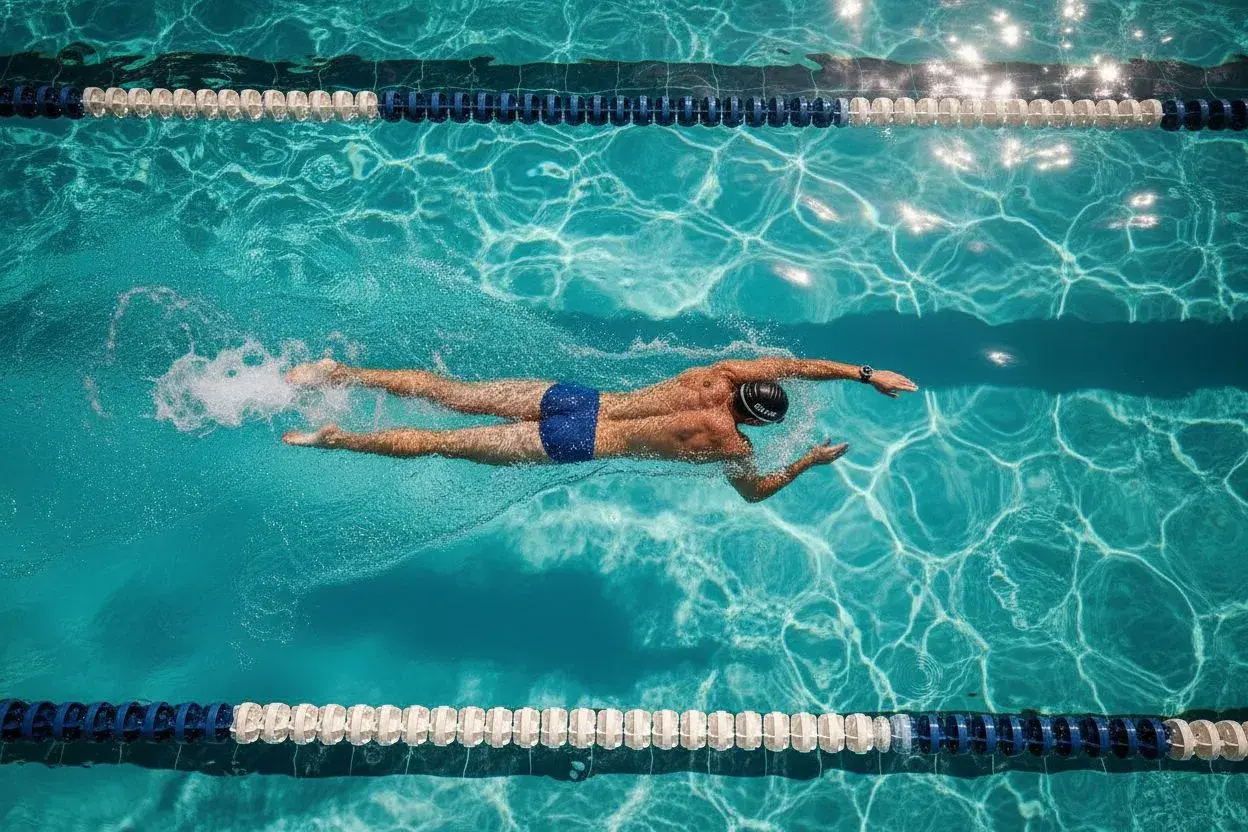
The essentials for building a pool routine that actually improves fitness
- Start every session with 5 to 10 minutes of easy swimming and a few drills so your stroke quality is set early.
- A useful week usually mixes technique work, endurance, and one harder session instead of repeating the same swim three times.
- Rest intervals matter as much as distance because they change whether the set builds speed, stamina, or control.
- Progress in small steps. Adding too much distance and intensity at the same time is the fastest way to stall.
- In a 25m pool, clean form on the final repeat matters more than chasing one extra length at the end.
What a useful swim week actually looks like
The simplest weekly structure is the one most swimmers can sustain: one technique session, one endurance or threshold session, and one mixed session that keeps the body honest. If you only have two pool visits, I would keep the technique day and the endurance day, then add a little dryland work rather than forcing more water time than you can recover from.
| Session | Focus | Example main set | Why it helps |
|---|---|---|---|
| Session 1 | Technique and aerobic base | 6 x 50 drill/swim + 6 x 100 easy to moderate | Improves body position, breathing control, and rhythm |
| Session 2 | Threshold work | 8 x 100 at a steady hard effort with 15 to 20 seconds rest | Builds the pace you can hold without fading |
| Session 3 | Endurance or mixed pace | 3 x 300 or 4 x 200 at controlled effort | Teaches you to stay organised when fatigue starts to creep in |
| Optional Session 4 | Recovery kick or pull work | 10 x 50 easy with fins or a pull buoy | Adds volume without turning every swim into a test |
Swim England’s fitness plan follows the same logic, starting small and building gradually rather than demanding a big jump in volume on day one. That approach is sensible for most swimmers, because consistency beats ambition every time once real recovery is part of the picture. Once that rhythm is clear, the session itself needs a clean structure.

How I build each session from warm-up to swim-down
Swim England’s fitness plan uses a simple pattern: warm-up, skill development, main set, and swim-down. I use the same framework because it keeps the session readable and stops the hard work from swallowing the whole workout.
- Warm-up - 200 to 400 metres easy, then 4 x 25 metres building speed gradually. The point is to loosen up, not to prove anything.
- Skill block - 6 x 50 metres as 25 drill and 25 swim. I like drills that sharpen catch, body line, and breathing, because those are the first things to fall apart when a session gets harder.
- Main set - 8 x 100 metres on a consistent send-off, or 4 x 200 metres if you are chasing endurance. For aerobic work, keep rest short enough that you stay engaged; for faster work, give yourself enough rest to hold real speed.
- Speed finish - 4 to 6 x 25 metres fast with full recovery. This is about quality, not chaos, so the stroke should stay long and sharp rather than frantic.
- Swim-down - 100 to 200 metres very easy. I never treat this as optional, because it helps the shoulders relax and gives the whole session a proper close.
If a workout starts to unravel, I shorten the main set before I add more volume. That small decision usually saves the next session too, which is the part people forget when they push too hard on one day. With the session shape in place, the next question is which tools actually help and which ones just add clutter.
The gear that helps, and the gear that gets overused
I prefer to treat kit as support, not the workout itself. A few well-chosen items can make technique work clearer and endurance sessions more comfortable, but the wrong gear can hide weak mechanics or overload the shoulders.
| Item | Best use | Common mistake |
|---|---|---|
| Goggles | Clear vision, relaxed breathing, better focus on stroke cues | Using a leaky pair and blaming the set when your concentration drops |
| Pull buoy | Upper-body focus and body position work | Relying on it so often that your kick stops contributing |
| Fins | Technique drills, body alignment, and short speed work | Turning every session into a fin session and overloading the ankles |
| Kickboard | Dedicated kick sets and leg conditioning | Holding it too tightly and straining the neck or shoulders |
| Hand paddles | Developing catch strength on controlled sets | Using them before your stroke mechanics are stable |
| Snorkel | Head-position work and stroke symmetry | Letting it replace normal breathing practice for too long |
If I had to keep the kit list short, I would choose goggles, a pull buoy, and fins first. Everything else is useful only when the session has a clear purpose behind it. The next piece is progression, because even the best set falls apart if the weekly load jumps too quickly.
How to progress without stalling or getting sore
The biggest mistake I see is adding metres and intensity at the same time, then wondering why the body feels flat after two weeks. Swim England’s fitness plan starts at 300 metres and builds gradually toward 2,000 metres, and that slow ramp is the right lesson: earn more volume by keeping the stroke together.
- Change one variable at a time: distance, speed, or complexity.
- Use a modest increase, roughly 5 to 10 percent in weekly distance, only when the current load feels controlled.
- Keep at least one session easier than you think you need it to be.
- Stop chasing pace if your stroke collapses, your breathing gets ragged, or your shoulders start to pinch.
Rest intervals also change the training effect. A hard 50 metres with generous recovery is a speed effort; the same 50 metres on a tight send-off becomes a different workout entirely. That detail matters when you want fitness gains without turning every swim into survival mode. From there, the same framework can be tuned for different goals.
How I’d adapt the same plan for different goals
| Goal | What to emphasise | What to limit |
|---|---|---|
| General fitness | Two steady swims, one technique-focused session, and a few short interval sets | Too many all-out repeats that leave you exhausted for no clear return |
| Endurance | Longer repeats such as 200s and 400s, plus controlled pacing and short rest | Frequent sprinting that steals energy from the main aerobic work |
| Speed | 25 to 50 metre repeats, generous recovery, and very clean stroke mechanics | Volume creep that turns a speed day into a tired, average session |
| Triathlon or open water | Continuous swimming, pacing discipline, and occasional sighting practice | Overusing paddles and spending all your time on wall-driven pool habits |
For most swimmers, the smartest plan is not the hardest one. It is the one that fits the goal, the pool time you actually have, and the recovery you can realistically support during the week. Even then, the plan only works if the habits around it are solid.
The habits that keep progress moving after the first month
- Log the session, including the main set, send-offs, and how the final third felt.
- Repeat one benchmark set every 2 to 4 weeks, such as 8 x 100 on the same interval, so you can see whether fitness is really moving.
- Finish at least one swim each week with energy left in reserve.
- Keep 10 to 15 minutes twice a week for dryland work such as rows, band external rotations, core stability, and hip mobility.
If you keep the week simple, a pool routine becomes easier to sustain than most gym plans. The real gain comes from repeated sessions that stay technically clean, not from squeezing in one more hard set when form is already slipping.