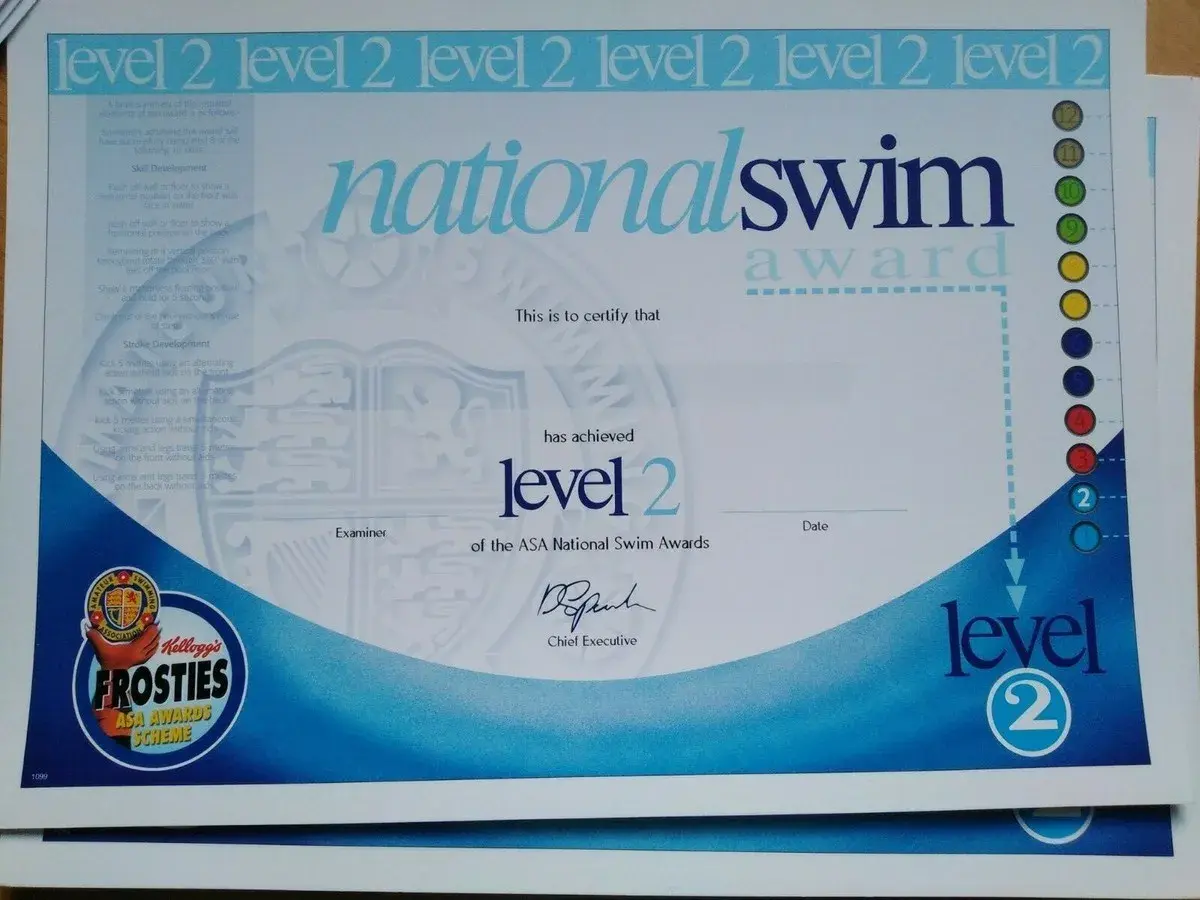
A certificate from swim lessons should do one thing well: show that a swimmer has actually reached a defined skill level, not just attended class. In practice, a swim certificate is most useful when it records what was tested, who taught the lesson, and what the swimmer can now do safely under supervision. That matters whether you are a parent comparing programs, an adult learner tracking progress, or an instructor deciding when a student is ready for the next step.
Here is the practical value a lesson certificate should deliver
- It should prove a specific level or skill set, not just class attendance.
- It is strongest when it names the abilities that were tested, such as breathing control, floating, and distance swimming.
- It does not mean the swimmer is ready for every environment, especially lakes, rivers, or the ocean.
- Good programs issue it only after consistent performance, not after one lucky attempt.
- For families, it creates a clean record of progress and makes the next lesson choice easier.
What a swim certificate actually proves
In the U.S., this is usually a program-based document rather than a single national credential. I treat it as a snapshot of ability at a specific level, not a lifetime license to swim anywhere.
| Document type | What it usually means | What it does not mean |
|---|---|---|
| Completion certificate | The swimmer finished a lesson level or course | Automatic readiness for open water or unsupervised swimming |
| Level record | The swimmer passed listed skills for a stage | That every other water skill is mastered |
| Instructor certification | The teacher is qualified to teach swimming and water safety | That the instructor's students all swim at the same level |
The most useful version names the level, the date, and the skills that were verified. If the paper or digital record is vague, I would treat it as a weak signal. A strong certificate tells a parent, coach, camp director, or school exactly what the swimmer can do, and what still needs work.
Skills that usually sit behind it
Water Safety USA frames basic water competency as more than stroke count alone. A solid beginner benchmark usually includes entering the water, resurfacing, controlling breathing, floating or treading, turning toward safety, and swimming a short distance such as 25 yards in a pool.
- Enter and resurface so the swimmer can recover after a jump or slip.
- Control breathing without panicking when the face goes in and out of the water.
- Float or tread water long enough to regain calm and orient themselves.
- Turn and move to safety instead of staying stuck in place.
- Swim a measured distance with enough control to reach the wall, edge, or another safe point.
- Exit the water independently without help from an adult or lifeguard.
For stronger swimmers, the bar rises. More advanced lessons often add longer distances, clothing practice, smoother turns, and better efficiency under mild fatigue. That difference matters because a swimmer who can manage a pool lane is not automatically ready for cold water, current, waves, or deeper environments. A certificate should reflect the setting it was earned in, not pretend every water situation is the same.
How instructors decide a swimmer is ready
Good instructors do not certify a skill the moment it appears once. They look for repeatable performance, calm body position, and enough control that the skill still holds when the swimmer is slightly tired, distracted, or asked to start from a different position.
- They watch comfort in the water before they focus on speed or style.
- They test core skills one by one instead of piling everything into one big pass or fail moment.
- They repeat the skill in more than one setting, such as from the wall, mid-pool, or after a short rest.
- They check whether the swimmer can stay safe without constant physical support.
- They record the result only when the performance is stable enough to trust.
I prefer programs that explain this process clearly. If an instructor cannot tell you what counts as passing, or why a child moved up, the certificate is more decorative than meaningful. The best programs make the decision feel earned, not rushed.
What a strong lesson program looks like
The American Red Cross uses a staged Learn-to-Swim path and separates instructor training into Basic Swim Instructor and Water Safety Instructor tracks, which is a useful reminder that good teaching is structured, not improvised. In my experience, strong programs share the same habits even when the branding is different: they group swimmers by age and ability, explain progression plainly, and make safety visible from the first lesson.
- Small groups for beginners, ideally with an instructor-to-student ratio of 1:4 or fewer.
- Clear ability grouping, so a nervous beginner is not placed beside a confident lap swimmer.
- Progressive skill levels, with each step building on the last instead of jumping ahead.
- Direct safety language, including supervision, water watchers, and pool rules.
- Instructor credentials that are easy to name and verify.
- Transparent assessment rules, so families know how the certificate is earned.
When I review a program, I usually ask four questions: What skills are required for each level? How many students are in the group? Is the certificate based on mastery or attendance? And who signs off on the final result? Those answers tell you far more than a glossy brochure ever will.
When it matters and when it does not
A lesson certificate can be genuinely useful. It helps with camp forms, school swim requirements, private club placement, and family decisions about which class to book next. It can also reassure a parent who needs a clear milestone before moving a child into a slightly harder environment.
| Situation | Why the certificate helps | What still matters |
|---|---|---|
| Camp or school paperwork | Shows that the swimmer has completed a recognized level | Staff supervision and pool rules |
| Moving from lessons to a swim team | Shows baseline water comfort and stroke progress | Technique, endurance, and coach evaluation |
| Family pool use | Helps judge whether the swimmer can manage short, supervised sessions | Adult supervision and clear boundaries |
| Lake, river, or ocean trips | May show a useful starting point | Life jacket use, current awareness, and much closer supervision |
What it does not do is replace judgment. A child who passes a pool level is still not automatically ready for surf, cold water, or fast-moving current. A certificate is a checkpoint, not a permission slip to relax supervision. That is the mistake I see most often, and it is an expensive one.
What I would keep after the certificate is issued
If I were organizing records for a child or an adult learner, I would keep more than just the certificate itself. The paper or digital file becomes far more useful when it contains enough detail to guide the next lesson block.
- The level name and date earned.
- The instructor or school that issued it.
- A skill checklist, if the program provides one.
- Notes about what still felt hard, such as breathing rhythm or floating.
- The next level the swimmer should target.
The best certificates do not end the conversation. They make the next step obvious, whether that means repeating a level, moving into a harder class, or staying in supervised practice until the swimmer has more confidence. If you treat the document as a milestone rather than a finish line, it becomes a genuinely useful part of safer swimming.