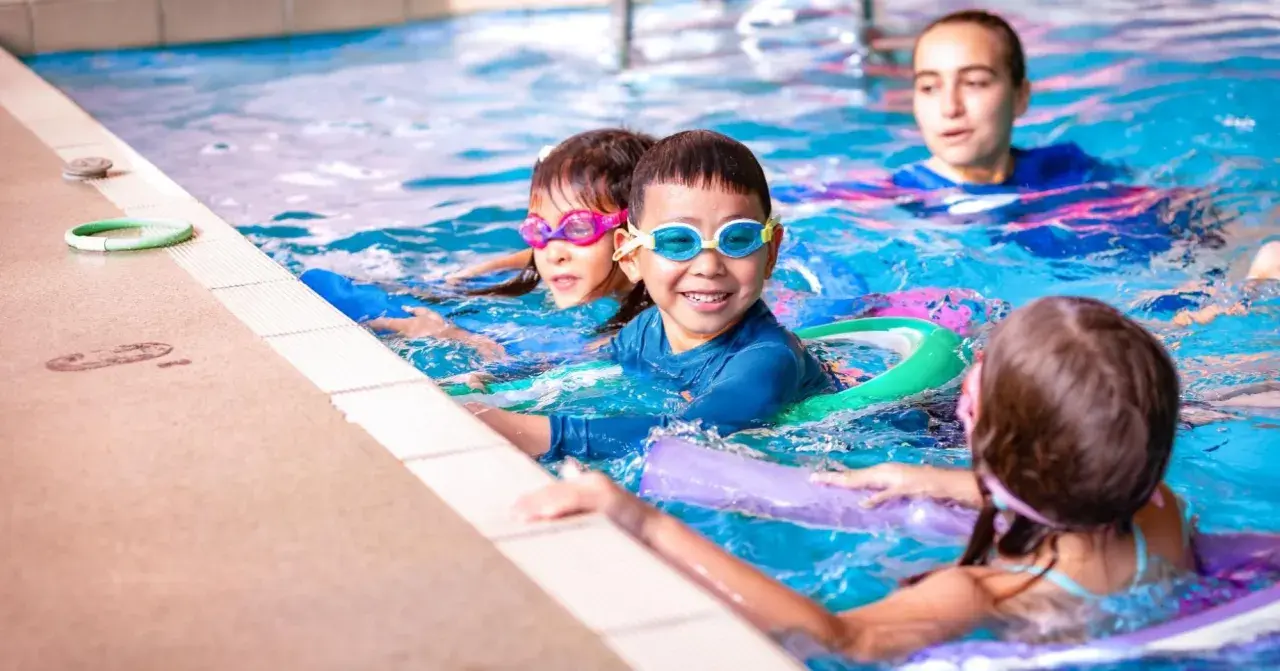
Well-run pool games turn a lesson from passive waiting into repeated movement, and that matters because swimmers learn faster when they are relaxed, listening, and actually doing the skill. The best swim lesson games are never just filler; they are a way to repeat a skill often enough that it starts to stick. In this guide I look at the activities that genuinely support swimming instruction, how to match them to age and ability, and how to keep them safe enough for real teaching.
The practical version of play-based swim teaching
- Good pool games are structured practice in disguise, not random entertainment.
- The strongest activities build one clear outcome at a time, such as breathing, floating, gliding, or directional control.
- For beginners, the most useful games usually reward face immersion, bubble blowing, and calm movement.
- For stronger swimmers, the useful games sharpen starts, stops, streamline, and stroke quality.
- If a game creates long queues, confused rules, or breath-holding contests, it is probably reducing the value of the lesson.
- A simple lesson structure often works better than trying to force three different games into one session.

Why games belong in swim teaching
I treat games as a teaching tool, not a reward for getting through the lesson. In the water, children and nervous adults usually learn more when they are distracted just enough to forget they are being tested, but still focused enough to repeat the movement properly. That is why Swim England’s Learn to Swim framework places fun and enjoyment at the centre of progress rather than at the edges.
There is also a broader reason games matter in the UK context. In England, school swimming aims for confidence, safe self-rescue, and the ability to swim 25 metres unaided, which means play has to support a serious outcome. A good game should build the habits behind competence: breath control, balance, orientation, entry, exit, and calm decision-making. Once you think of it that way, the lesson stops being about “keeping them busy” and starts being about shaping water behaviour.Fun is the wrapper; technique is the product. If the children leave smiling but still cannot float, breathe, or move safely, the game did not do its job. That is why I like to choose activities that have one obvious skill at the centre, which leads neatly into the question of which games are actually worth using.
The best games by skill
The easiest way to choose a pool activity is to ask what movement you want the swimmer to repeat. I prefer games that are simple to explain, easy to reset, and hard to “win” without doing the correct skill. If an activity can work for a nervous beginner and still challenge a stronger swimmer, it is usually worth keeping in the lesson plan.
| Game | Skill focus | Why it works | Best use |
|---|---|---|---|
| Bubble trail | Breath control and face immersion | Swimmers practise exhaling into the water without rushing | First-time swimmers and younger children |
| Treasure hunt | Submersion, reach, and confidence | There is a clear reason to put the face down and move with purpose | Beginners who can already tolerate brief face dips |
| Red light, green light | Starts, stops, body control, and listening | It rehearses control rather than speed | Mixed-ability groups and early stroke work |
| Shark and islands | Travel, dodging, quick decision-making | Swimmers keep moving while managing space and direction | Confident beginners and primary-age groups |
| Kickboard relay | Leg drive and body position | The relay format keeps effort high without needing complex instructions | Children who need more kick practice |
| Mirror swim | Stroke shape, balance, and timing | Swimmers copy a leader, which makes technique easier to see | Older children and more capable swimmers |
I use the table above as a filter, not a menu. A bubble game is brilliant when the real issue is fear of submerging the face; it is a poor choice if the swimmer already needs work on streamline or kick rhythm. Likewise, a relay can be motivating, but if the group is too young or too anxious, the competition becomes noise and the teaching point disappears. The next step is matching the activity to the swimmer in front of you, not to the one you hoped would turn up.
How I match a game to age and ability
The strongest sessions are rarely the most energetic ones. They are the ones where the activity is tight enough to suit the swimmers’ current stage, but open enough to let everyone succeed. I think about three things first: how much water confidence the group already has, how much waiting they can tolerate, and whether the game works in shallow water before it works in deeper water.
Preschool and first-timers
With very young swimmers, I keep the rules minimal and the imagery simple. “Blow bubbles,” “reach for the toy,” and “go to the island” are better than long explanations. At this stage, the game should create comfort more than competition, and it should reward small wins like putting the face in, floating for a moment, or moving without clinging to the wall. Parents or carers in the water can help, but only if they support the lesson rather than distract from it.
School-age beginners
Once children can listen, move independently, and repeat a basic shape, I can add a little more structure. This is where relays, movement lanes, and target-based games become useful because they keep attention high while still allowing skill repetition. I like games that make the swimmer travel with a clear purpose: glide to a marker, collect a sinker, or stop on command and float. That extra layer of control is where confidence starts turning into competence.
Read Also: ISR vs. Swim Lessons - Which is Right for Your Child?
Older children and adults
Older beginners usually want less fantasy and more clarity. They may still enjoy the game format, but they often respond better to challenge-based tasks than to cartoon names. For them, I use short timed repeats, partner mirroring, or “beat your own score” activities that keep dignity intact. The lesson still feels playful, but the task is more grown-up: cleaner entries, smoother streamlining, better breathing rhythm, and fewer wasted movements.
When a game is matched properly, the swimmer hardly notices that repetition is happening. That is the point. The only real challenge left is keeping the activity safe and disciplined enough that the fun does not pull the lesson off course.
How to keep games safe without making them dull
Good teaching in the pool has a hard edge underneath the play. I can make a lesson lively without making it chaotic, and I can keep it enjoyable without creating risks that were never necessary in the first place. RLSS UK’s water-safety resources are a useful reminder that safe habits should stay visible even when the atmosphere is light.
- I avoid breath-holding contests completely. They add pressure, create poor habits, and do not teach the right kind of control.
- I keep underwater actions short and intentional. The aim is confidence and technique, not duration.
- I explain the rule once, then I start. Long briefings kill momentum and usually do not improve understanding.
- I use clear stopping points so the swimmers know exactly when to freeze, float, return, or listen.
- I choose shallow water or close supervision whenever the game involves submersion, jumping, or a new body position.
- I simplify the activity the moment form starts to fall apart. A game that teaches sloppy movement is not helping.
- I watch for the quiet swimmers as well as the loud ones. The confident child often gets the most attention, but the nervous one usually needs the clearer adjustment.
Safety is also about social control. If one child turns a cooperative task into a race that leaves everyone else behind, I reset the rules rather than hoping the group will self-correct. A lesson can be energetic and still be orderly, and in my experience that balance is what makes games genuinely useful rather than merely entertaining.
A lesson structure that makes play teach something
When I plan a session, I usually think in blocks rather than one continuous game. That keeps the lesson from drifting and makes it easier to connect each activity to a real teaching target. For a typical 30-minute lesson, a structure like this is often enough:| Block | Time | What happens | Why it matters |
|---|---|---|---|
| Arrival and recall | 2-3 minutes | One reminder of the lesson goal and one simple safety cue | Sets the tone and reduces wasted time |
| Warm-up movement | 4-5 minutes | Easy travel, bubbles, floating, or kicking | Gets swimmers active before the main task |
| Teaching block | 6-8 minutes | Direct instruction on one skill | Gives the lesson its technical spine |
| Game block | 6-8 minutes | A game that repeats the same skill under light pressure | Turns instruction into practice |
| Refinement | 4-5 minutes | One or two final reps with cleaner shape or better control | Locks in the movement after the fun part |
| Calm finish | 2 minutes | Slow movement, short feedback, clear exit | Ends the lesson with control rather than noise |
That structure changes if the lesson is 45 minutes or if the group is very young, but the logic stays the same. Teach the skill, apply it in a game, then return to the skill while the memory is still fresh. If the only part of the lesson the swimmers remember is the game itself, the teaching block was too weak; if they remember the teaching but not the confidence, the game was too weak. The best sessions do both.
The mistakes that waste the game
Most weak pool games fail for the same few reasons, and the fix is usually simple. I see instructors make the lesson more complicated than it needs to be, or they choose an activity because it looks fun on paper rather than because it supports a precise outcome. Once that happens, the pool fills with motion but not with progress.
- Too many rules. If the swimmers cannot repeat the instructions back in one sentence, the game is too complex.
- Too much waiting. Long queues reduce movement and give nervous swimmers too much time to worry.
- Competition before control. Speed is not the same thing as skill, especially for beginners.
- No progression. If the same activity stays at the same level for months, the lesson becomes a habit rather than a pathway.
- Using props as toys instead of tools. Sinkers, hoops, and kickboards should support the goal, not replace it.
- Forcing every swimmer into the same game. Mixed-ability classes need variation or at least a scaled version of the same task.
The repair is usually straightforward: simplify the rule, shorten the queue, or split the activity into two versions. I am always happier with one clear game that produces better breathing or body position than with a clever-looking format that leaves technique unchanged. That leaves one final question: what should a lesson actually leave behind once the game is over?
What a strong game-based lesson leaves behind
The best sessions do not end with applause alone. They leave behind a visible change in how swimmers move, breathe, and listen. If I have done the job properly, I should be able to see at least one of these things by the end of the lesson: calmer submersion, a smoother glide, a cleaner stop, a better body line, or less panic when the task changes.
- More willingness to put the face in the water
- Less rushing and better control on command
- Cleaner kicks or a longer glide
- Better listening and faster resets between repetitions
- More confidence without losing discipline
If swimmers leave with one clearer habit and one repeatable success, the game worked. That is the standard I use: more control, more confidence, and a lesson that still feels active when the children get out of the pool. When I plan the next session, I ask a simple question: what skill should still be visible five minutes after the fun part ends?