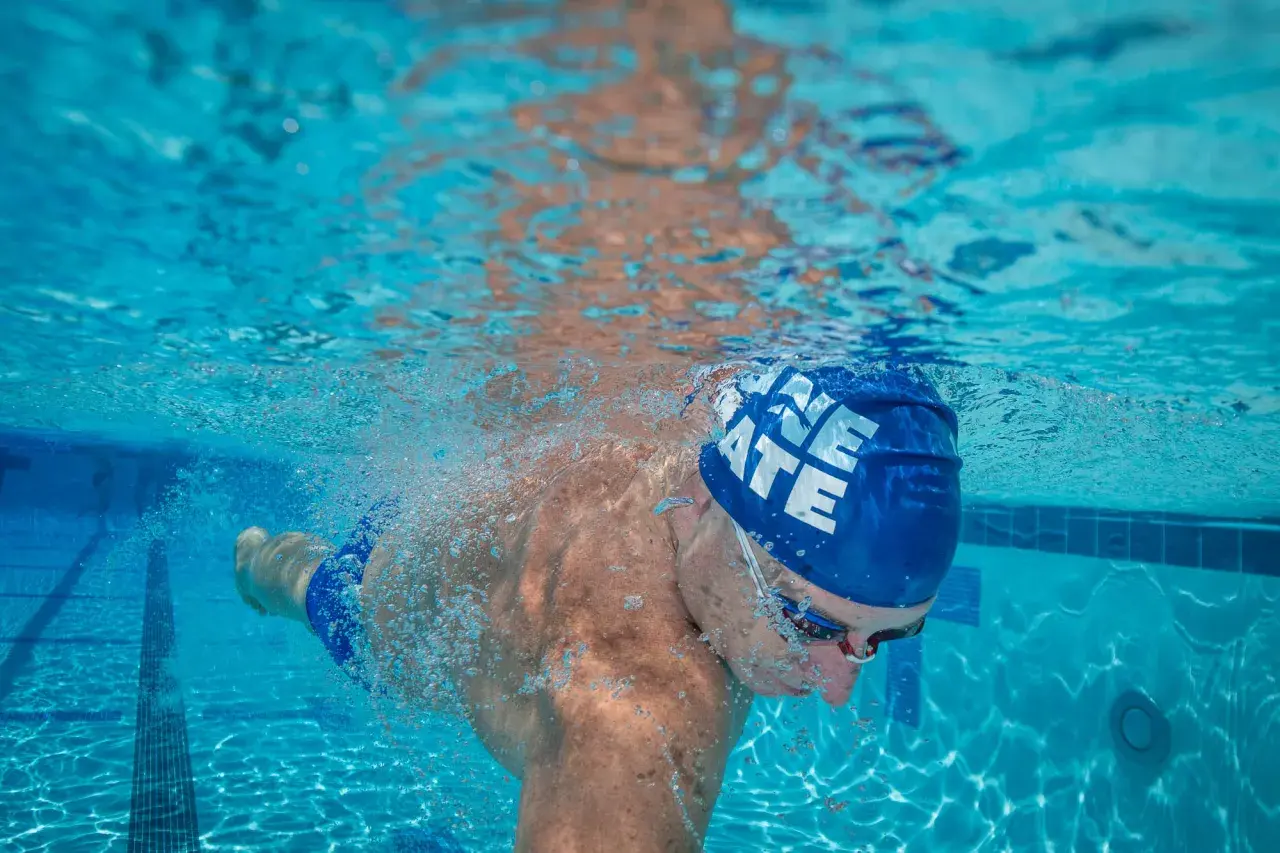
The phrase swimmer lats points to more than a big back; it points to the muscles that help a swimmer hold shape, finish the pull, and protect the shoulders under repeat load. In practical terms, that means better stroke control, better body line, and fewer surprises when the volume climbs. In this article, I break down what the latissimus dorsi actually does in the water, how to train it without creating shoulder problems, and what to watch for when swim health starts to slip.
The lats matter most when they work with the shoulder, not against it
- The latissimus dorsi drives much of the underwater pull in freestyle, backstroke, and butterfly.
- Strong lats help only when scapular control, rotator cuff strength, and mobility are also in place.
- Pain, pinching, or a limited overhead reach usually means the back muscles need a better balance of load and recovery.
- Pull-ups, pulldowns, rows, and straight-arm work transfer well when they are done with clean mechanics.
- Mobility and recovery are part of the training plan, not an afterthought.
What the lats actually do in the water
The latissimus dorsi is a broad back muscle that runs from the lower trunk toward the upper arm. In swimming, it helps with shoulder extension, adduction, and internal rotation, which is why it matters so much during the pull phase. I think of it as one of the main engines behind a strong catch, but not the only one. The serratus anterior, lower trapezius, rotator cuff, and trunk all have to do their part if the stroke is going to feel smooth instead of forced.
That matters because different strokes ask for slightly different work from the same muscle. Freestyle and backstroke want the lats to help anchor the catch and finish the underwater pull. Butterfly asks for a more forceful, rhythmic contribution. Starts, turns, and underwater dolphin work also lean on the lats for body tension and streamlining.
| Stroke or skill | How the lats contribute | What usually goes wrong |
|---|---|---|
| Freestyle | Helps drive the pull and keeps the arm connected to the torso | The catch collapses early and the swimmer loses pressure on the water |
| Backstroke | Supports a long, controlled underwater pull with stable shoulders | The arm slips too early and the body rolls without useful force |
| Butterfly | Assists the down-and-back pull that links the stroke together | The upper body becomes sloppy and the rhythm breaks down |
| Starts and turns | Helps lock in streamline tension and transfer force through the trunk | The body line leaks and push-off power disappears |
Once you see the lats as a force-transfer muscle instead of just a “back muscle,” the next question is obvious: when does that strength help, and when does it start creating problems?
Why strong lats help and why bigger is not always better
When the lats are strong and coordinated, the swimmer usually gets a more solid pull, better shoulder stability, and a cleaner finish to each stroke. That is especially useful in high-volume training, where the same overhead pattern repeats thousands of times. Strong lats can help spread the load across a larger muscle group instead of dumping everything into smaller tissues around the shoulder.
But I would not chase size for its own sake. A swimmer can have impressive lat strength and still struggle if the shoulder blades do not move well or the front of the shoulder gets crowded during the catch. If the lats dominate while the serratus anterior, lower trap, and rotator cuff lag behind, the shoulder can start to feel pinched, heavy, or irritated after hard sets.
In other words, the best outcome is not “more lat” at any cost. The best outcome is a back that creates force without stealing mobility from the rest of the stroke. That trade-off shows up fast in real swimming, which is why I pay close attention to symptoms before I ever add more load.
How to tell whether your lats are helping or holding you back
Healthy lat development usually feels like better connection in the water, not just more soreness in the gym. The swimmer feels a stronger catch, a steadier torso, and less wasted movement during the pull. When the muscles are doing their job well, they are quiet most of the time.
| What you notice | What it often means | What I would do next |
|---|---|---|
| Strong pull with stable shoulders | The lats and shoulder stabilizers are working together | Keep the current balance and monitor volume |
| Tightness under the armpit after hard sets | Normal fatigue, or the first sign of overload | Check recovery, stroke volume, and dryland intensity |
| Pinching at the front of the shoulder | The shoulder is taking too much stress during the catch | Reduce intensity and look at technique and scapular control |
| One side feels much stronger | An asymmetry is building | Add unilateral work and check body roll or breathing pattern |
| Limited overhead reach | Mobility or lat stiffness is restricting the shoulder | Use mobility work and reduce aggressive overhead loading |
If the discomfort is sharp, persistent, or changes the way you swim, lift, or sleep, I would not try to “train through it.” At that point, the problem is no longer just muscle adaptation. The more useful fix is usually a better mix of loading, technique, and recovery, which is where dryland work comes in.

Dryland exercises that actually carry over to the pool
I like dryland work that looks simple on paper and feels precise in practice. Pull-ups, pulldowns, rows, and straight-arm cable work all have a place because they train the lats through patterns swimmers already use, but with more room to control posture and tempo. The goal is not to win the gym session. The goal is to make the next swim stroke cleaner.
| Exercise | Why it helps swimmers | Common mistake |
|---|---|---|
| Pull-ups or assisted pull-ups | Build vertical pulling strength and trunk tension | Kipping, shrugging, or rushing the rep |
| Lat pulldowns | Useful when you need load without full bodyweight demand | Pulling behind the neck or yanking the bar down |
| Straight-arm pulldowns | Trains the lats with a more stroke-like arm path | Overarching the lower back to fake range |
| One-arm cable rows | Helps clean up left-right differences | Rotating the torso to cheat the pull |
| Dumbbell pullover | Can build long-range lat control if the shoulders tolerate it | Going too deep or letting the ribs flare |
For programming, I usually keep one heavier pulling movement in the 4 to 6 rep range and one or two controlled accessory drills in the 8 to 12 rep range. If a swimmer is already in the water six or seven days a week, two clean dryland sessions are usually enough. More volume is not automatically better when the shoulders are already carrying a large pool load.
The rule I use is simple: if the exercise improves stroke mechanics and does not leave the shoulders noisy the next day, it earns its place. That naturally leads to the part many swimmers underdo, which is mobility and recovery.
Mobility and recovery that keep swim health intact
Tight lats are not always a bad sign. Sometimes they are just tired. The problem starts when stiffness limits overhead reach, blocks scapular motion, or forces the lower back to do work the shoulder should handle. That is when a strong back can quietly become a less useful back.
In practice, I want swimmers to cover three things outside the pool: a short warm-up before training, enough mobility to keep the shoulder moving well, and real recovery after hard sets. A few minutes of thoracic extension, lat stretching, and scapular activation can change how the next session feels. It is not glamorous work, but it matters.
- Before practice, use dynamic arm circles, wall slides, and light band pull-aparts.
- After practice, use a controlled lat stretch, a doorway pec stretch, and easy breathing to settle the rib cage.
- On heavy weeks, reduce dryland volume before pain turns into a pattern.
- Keep rotator cuff work in the program so the shoulder stays centered under load.
That balance matters because the big back muscles and the smaller stabilizers are partners, not replacements for each other. When the larger muscles get all the attention, the shoulder usually ends up paying the price. The final step is turning all of this into something you can actually use week to week.
The fastest way to build better lats without upsetting the shoulder
If I were building a swimmer’s back from scratch, I would keep the formula boring and honest: one vertical pull, one horizontal pull, one mobility habit, and one recovery check. That is enough to build useful strength without turning the shoulders into a problem. The cleanest gains usually come from repetition, not from chasing novelty.
The real target is not to feel your back more in the gym. The target is to pull the water better, stay stable through the stroke, and show up to the next practice ready to do it again. When the lats are strong, mobile enough, and balanced by the rest of the shoulder complex, they become a performance asset instead of a source of friction. That is the version of swim health I trust.