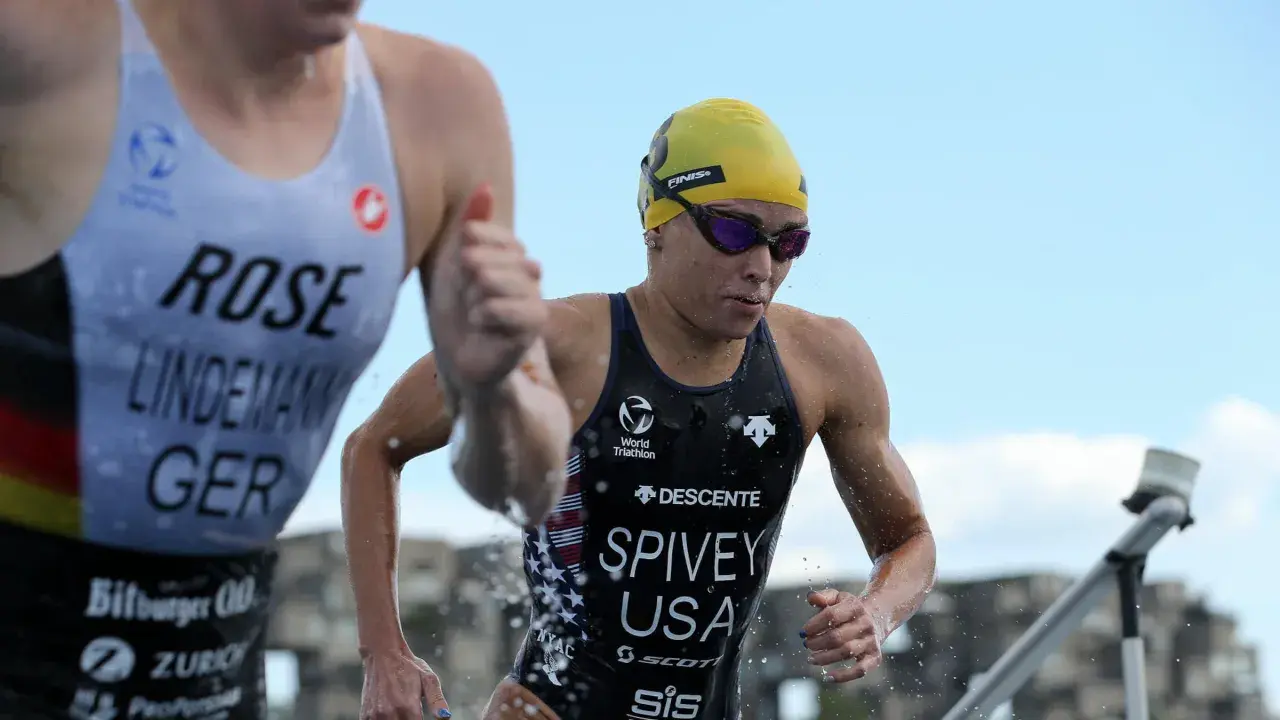
Taylor Spivey is a strong example of how a swimmer can evolve into a complete triathlete without losing the water instincts that separate good competitors from dangerous ones. Her career spans surf lifesaving, collegiate swimming, WTCS podiums, a mixed relay silver in Paris, and a 2026 season that still shows top-end speed. What matters most is not the headline results alone, but the pattern behind them: strong swim execution, clean transitions, and enough tactical discipline to stay in the front group when the pace gets ugly.
Key facts that frame her profile
- Born and raised in California, she moved from surf lifesaving and collegiate swimming into elite triathlon.
- Her biggest asset has always been the swim, but her results show real depth across all three disciplines.
- She won mixed relay silver at the Paris Olympic Games and has been a regular top-tier WTCS finisher.
- World Triathlon lists 119 starts, 25 podiums and 4 wins, which is elite consistency by any standard.
- In 2026, she remained a factor in both WTCS and T100 racing, which is unusual and important.
Why her swim background matters in triathlon
USA Triathlon notes that she came through surf lifesaving before moving into triathlon, and that background still shows up in how she races. Surfers, lifeguards and open-water swimmers learn to read chop, stay relaxed when the field is crowded, and tolerate contact without wasting energy. Those are not glamorous traits, but they are exactly what separate a smooth elite swim from a chaotic one.
What I find useful about that pathway is how well it translates to triathlon. A strong swim does more than save time; it reduces panic, lets the athlete choose better lines into transition, and often decides whether the bike leg begins in a winning group or in damage-control mode. For a swimmer entering triathlon, that is the first lesson: raw speed matters, but so does water IQ.
Her college years at Cal Poly matter for a different reason. Distance freestyle work builds economy, rhythm and patience, while surf-lifesaving builds aggression and adaptability. Put those together and you get an athlete who can move between steady control and race intensity without looking surprised by either. That balance is the real foundation of her triathlon identity, and it leads straight into the way she handles race dynamics.
The race style that keeps her in the front group
I would describe her racing style as controlled pressure. She does not need every leg to be perfect; she needs the swim to be sharp, the first transition to be tidy, and the bike to stay honest enough that stronger runners cannot simply reorganize the race later. In short-course triathlon, that is often enough to remain relevant all day.
| Race element | What it demands | Why it fits her profile |
|---|---|---|
| Opening swim | Fast pacing, body positioning, and contact tolerance | Her surf-lifesaving and swim background make crowded starts less costly |
| Transition | Decision speed and calm execution | Swim-led athletes often gain free seconds here if they stay composed |
| Bike leg | Drafting discipline and repeatable power | She races well when the bike is tactical rather than purely destructive |
| Run off the bike | Durability and pain management | Her recent results show enough run quality to stay in podium conversations |
The limitation is just as important as the strength. A swim advantage only buys so much if the run fades badly. That is why I think her own evolution is interesting: she has never behaved like a one-dimensional swimmer who happened to add biking and running. She has had to become more complete, because elite triathlon punishes specialization faster than most fans realize.
The results that built her reputation
The easiest way to understand her standing is to follow the progression. Her resume is not built on one breakout day; it is built on years of proof that she belongs in high-level fields, especially when the race is fast and technical.
| Period | Milestone | Why it mattered |
|---|---|---|
| 2017 | First WTS podium at Leeds and World Cup silver medals in Madrid and Miyazaki | Showed she could compete with the best on the biggest short-course stages |
| 2018 | First World Cup win in Weihai and mixed relay silver in Edmonton | Confirmed that she could finish races, not just hang on in them |
| 2019 | Fourth overall in the World Triathlon Series | Marked her as a genuine season-long contender, not a one-off podium athlete |
| 2024 | Mixed relay silver in Paris | Validated her value in championship pressure and team racing |
| 2026 | Top-10 WTCS results and a third in T100 Spain | Showed that she remains relevant across both short-course and longer formats |
The reason this matters is simple: in endurance sport, reputation follows repeated evidence. One good race can be noise. A decade of top finishes is signal. That is why she keeps showing up in conversations about the best American women in the sport, and why her 2026 results deserve attention rather than being treated as a late-career footnote.
What the 2026 season says about her ceiling
The 2026 picture is especially telling. Her results across the WTCS included a fifth in Samarkand, eighths in Yokohama and Alghero, and a fourth in Hamburg, which pushed her to seventh in the world ranking. That is the kind of season that matters because it is not built on a single lucky course or a single fast day; it is built on stability.
There is also a strategic layer here that I think many fans miss. Competing well in both WTCS, the top short-course circuit, and T100, the longer-format pro series, requires real adaptation. Short-course racing rewards punch, positioning and split-second moves. T100 asks for patience, steady power and enough durability to survive a longer bike-run grind. Very few athletes can look credible in both. When someone does, it usually means the training base is broad and the decision-making is mature.
Her 2026 results suggest a ceiling that is still high, but not abstractly high. The next step is not just more fitness. It is better closing speed, better run resistance after hard bike pressure, and fewer gaps between her best swim and the rest of the race. That is the difference between being a perennial top-10 athlete and being someone who can convert more of those finishes into podiums.
What swimmers and triathletes can copy from her approach
If I were coaching a swimmer moving into triathlon, I would not copy her volume blindly. I would copy the way her background supports race-specific habits. That is where the value really is.
- Train open-water calm, not just pool pace. You need sighting, contact tolerance and breathing control under pressure.
- Protect the first 300 to 500 meters. A fast start matters, but only if it gets you into the right group without detonating the rest of the swim.
- Practice transitions like skills, not chores. The seconds are small, but the mental rhythm they create is huge.
- Build run durability after the bike. Swim strength can hide weaknesses for a while, but podiums are usually decided on the run.
- Use mixed training with intent. Threshold swims, short surges and brick sessions should all solve a race problem.
These are not elite-only ideas. Age-group triathletes benefit from them even more because most of them lose time in exactly the same places: the first minutes of the swim, a messy transition, and the first kilometer of the run after the bike. Her career is a reminder that swimming skill still has strategic value, but only when it is connected to the rest of the race.
Why she still matters for the next Olympic cycle
The main reason I still pay attention to her is that she represents a very modern version of triathlon success. She is not the purest runner, and she does not need to be. She is the athlete who can make the water count, stay tactically alive on the bike, and then produce enough late-race quality to stay in the mix when medals are decided.
For readers who care about swimming performance, that is the useful takeaway. The swim is not isolated from the rest of the race; it is the part that shapes almost everything that comes after it. Her career shows what happens when elite swim ability is turned into race leverage instead of being treated as a standalone talent. That is why her profile still feels relevant in 2026, and why it will probably stay relevant as the next Olympic cycle unfolds.
