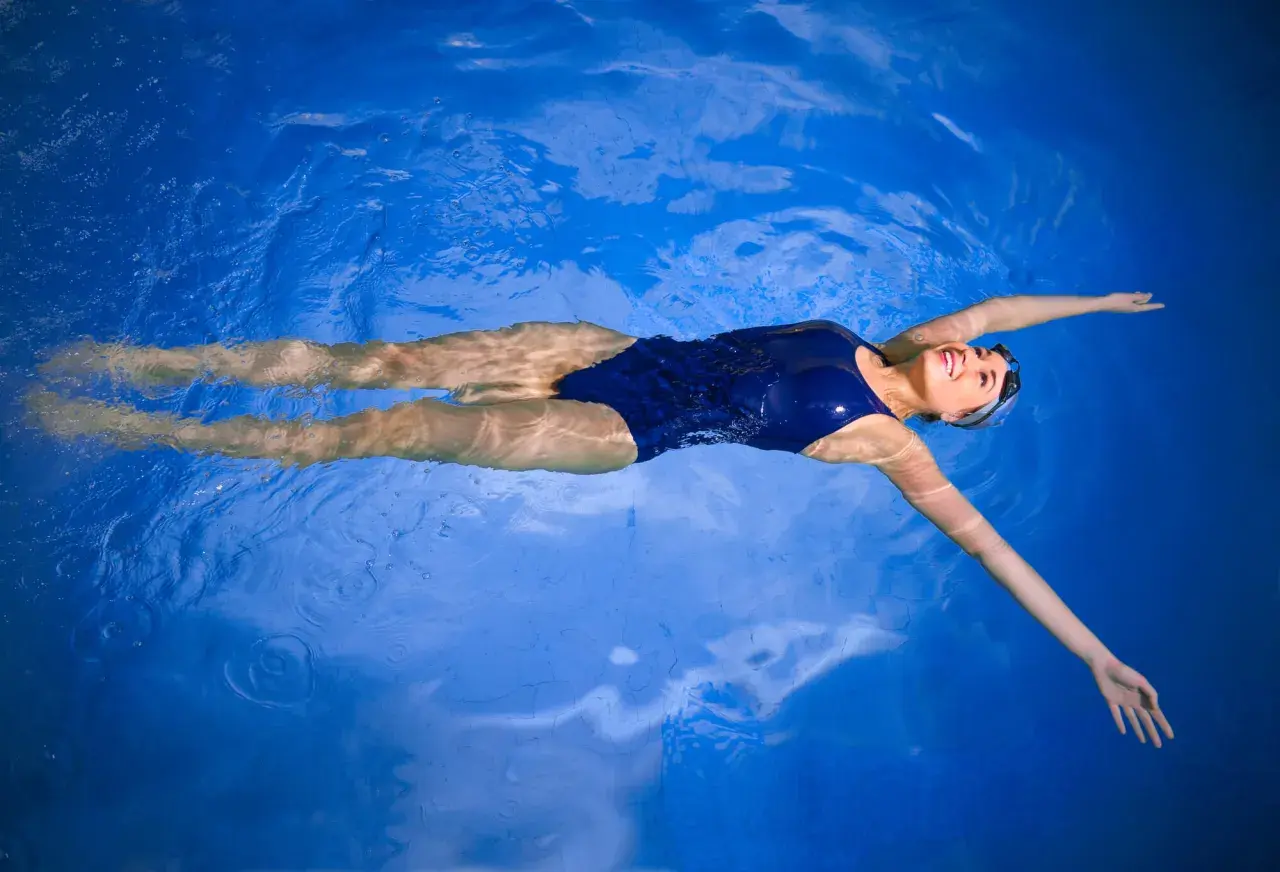
Water does not reward effort in the same way land does. Floating is a mix of physics, body position, breathing, and calm, which is why two people can enter the same pool and have very different experiences. Can everyone float? The practical answer is that most people can learn a usable float, but not every body stays high in the water without technique.
What decides whether you stay on the surface
- Buoyancy comes from the water you displace, not from trying harder.
- A relaxed inhale usually helps more than muscle tension; empty lungs work against a float.
- Saltwater is denser than freshwater, so the sea usually feels easier to float in.
- Body shape, body fat, and how you distribute your weight all change the position you settle into.
- For safety, a back float is the most useful version to learn first in the pool.
What actually makes a body float
When I break floating down, I start with density. Your body floats when the water pushing up on you is enough to balance your weight, and that balance changes with the amount of air in your lungs, your body composition, and the kind of water you are in. In simple terms, more air and less dense tissue mean more buoyancy.
Freshwater is usually about 1,000 kg/m3, while seawater is around 1,025 kg/m3. That difference sounds small, but it is enough to make the sea noticeably easier to float in than a lake or a pool. A calm inhale also matters because air in the lungs lowers your average body density for a short time.
| Factor | What it does | Practical effect |
|---|---|---|
| Lung volume | More air lowers average density | A calm breath can lift the chest and hips |
| Body fat | Fat is less dense than water | Higher body-fat levels often make natural floating easier |
| Muscle and bone | Denser tissues add mass without much extra volume | Very lean or muscular swimmers may sit lower in the water |
| Water type | Saltwater is denser than freshwater | The sea gives more lift than a pool or lake |
| Clothing and kit | Neoprene and trapped air add buoyancy | Wetsuits can make a float easier, especially outdoors |
The other piece that beginners miss is the difference between your centre of mass and your centre of buoyancy. The centre of mass is where your weight effectively sits; the centre of buoyancy is where the upward force of the displaced water acts. When those two points do not line up neatly, the body rotates until it finds a stable position. That is why some swimmers naturally feel feet-heavy even when they are, technically, floating.
Once the physics makes sense, the next question is why floating feels easy for some people and surprisingly awkward for others.
Why some people float easily while others sink lower
In practice, I do not see floating as a fixed talent. I see it as a moving result of body type, breath control, tension, and water conditions. The same swimmer can float better on one day and worse on another if they are cold, tired, nervous, or breathing shallowly.| What helps | What makes it harder | What I usually tell swimmers to do |
|---|---|---|
| Relaxed breathing | Panic or breath-holding | Exhale slowly, then take a calm breath before settling |
| Head back with ears in the water | Chin lifted high | Keep the face neutral and let the water support the head |
| Open limbs and a broad shape | Tight legs and rigid shoulders | Spread out to improve stability |
| Saltwater or a wetsuit | Freshwater or heavy clothing | Expect the float to feel different and adjust your balance |
| Good breath control | Shallow, rushed breathing | Use breathing drills on deck or at the wall first |
The RNLI’s current advice is refreshingly direct: your legs may sink, and that is still a valid float. That matters because many swimmers assume floating has to look like a perfect star shape, when in reality a workable float can be slightly uneven and still keep your airway clear. I think that point removes a lot of unnecessary shame from the learning process.
That leads naturally to the skill side of the question: if floating is not identical for everyone, how do you practise it without fighting the water?
How to find a stable float without fighting the water
I prefer to teach the back float first. It keeps the mouth and nose out of the water, which lowers panic and gives you time to feel how your body settles. A front float has value too, but it asks more from your breathing control and is less forgiving for beginners.
- Start in shallow water where you can stand comfortably.
- Take one calm breath and relax your neck, shoulders, and jaw.
- Lean back until your ears are in the water and your eyes are looking up.
- Open your arms and legs slightly to widen your base of support.
- If you begin to tip, use small hand movements to scull rather than kicking hard.
- Stand up slowly, reset, and repeat for short holds of 5 to 15 seconds.
Once that feels familiar, the next step is not more effort. It is understanding how floating changes the way your swim strokes behave.
What floating means for your strokes and efficiency
Floating skill and stroke skill are closer than most swimmers realise. If your body sits well in the water, every stroke has less drag to overcome. If your hips drop or your head pops up too high, you create extra resistance and waste energy on every length.
| Stroke | What buoyancy changes | Common mistake |
|---|---|---|
| Freestyle | Higher hips reduce drag and make the catch cleaner | Lifting the head to breathe and dropping the legs |
| Backstroke | A relaxed head and hips help you stay long and flat | Over-arching the back and pressing the chest too high |
| Breaststroke | Timing matters more than raw float | Holding the head high for too long and losing the glide |
| Butterfly | Core control keeps the body line from collapsing | Sinking during the recovery and fighting for every breath |
In my experience, the swimmers who improve fastest are the ones who stop treating floating as a separate trick and start treating it as part of alignment, breathing, and balance. That is also why a short float drill often fixes stroke problems more effectively than another hard set of lengths. The only time I change the message is when safety, not technique, is the real issue.
When floating is not enough
Floating is a skill, not a guarantee. Cold water, panic, waves, currents, heavy clothing, and fatigue can all overwhelm even a strong swimmer. In the UK, cold water is the big one to respect: water below 15°C can affect breathing and movement very quickly, which is why a back float is a survival skill, not just a pool exercise.
The RNLI’s advice in that situation is simple: turn onto your back, keep your ears in the water, relax, and use small movements only if you need them to stay afloat. That buys you time to recover your breathing and decide the next move. If you are in the sea, call 999 or 112 and ask for the Coastguard; inland, call 999 or 112 and ask for Fire and Rescue.- A tow float helps visibility and gives you something to grab, but it is not a substitute for learning to float.
- A buoyancy aid or wetsuit can help in open water, especially when conditions are cold or choppy.
- If someone else is struggling, shout reassurance and call for help rather than rushing in.
Once the safety frame is clear, the most useful next step is a simple pool routine that turns floating from an idea into a repeatable skill.
A small pool routine that builds real floating confidence
Here is the routine I would use with a beginner who wants practical progress without overthinking it:
- At the wall, take 5 slow breaths and lengthen the exhale.
- Push off gently and hold a back float for 5 to 10 seconds.
- Repeat the float 3 times, widening the arms each round.
- Practise a tiny scull with the hands while staying relaxed.
- Roll from a front float onto your back, then recover by standing up.
- Finish with one easy glide in streamline, watching how your body line changes.
That session is short on purpose. Floating confidence comes from repeating calm positions, not from forcing long holds and hoping the body cooperates. So, can everyone float? In a functional sense, most people can learn to rest, recover, and stay safe in the water, but the way they do it will not look identical. The real skill is not looking perfect; it is staying calm enough to let buoyancy do its job.
