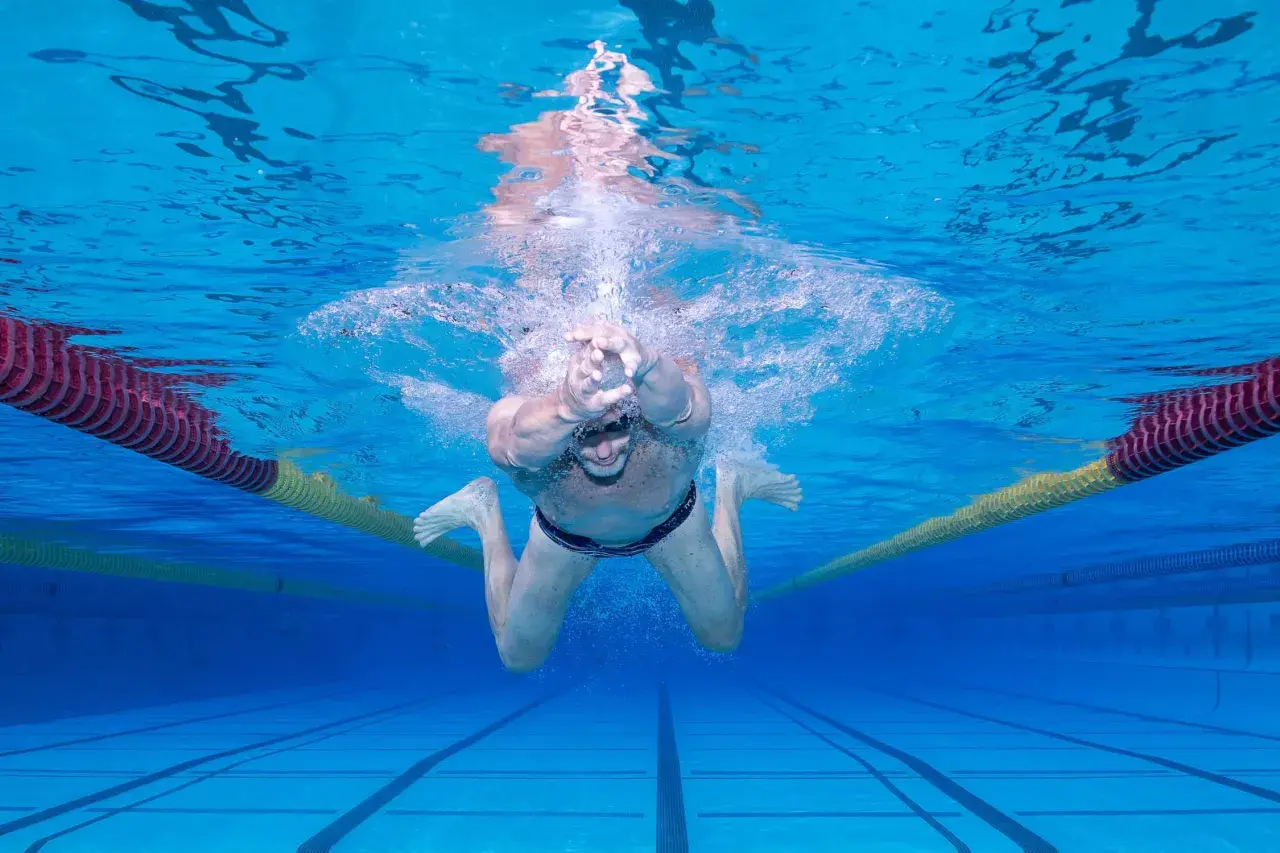
Breaststroke rewards precision more than brute force. The breast stroke is usually the easiest to recognize and one of the easiest to get slightly wrong, because a small timing error can turn a smooth cycle into a stop-start grind. In this article I focus on the movement pattern, the kick, the legal race details, and the drills that actually clean the stroke up.
The main ideas to keep in mind before you get in the water
- Keep the cycle compact: pull, breathe, recover, kick, and settle.
- The kick drives a large share of the speed, so foot angle and recovery shape matter.
- Race legality depends on symmetry, especially the two-hand touch and matched leg action.
- A short glide helps; a dead stop usually hurts.
- Short technical sets usually fix problems faster than long, sloppy laps.
What makes this stroke different from the others
Unlike freestyle or backstroke, breaststroke is built on symmetry. Both arms recover together, both legs kick together, and the body moves in a repeating pulse rather than a constant churn. I like to think of it as a stroke that asks for discipline: if the head, hands, and feet are not finishing the same job at the same time, the water punishes you immediately. Once the rhythm is clear, the stroke becomes much easier to trust.
For race swimmers, the legal side matters too. The body stays on the breast, the touch at the wall is made with both hands together, and the underwater phase is tightly controlled. That legal frame is not just for officials; it shapes how the whole stroke feels, especially off the start and after turns. When that foundation is solid, the details of timing become much easier to fix.
Unlike the breast stroke many beginners imagine as a slow glide, efficient swimming is really a compact rhythm: pull, breathe, recover, kick, and settle. If one part hangs around too long, the whole cycle gets heavy.
Once the rhythm is clear, the next step is learning how to keep it legal and efficient under race rules.
The sequence that keeps you moving without stalling
When I coach this stroke, I break it into five beats: pull, breathe, recover, kick, settle. The trick is not to let any one beat take over the others. The pull creates room to breathe, the recovery gets the hands back into a streamlined line, and the kick finishes the cycle with real propulsion. The settle should be brief and controlled, not a full pause.
- Pull. Keep the hands under the chest and avoid sweeping so wide that the elbows collapse.
- Breathe. Let the head rise just enough to inhale; the shoulders should not climb with it.
- Recover. Shoot the hands forward fast and clean, because a slow recovery drags the whole stroke down.
- Kick. Turn the feet out and sweep back, then finish with the legs together.
- Settle. Ride the line for a moment, then start the next pull before momentum fades.
In U.S. competition, USA Swimming still allows one butterfly kick after the start and each turn before the first breaststroke kick, and the head has to break the surface by 15 meters. That is why the pullout matters so much: it is one of the few places where a legal, clean underwater shape can buy obvious speed.
From there, the kick becomes the real limiter, and that is where I see the biggest technical gains when swimmers are willing to get specific.
Why the kick decides most of the speed
The kick is the part I spend the most time fixing, because it gives away or recovers speed faster than anything else. Coaches often say it is the engine of the stroke, and that is fair, but the more useful truth is that it is also the easiest place to lose water. If the heels do not come up cleanly, the feet do not turn out, or the snap finishes downward instead of backward, the whole cycle slows immediately.
Here are the cues I rely on:
| Common kick issue | What it usually means | Better cue |
|---|---|---|
| Knees flare too wide | The recovery is built around the knees, not the heels | Bring the heels toward the seat first, then let the knees open only as much as needed |
| Feet stay pointed down | The soles are not catching enough water | Turn the feet out before the snap and finish with the legs together |
| The kick splashes upward | The legs are pushing down instead of back | Sweep back and squeeze the water, not the surface |
| Hips drop after the breath | The kick is late or the head stays up too long | Recover the hands fast and return the chest forward sooner |
The rule of thumb I use is simple: the kick should feel compact, not violent. If it feels like a bicycle motion or a frog kick with a big pause in the middle, it is probably leaking speed.
That leads directly to the mistakes I see most often in pool after pool.
Common mistakes I see again and again
The most common problems are rarely exotic. They are usually small habits that repeat every length until they become normal.
- Chasing a long glide. A short line is useful; a dead stop is not. If the glide lasts too long, the next pull has to restart the body from zero.
- Lifting the head too high. You only need enough air to breathe comfortably. When the head climbs, the hips usually sink behind it.
- Pulling too wide. A wide sweep looks powerful, but it often creates drag instead of speed. The hands should stay organized under the chest.
- Finishing the kick late. If the hands start the next pull before the legs finish, the stroke loses its shape and the timing falls apart.
- Training tired technique. Once the stroke gets sloppy, more yards only rehearse the error.
One practical test I use: if your stroke count rises by more than one or two per 25 yards while the pace stays the same, the technique is breaking down somewhere. That is usually the moment to shorten the repeat, not to push through and hope for the best.
The fastest way to fix those habits is to build a small, repeatable drill set that rewards the correct rhythm.
A practical pool session that builds better mechanics
I prefer short technical sets for this stroke because quality disappears quickly once fatigue builds. A useful session does not need to be long; it needs to be clean enough that every repetition reinforces the same body line.- 4 x 25 easy kick on your back, 20 seconds rest. Focus on heel recovery and a tight finish.
- 4 x 25 pull-breathe-recover with no board, 20 seconds rest. Keep the head low and the hands fast.
- 6 x 25 full stroke, 15 seconds rest. Hold the same tempo on every repeat and keep the glide brief.
- 4 x 50 moderate pace, 25 seconds rest. Count strokes and stop if the count starts drifting upward.
If you like to use gear, short fins can help a swimmer feel body line and ankle position in drill work, but I would not let them replace actual kick training. That is especially true for breaststroke, where the feet and lower legs have to learn the exact turning and sweep that create propulsion.
When the set starts falling apart, I would rather cut the distance in half than let bad movement become the new normal. That is usually the difference between practice that changes the stroke and practice that only makes you tired.
From there, the final step is deciding which correction deserves your attention first.
The small changes I would make first
If I had one session to improve a swimmer, I would start with three things: lower the breath, sharpen the kick recovery, and shorten the pause after the kick. Those changes usually clean up the stroke faster than trying to add more power to the arms.
After that, I would check two race details: the two-hand touch and the pullout. They are easy to overlook in training, but they matter when the stroke has to survive under pressure and still stay legal. Once those pieces are stable, speed becomes a much more realistic goal because the body is no longer fighting its own timing.
That is the point of the whole stroke: not to look busy, but to move with enough symmetry and rhythm that every part supports the next one. If you keep the cycle compact and honest, the stroke gets smoother, the kick feels more useful, and the water starts doing more of the work for you.