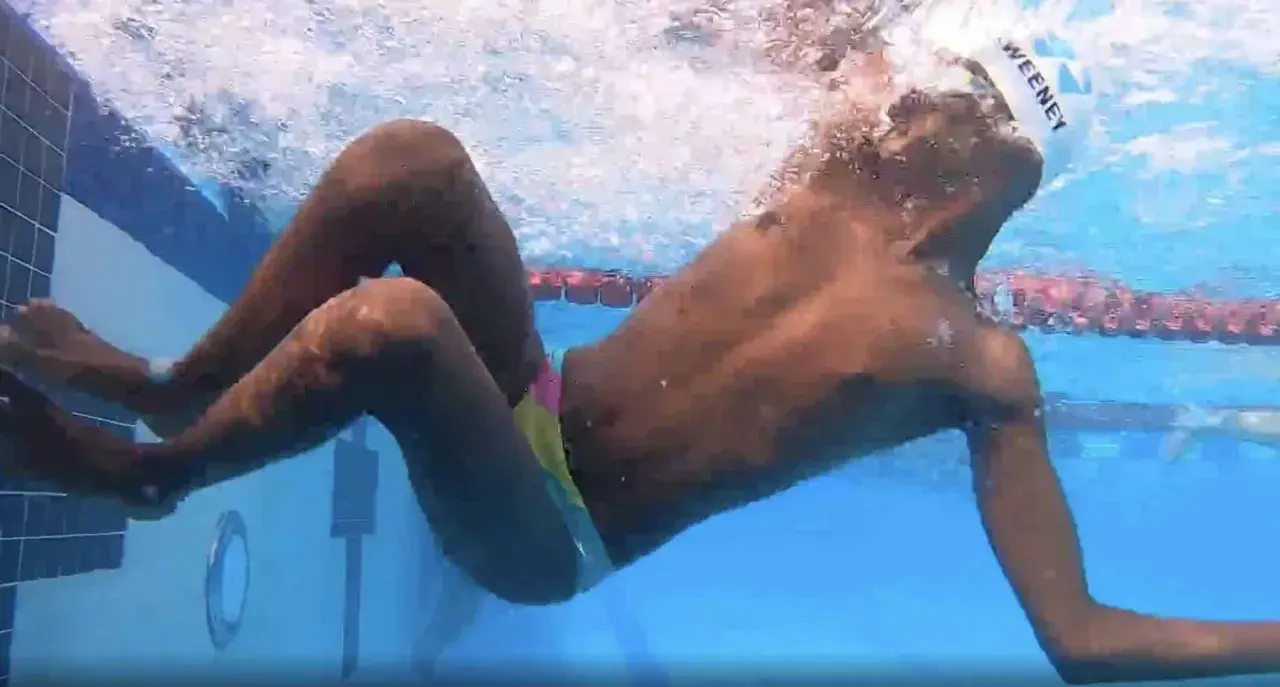
Breaststroke is the stroke that most directly answers what is a breast stroke: a chest-down style built on a simultaneous arm pull, a frog-like kick, and a glide that only works when the timing is clean. It looks calm from the deck, but it is one of the most timing-sensitive strokes in the pool, which is why small mistakes show up fast. I wrote this guide to make the movement, the rules, and the practical fixes easy to see in one place.
Breaststroke works best when pull, kick, and glide stay in sync
- Breaststroke uses both arms together and both legs together, then a short glide.
- The usual rhythm is pull, breathe, kick, glide.
- In U.S. racing, breaststroke events are commonly 50, 100, and 200 yards or meters.
- The stroke is technically simple to recognize, but timing is what makes it fast or slow.
- For competition, swimmers stay on the breast and finish with a two-hand touch.
What breaststroke actually is
Breaststroke is the swimming stroke where the swimmer stays on the chest, moves both arms together, and uses both legs together. The standard rhythm is pull, breathe, kick, glide. That last glide is the reason the stroke feels so different from freestyle or backstroke: you are not trying to keep constant motion going at all times, you are trying to build a burst of speed and then carry it efficiently.In casual lap swimming, many people keep the head higher because it feels easier to breathe and sight. In race swimming, that habit usually creates too much drag. I treat breaststroke as a stroke of restraint: the best swimmers do not look busy, they look economical. That makes the stroke very learnable, but not especially forgiving, which brings us to the mechanics.
How the stroke works from pull to glide
The arm pull
The arms begin from a streamlined position, then sweep outward and inward in a controlled path. The useful part of the pull is the inward sweep, because that is where the hands hold water and move the body forward. If the hands travel too wide or too deep, the swimmer wastes energy and often lifts the upper body too much.
The whip kick
The breaststroke kick is often called a whip kick, which is a simple way to describe how the legs snap around and back together. The feet turn outward, the heels draw in, and then the legs press back to finish with a tight squeeze. The power should come from a compact, clean whip, not a bicycle motion. When the kick gets too wide, the knees feel it and the swimmer usually loses speed.The breath
Breathing happens during the pull, not before it. The head rises just enough to inhale, then settles again as the arms recover and the kick finishes. The goal is to keep the neck quiet and the hips high. If the head shoots up too early or stays up too long, the body angle tilts and the water starts winning the argument.
Read Also: Sidestroke Swimming - Master This Essential Water Skill
The timing
The classic rhythm is pull, breathe, kick, glide. That sequence matters more than force, because breaststroke slows down quickly when the arms and legs work against each other. I often tell swimmers to think in terms of one clean action at a time: the pull sets up the breath, the kick finishes the power phase, and the glide carries the result forward. When those parts overlap too much, the stroke feels stuck.Once you can name those four pieces, it becomes much easier to practice the stroke on purpose rather than just surviving each length.
How I would teach it to a beginner
- Start in a long, face-down streamline and get comfortable staying flat in the water.
- Practice the kick first: draw the heels in, turn the feet outward, then snap the legs together.
- Add a compact arm pull and let the breath happen as the hands come in, not before the stroke starts.
- Connect the pull and kick so the arms recover while the kick finishes the drive forward.
- Insert a short glide, then shorten it again if your speed drops too much before the next pull.
For drills, a kickboard can isolate the kick, a center-mount snorkel can keep the head still while you work on timing, and short fins can help you feel where the feet and ankles should be. Those tools help, but they do not fix a broken rhythm for you, so I would always use them as feedback rather than as a shortcut.
When the basics are stable, the next thing to clean up is usually the biggest sources of drag.
The mistakes that slow breaststroke down
| Mistake | What it does | Better cue |
|---|---|---|
| Head lifting too high | Sinks the hips and breaks the body line | Take a quick breath and let the chest rise, not the neck |
| Pulling too wide | Adds drag and usually slows the recovery | Keep the pull compact and finish the inward sweep cleanly |
| Kicking like a bicycle | Wastes power and can irritate the knees | Draw the heels in, turn the feet out, and snap the legs together |
| Gliding too long | Momentum dies before the next stroke starts | Glide only until the speed begins to fade |
| Arms and legs drifting out of sync | Makes the stroke feel choppy and inefficient | Keep the rhythm as pull, breathe, kick, glide |
Most of these fixes are not glamorous, but they matter because breaststroke punishes unnecessary movement. A smaller, cleaner stroke almost always beats a bigger one that looks powerful from the deck. If the kick starts to hurt the knees, the first thing I would check is width and turnout, not effort.
To see why those fixes matter, it helps to compare breaststroke with the other competitive strokes.
How breaststroke compares with the other race strokes
| Stroke | Movement pattern | Breathing | Main advantage | Main tradeoff |
|---|---|---|---|---|
| Breaststroke | Simultaneous pull and kick with a glide | Easy to fit into the cycle | Controlled, readable, and rhythm-based | Very sensitive to timing and drag |
| Freestyle | Alternating arms with a flutter kick | Side breathing | Fastest and usually most efficient | Requires more continuous coordination |
| Backstroke | Alternating arms on the back | Natural breathing | Open chest and easy ventilation | Orientation and wall approach can feel awkward |
| Butterfly | Simultaneous arms with dolphin kick | Breath timed to the recovery | Powerful and rhythmic | Most demanding over distance |
That comparison matters because breaststroke is not simply the “slow” stroke; it is the stroke that rewards control and punishes poor sequencing more than the others. Once you know that, the race rules feel less arbitrary.
What race rules matter most in the pool
In U.S. competition, breaststroke has a few non-negotiables. The swimmer stays on the breast, the arms and legs move simultaneously, and the race finishes with a two-hand touch. The feet must turn outward during the propulsive part of the kick, and after the start and each turn, a single dolphin kick is allowed before the first breaststroke kick. That rule matters mainly for competitive swimming, but it also explains why legal technique looks so specific.
- The stroke cycle is one arm pull and one leg kick in that order.
- Both arms move together, and both legs move together.
- The touch at the wall must be made with both hands simultaneously.
- The swimmer must remain on the breast throughout the race, aside from the legal turn and start actions.
- The kick finishes with the feet turned outward during the propulsive part of the motion.
If you are only swimming laps, you do not need to obsess over every race detail, but you should still borrow the same clean lines: a quiet head, a tight kick, and a glide that does not stall.
What matters most if you want faster breaststroke
If I had to reduce breaststroke improvement to one sentence, it would be this: make the stroke smaller before you make it stronger. The biggest gains usually come from reducing drag, tightening the kick, and improving the moment when the breath happens. Most swimmers try to force more speed by adding more motion; the better move is usually to remove the waste.
That is why breaststroke rewards patient practice. When the timing is right, the stroke looks smooth, the breathing feels easy, and the pool gives you back more of the effort you put in. When the timing is off, no amount of extra pull usually saves it.