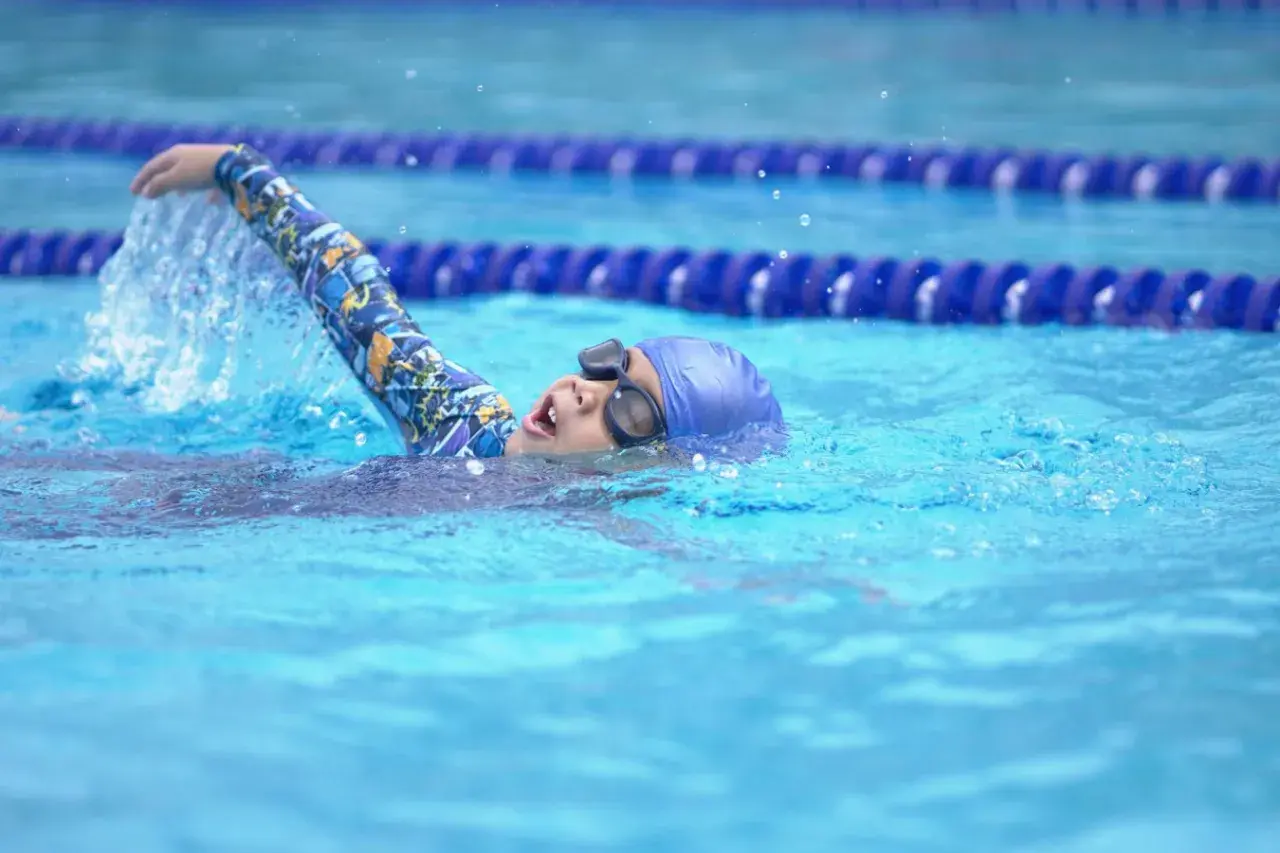
What matters most before you practise sidestroke
- Keep the body long and lightly rolled, not twisted at the waist.
- Make the scissors kick compact and decisive, because wide openings create drag.
- Let one arm do the main work while the other stays quiet and organised.
- Take the breath without lifting the head high, or the hips will sink.
- Practise both sides so the stroke stays usable, not just familiar on one side.
Why sidestroke still deserves a place in training
In a modern pool session, sidestroke is rarely the fastest choice, but that is not the point. It gives you a way to move without spiking your breathing rate, which makes it useful for recovery lengths, open-water confidence, lifeguard-style skills, and swimmers who want a gentler option for part of a workout. I also like it for beginners who panic when they feel out of breath, because the stroke gives them time to settle instead of rushing them into a tight breathing pattern.
There is also a simple skill benefit that people underestimate: sidestroke teaches you to control body line while one side of the body is doing more work than the other. That balance carries over into better rotation awareness, steadier kicking, and cleaner movement in the water. If you have seen combat side stroke tutorials, treat them as a variation rather than the baseline; the classic version is enough to build the core skill first. Once that idea clicks, the mechanics become much easier to learn.
The stroke mechanics you need to get right
The easiest way to learn sidestroke is to stop thinking of it as one big movement. I teach it in four parts: position, pull, kick, and glide. If those pieces are clean, the stroke feels smooth; if one piece is rushed, the whole thing starts to fight you.

Body position
Start by lying long on one side with the body slightly rolled, not collapsed. I want the head relaxed, the neck free, and the hips close to the surface so the line stays quiet. The goal is not to sit upright in the water; it is to keep enough roll for breathing and arm movement while still staying streamlined. If your chest and hips twist in different directions, the stroke immediately gets messy.
Arm action
One arm does the useful work while the other stays organised near the side of the body. The working arm reaches, pulls, and finishes near the rib cage before returning with control. The resting arm is not dead weight; it helps keep the body shape tidy and ready for the next cycle. When swimmers overdo the pull, they usually try to make up for poor body line with more force. That is the wrong trade-off. A clean pull beats a hard pull every time.
The scissors kick
The scissor kick is the engine of the stroke, and it works best when it is compact. Open the legs just enough to load the kick, then close them with intent so the legs snap together and the body glides forward. Think of it as a reset, a load, and a close, not a big splashy kick cycle. If you open too wide, the kick starts acting like a brake. If you close too softly, you lose the drive that carries you through the glide.
Read Also: Combat Sidestroke - Master This Survival Swim Technique
Breathing and rhythm
Breathing should feel natural, not forced. You should not need to jack the head up just to find air. I prefer to breathe during the stable part of the cycle, then return to a long line before the next pull. A good rhythm feels almost unhurried: reach, pull, close, glide. If the stroke feels frantic, the fix is usually to slow the timing down, not to add more power.
Once those parts are clear in your head, the next step is to practise them in short pieces instead of trying to master the whole stroke in one go.
Drills that make the movement stick
Short repeats are the fastest way to build sidestroke skill. In a 25 m pool, I would rather see six tidy lengths than one long, tired effort with good intentions and poor shape. The drills below break the stroke into pieces so you can feel what each part is doing.
- Side balance kick, 4 x 10 m each side, 15 seconds rest. Keep one arm extended and the other resting by the thigh. This teaches you how to stay calm on one side before you add the full arm cycle.
- Lead-arm pull with kick, 4 x 10-15 m each side, 20 seconds rest. Pull once, close the kick, then glide for a beat. This shows you whether the pull and kick are actually connected.
- Three-part rhythm drill, 4 x 15 m. Count “reach, pull, kick” out loud in your head. It sounds simple, but it stops swimmers from rushing through the stroke as if speed alone would fix the timing.
- Whole-stroke repeats, 6 x 25 m. Swim at a pace where the body line stays clean. If the stroke starts breaking down, cut the repeat short and reset. Practising bad reps teaches the wrong habit faster than most people realise.
A small pair of fins can help you feel the line in the water, especially when you are learning the kick, but I would not start with a pull buoy because it hides the leg action you are trying to build. With the pattern in place, it becomes much easier to spot what is going wrong.
Common mistakes that slow swimmers down
Most sidestroke problems come from drag, not lack of effort. That is useful news, because drag is usually easier to fix than strength. When the stroke feels awkward, I look for one of the mistakes below first.
| Mistake | What it does | Better correction |
|---|---|---|
| Lifting the head to breathe | Hips drop and the body line breaks | Keep the head relaxed and let the body roll enough for the breath |
| Opening the scissors kick too wide | The legs create more resistance than propulsion | Make the opening smaller and the closing sharper |
| Rushing the arm recovery | The stroke feels busy but goes nowhere | Finish the pull, reset the line, then move forward again |
| Twisting at the waist | Balance disappears and the kick loses power | Rotate as one unit from the core and hips |
| Only practising one side | The weaker side becomes unreliable when you need it | Split your practice evenly between both sides |
If you fix just one thing first, fix the body line. A cleaner line removes drag, and once drag drops, the stroke suddenly feels easier without any extra force. That is the point where it helps to compare sidestroke with the other strokes you already know.
How sidestroke compares with freestyle and breaststroke
People often ask whether sidestroke is worth learning if they already swim freestyle and breaststroke. My answer is yes, but for different reasons. It is not a replacement for your main stroke. It is a useful extra skill that gives you breathing control, a recovery option, and a calmer way to keep moving when the session is long or the water feels less predictable.
| Stroke | Breathing feel | Main advantage | Main limitation | Best use |
|---|---|---|---|---|
| Sidestroke | Calm and flexible | Easy head control and low-stress movement | Slower than front crawl | Recovery, rescue skills, relaxed open water |
| Freestyle | Rhythmic but demanding | Fastest practical lap stroke | Breathing can raise effort quickly | Distance, speed, general conditioning |
| Breaststroke | Predictable and symmetrical | Good pacing and clear sightline control | Can become draggy if the timing is off | Steady pool swimming and moderate-tempo sets |
In a UK leisure centre, I would usually keep sidestroke for recovery lengths, skill work, or sessions where I want variety without losing control of breathing. If the goal is pure speed, freestyle still wins. If the goal is stable tempo and symmetry, breaststroke is usually easier to sustain. Sidestroke sits neatly between them as a practical, low-drama skill stroke. That makes it worth building into a real session rather than leaving it as an old-fashioned curiosity.
A 20-minute practice set you can use in a UK pool
Most UK pools are 25 m, which makes sidestroke practice easy to structure. I like short, repeatable sets because they keep the stroke honest. You want enough volume to learn the rhythm, but not so much that your form collapses and you start rehearsing mistakes.
- 4 x 25 m easy side balance, 15 seconds rest.
- 4 x 25 m lead-arm pull plus scissors kick, 20 seconds rest.
- 4 x 25 m whole sidestroke on your stronger side, 20 seconds rest.
- 4 x 25 m whole sidestroke on your weaker side, 20-30 seconds rest.
- 2 x 25 m easy freestyle or backstroke to reset the shoulders.
If the pool is busy, halve the set and keep the order the same. I would rather see two clean lengths than eight messy ones. If the water feels crowded or the lane pace is uneven, use the session to protect rhythm rather than chase volume. That approach is what makes the skill reliable when you actually need it.
The few habits that make sidestroke reliable when it matters
The biggest improvement usually comes from three habits: practise both sides, keep the kick compact, and stop the moment the stroke starts to unravel. That last part matters more than most swimmers expect. Once timing goes, sidestroke quickly turns into effort without shape, and shape is what keeps the stroke efficient.
My rule is simple. If you can swim several 25 m lengths with the same calm breathing and the same body line on both sides, you have the core of the skill. From there, you can make it smoother, faster, or more endurance-based, but the foundation is already there. Build that foundation first, and the stroke becomes a real tool instead of a novelty.