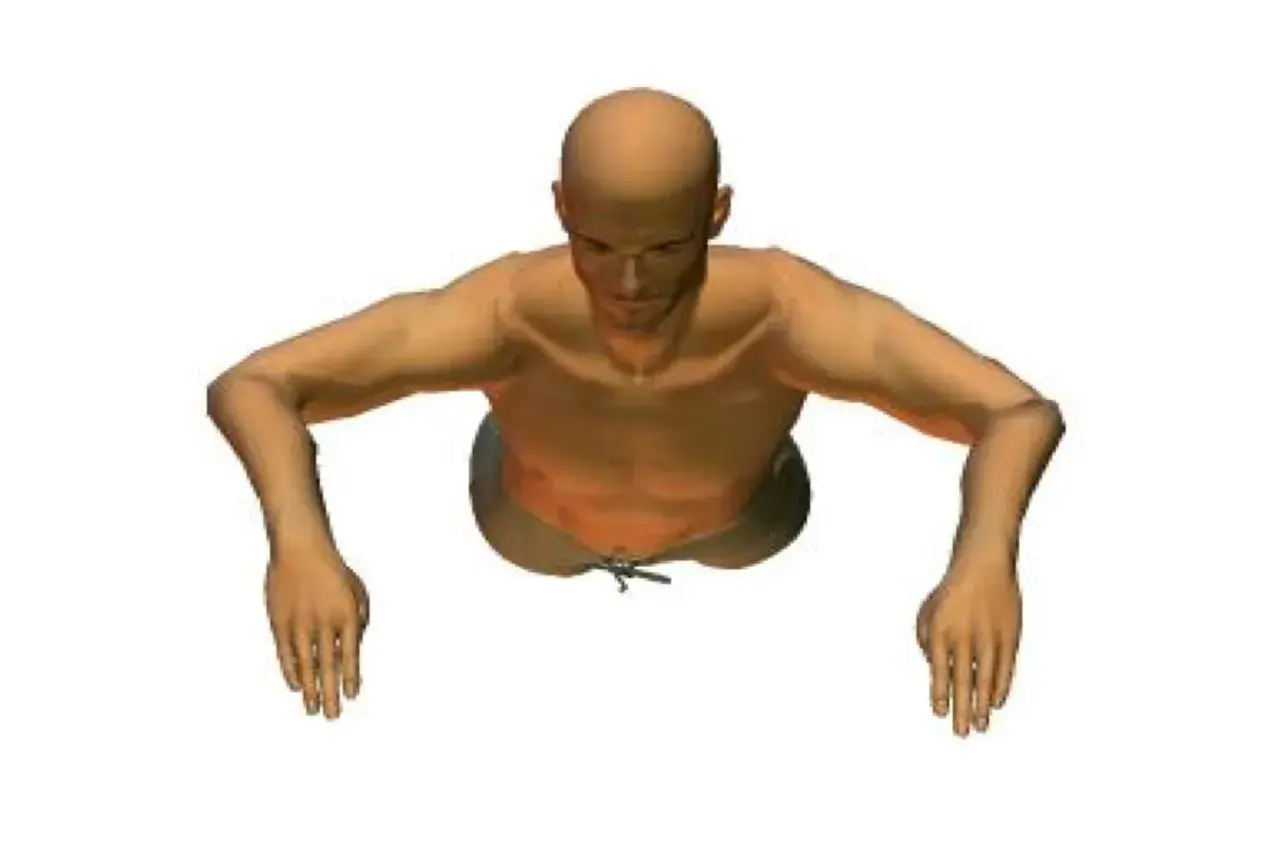
Good butterfly arm action is less about forcing the water and more about holding pressure on it from entry to recovery. The arm action most swimmers mean when they talk about butterfly arms is what I break down here: how the hands enter, how the pull finishes, how the recovery stays efficient, and how the timing locks to the kick and breath. Whether you're in a UK club session or training on your own, those details decide whether the stroke feels smooth or exhausting.
The essentials in one glance
- Hands enter about shoulder-width apart, with the elbows slightly higher than the hands.
- The underwater pull works best as a smooth three-part sweep, not a hard downward yank.
- The recovery should stay close to the surface so the hips do not sink.
- Most swimmers get better rhythm from two kicks per arm cycle.
- The breath belongs near the end of the pull, and the face should be back down before the next entry.
- Big improvements usually come from timing and shape, not from trying to pull harder.
What the arm action is really doing in butterfly
Good butterfly arms are there to keep pressure on the water and keep the body moving forward, not to yank the swimmer up and down. When the hands enter cleanly and the forearms start holding water early, the stroke feels organised; when the hands dive too deep or too wide, everything else gets harder. I usually tell swimmers that the goal is not to lift themselves with brute force but to create a continuous line of support through the water.
That matters because butterfly is built on rhythm. The body rises, the hands catch, the chest breathes, the arms recover, and the second kick keeps the hips near the surface. If any one of those pieces breaks, the whole stroke starts to feel expensive.
The arm cycle, phase by phase
I find it easier to coach the arm cycle in four parts.
Entry and catch
The hands enter roughly shoulder-width apart, usually with the thumbs going in first. The elbows stay soft and a little higher than the hands so the forearms can start pressing on water almost immediately. A wide entry looks powerful, but it often wastes energy and puts extra stress through the shoulders.
Outsweep and in-sweep
The hands sweep out and then back in toward the midline, creating a shallow Y shape before turning inward again. This is where the swimmer should feel support, not a sudden jerk. If the hands move too fast here, the stroke turns into a splashy lunge instead of a controlled pull.
Finish
The final part of the pull drives the hands back past the ribs and toward the hips. That is the point where the body gets the cleanest forward push, so I do not want swimmers cutting it short. Ending the pull early is one of the simplest ways to lose speed without noticing why.
Recovery
The arms leave the water and swing forward together, staying relaxed but purposeful. The best recoveries are not exaggerated; they skim close enough to the surface that the hips stay high and the next entry does not have to rescue a sinking body. A loose recovery is good, but a sloppy one usually means the stroke has already fallen apart.
Once the shape is sound, the real test is whether the arms can work with the kick and breath rather than against them.
How the pull, kick, and breath stay in sync
The arm action only works properly when the timing is honest. A common coaching cue in Swim England teaching is to take the breath as the hands are in the propulsive phase, meaning the part of the pull that actually drives you forward, then return the face to the water before the next entry. That keeps the head from hanging high and lets the body stay closer to the surface.
The rhythm most swimmers handle well is two kicks per cycle: one as the hands begin to press and the chest rises, and a second as the hands exit and recover. The first kick helps the hands drive water backward; the second kick helps the arms come forward without the hips dropping. If the kicks disappear, the arms suddenly have to do all the work, and the stroke gets heavy fast.Breathing every stroke can be useful in short repeats or when you are still learning the pattern, but it is not always the most efficient choice for longer efforts. Breathing every two strokes is often easier to sustain, while some swimmers breathe every three cycles in shorter races or use a mix depending on the pace.
Common mistakes that make butterfly feel heavy
Most poor arm action comes from trying to force speed in the wrong place. The table below shows the errors I see most often and the correction that usually works first.
| What goes wrong | What it feels like | What to change |
|---|---|---|
| Hands enter too wide | The shoulders feel stretched and the pull loses line | Bring the entry back to shoulder width and keep the elbows softly bent |
| Elbows drop too early | The swimmer feels like they are pressing down instead of holding water | Keep the forearms angled to the water and let the hands sweep, not sink |
| The pull is rushed | The stroke feels splashy but not powerful | Slow the outsweep slightly and finish the press all the way back |
| The head comes up too early | The hips sink and the recovery gets harder | Breathe later, then return the face down before the hands re-enter |
| The recovery is stiff | The shoulders tighten and the next catch feels late | Recover with loose shoulders and a controlled arc just above the water |
There is also a subtle mistake that coaches sometimes miss: a swimmer may be technically moving the arms correctly, but with no body rise underneath them. When that happens, the pull never gets a usable anchor, so the stroke feels flat no matter how hard the swimmer works. Fixing the timing usually solves that faster than adding strength work.
Drills that make the stroke cleaner without overloading your shoulders
When I want to improve the arm mechanics without exhausting the swimmer, I prefer short technical work over long full-stroke sets. Six to 10 controlled strokes, repeated for a few rounds, usually gives better feedback than a 25-metre repeat done at survival pace.
- Single-arm butterfly: this slows the stroke enough to feel the catch, the finish, and the recovery on one side at a time.
- Three kicks, one pull: useful when the rhythm breaks down, because it separates body wave from arm timing without removing the kick completely.
- Front scull with butterfly body position: this helps swimmers feel pressure on the water before they try to race the stroke.
- 2-2-1 rhythm work: two strokes, two kicks per stroke, then one full stroke to rebuild timing under control.
If a swimmer is new to the stroke, I also like alternating drill and swim lengths. That keeps the session technical instead of turning every repeat into a fight. For stronger swimmers, short race-pace bursts of 8 to 12.5 metres can be more useful than endless whole lengths, because the arm path stays crisp while fatigue is still manageable.
The first fixes I would make when the stroke starts falling apart
When butterfly falls apart, I start with the entry and finish before I touch the recovery. A clean shoulder-width entry gives the stroke shape; a complete finish gives it propulsion; and only then does the recovery start to matter. If you fix the recovery first, you can make the stroke look smoother without actually making it faster.
My usual order is simple: tighten the entry, keep the elbows higher through the pull, breathe later, and restore the two-kick rhythm. That sequence works because it solves the biggest energy leaks first. Once those are in place, the stroke usually becomes easier to repeat and easier to pace across a whole length.
The quickest sign that things are improving is not dramatic speed. It is the feeling that each cycle has less dead space, less shoulder strain, and fewer moments where you have to rescue the stroke with brute force. When that happens, the arms are finally doing their job instead of fighting the rest of the body.