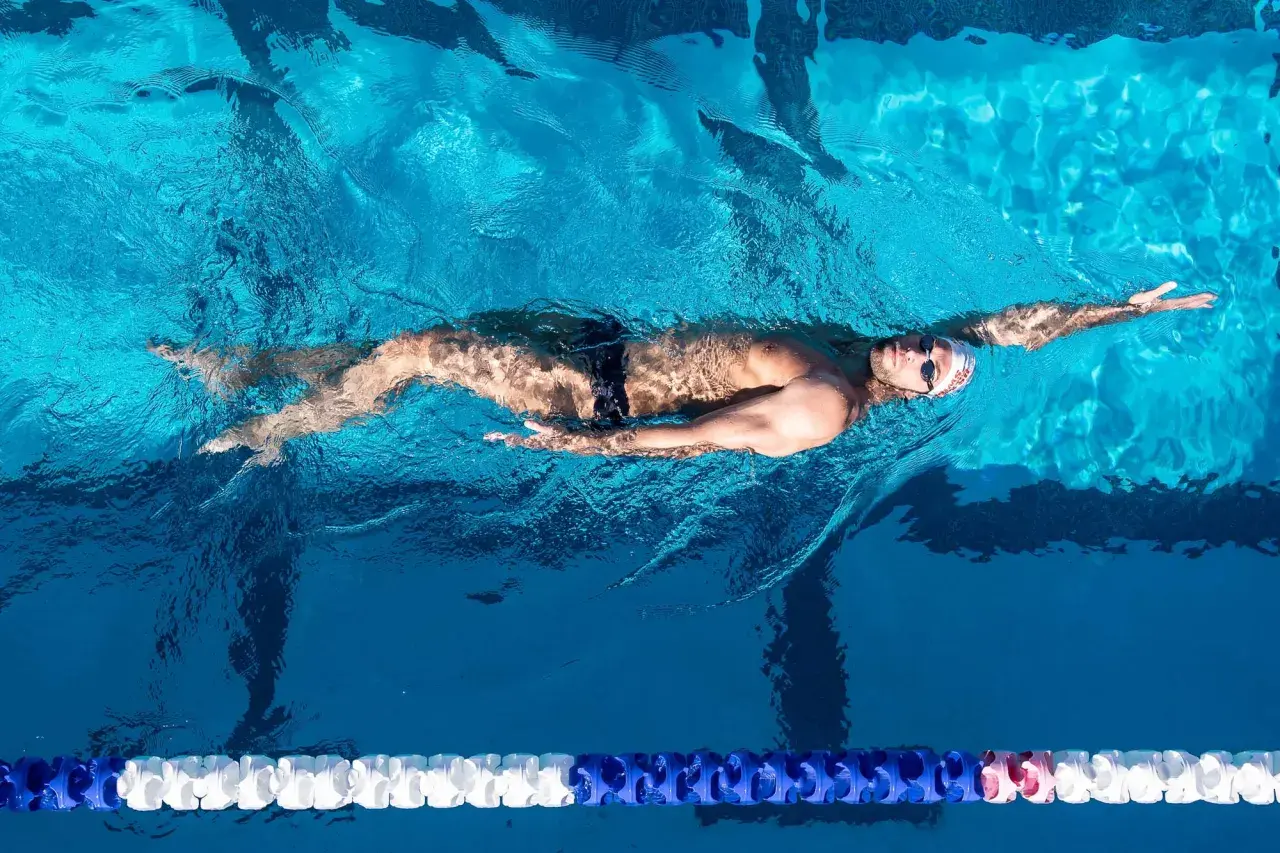
A strong backstroke swimmer looks relaxed from the deck, but the stroke is built on very specific habits: a stable body line, a disciplined pull, a tight kick, and turns that do not leak speed. In UK club swimming, those details matter because backstroke rewards control as much as raw fitness, and the race is often decided by what happens between the flags and the wall. This article breaks down the technique, the race phases, the mistakes I see most often, and the gear and drills that actually help.
The essentials in one glance
- Body position comes first. If the hips sink or the head lifts, everything else gets harder.
- The pull should find pressure early. Wide, loose arm paths waste effort and slow the stroke down.
- The kick is a stabiliser and a finisher. It keeps the body high and supports the pull rather than replacing it.
- Starts and turns are not extras. In racing, they can decide more than a whole length of surface swimming.
- Underwater work matters. In major competition, the underwater phase is limited to 15m after the start and each turn.
- Small technical fixes beat random volume. Clean reps and shoulder-friendly strength work produce better gains than simply swimming more.
Why backstroke feels different from freestyle
The simplest way I explain it is this: you are still moving fast, but you lose visual control of the lane and have to replace it with balance and rhythm. That changes the whole skill set. Swim England coaching notes keep coming back to the same priorities: a flat body line, a still head, and relaxed neck tension. If any one of those slips, the stroke starts to feel heavy very quickly.
Backstroke is also unforgiving in a slightly odd way. You can breathe freely, which makes it feel easier, but that freedom can tempt swimmers to lift the head or rush the shoulders. I prefer to think of it as a stroke that needs calmness before power. When the body stays organised, the arms and legs can do their job without fighting drag.
| Feature | What changes in backstroke | Why it matters |
|---|---|---|
| Breathing | The face stays out of the water, so breathing is continuous. | It removes panic, but it also makes head position easier to spoil. |
| Line of sight | You swim without looking forward. | Lane control has to come from body awareness and ceiling markers, not sight. |
| Rotation | The shoulders and hips roll around a quiet head. | That roll creates power without forcing a long, tiring arm swing. |
| Kick role | The flutter kick mainly supports balance and speed maintenance. | A weak kick lets the hips sag and makes the pull less effective. |
Once that balance is clear, the next step is the actual stroke mechanics, because the difference between average and fast is usually hidden in the details of how the hands and feet work together.

The technical cues that make the stroke faster
When I watch a backstroke specialist, I am usually checking three things first: body line, catch quality, and kick timing. The stroke can look smooth even when one of those is off, so you need cues that are specific enough to catch the problem before it becomes a habit.
Body line
The body should sit high in the water with the hips close to the surface and the chest steady. A slight slope down toward the hips is fine, but a broken line is not. I want the head quiet, the neck loose, and the eyes fixed upward rather than searching around the pool. If the chin lifts, the hips usually drop a beat later.
One useful check is simple: if the water is climbing onto the face or the thighs are dragging, the line has gone. That is not a fitness problem first. It is a position problem.
The pull and recovery
Backstroke is not about throwing the arms around. The hand should enter cleanly, the body should rotate enough to help the catch, and the forearm should find pressure early. As the hand moves through the pull, I want to see it work back toward the hip rather than sweep out wide. That is where propulsion lives.
On the recovery, the arm comes out in a controlled path, with the shoulder rolling naturally and the hand re-entering cleanly. Swim England’s backstroke coaching material puts a lot of emphasis on this phase, and for good reason: the recovery can look glamorous, but the pull is where the speed comes from.
The kick and rhythm
The kick is small, fast, and annoyingly easy to exaggerate. A huge splash usually means wasted energy, not extra speed. I like a tight flutter kick with loose ankles and a clean hip drive. In sprint work, many swimmers settle into a six-beat rhythm per arm cycle, but the best cadence depends on the distance and the swimmer’s body type.
If the legs are doing too much work, the upper body usually loses shape. If the kick is too soft, the hips sink. The right answer sits in the middle: enough leg action to keep the body high and stable, not so much that the stroke turns into survival work.
Once these cues are clean, the race phase becomes much easier to manage, because the wall work finally has something solid to build on.
Where races are won at the start, turn and finish
Backstroke is one of the few events where the race begins in the water, and that changes the whole rhythm. World Aquatics rules are clear: the swimmer starts in the water, continues on the back, and must finish by touching the wall while on the back. The underwater phase is also capped at 15m after the start and after each turn, so a clean breakout is not optional if you want to race well.
In a 25m pool, the walls matter even more than many swimmers realise. In a 50m pool, the surface rhythm gets a little more room to breathe, but the start and turn still set the tone. I tell club swimmers that backstroke is not only a stroke, it is a sequence of controlled transitions.
| Race phase | What good swimmers do | What it changes |
|---|---|---|
| Start | Set the feet firmly, keep the hips loaded, and launch with a tight streamline. | Creates the first burst of free speed without extra strokes. |
| Underwater | Stay narrow, keep the kick compact, and break out before the 15m mark. | Preserves the fastest part of the race while staying legal. |
| Turn | Rotate smoothly, keep the motion continuous, and push off in a stable line. | Protects speed through the wall instead of killing momentum. |
| Finish | Count strokes from the flags and keep the chest steady to the touch. | Prevents the late, awkward glide that costs places. |
If the start is loose, the turn is rushed, or the finish is guessed, even good surface swimming will not save the race. That is why the next thing I look at is not effort, but the errors that quietly drain speed.
The mistakes that slow good swimmers down
Most backstroke problems are not dramatic. They are small habits that repeat every length until the swimmer assumes they are just “how the stroke feels”. They are not. They are usually fixable in a few focused sessions if you know what to look for.
| Mistake | What it does | What to do instead |
|---|---|---|
| Lifting the head to look forward | The hips sink and the body loses its long, fast line. | Keep the head still and use ceiling markers or lane lines for awareness. |
| Overreaching across the centre line | The shoulder gets stressed and the pull loses a clean path. | Enter in line with the shoulder and build pressure earlier in the catch. |
| Kicking from the knees with too much splash | Energy disappears into turbulence instead of forward motion. | Kick from the hips with loose ankles and a smaller, quicker action. |
| Gliding into the wall on turns | The transition becomes slow and the push-off loses force. | Keep the turn compact and continuous so the wall becomes a launch, not a pause. |
| Guessing the finish | The swimmer shortens the stroke or reaches awkwardly at the end. | Count strokes from the backstroke flags and keep the rhythm to the touch. |
None of these fixes requires heroic effort; they require more accurate repetition. That is why I prefer drills with clear feedback before I add more volume, and why a little useful kit can help when it supports the stroke instead of distracting from it.
Drills and gear that build speed without adding noise
When I put together backstroke work, I want three things from the session: better position, a cleaner feel for pressure, and a stroke that survives fatigue. The right drills do that without turning practice into random hard swimming. The wrong ones just add noise.
Pool drills
- Single-arm backstroke. This helps isolate the catch and shows whether the body roll is helping or hurting the stroke.
- Fist backstroke. Swimming with closed fists forces the forearm to feel pressure earlier, which sharpens the catch.
- Six-kick switch work. This is useful for timing the rotation so each arm has a clean entry and exit.
- Sculling on the back. Short sculls build sensitivity for water pressure, which matters more than people think.
- 15m breakout repeats. These train the underwater line and help the swimmer feel where the legal limit sits.
A very simple example session looks like this: 6 x 25m single-arm, 6 x 25m full stroke, and 4 x 15m breakout reps with full focus on body tension. That is enough to expose weak points without burying the swimmer in fatigue.
Shoulder-friendly dryland work
- Band external rotations. Good for shoulder stability when used with control, not speed.
- Y-T-W raises. These support upper-back strength and cleaner shoulder mechanics.
- Dead bugs and hollow holds. A stable trunk keeps the hips from swinging around in the water.
- Thoracic mobility work. Better upper-back rotation usually means a smoother, less forced stroke.
If the shoulders are irritated, I would reduce paddle work before I add more. Backstroke punishes poor mechanics faster than many swimmers expect, so strength work should support the stroke rather than inflame it.
Read Also: Phelps Butterfly - Real Speed Secrets & What to Copy
Kit that earns its place
- Low-profile goggles. Backstroke is easier when the fit stays secure and the view upward stays clear.
- Short-blade fins. These are useful for body position and kick rhythm without turning the legs into the main engine.
- Well-fitted cap. This reduces drag slightly and keeps the hair from becoming another source of resistance.
- Small paddles, used carefully. They can help a stable catch, but they are a poor substitute for better alignment.
When those pieces support the main work instead of replacing it, training stays simple and the stroke gets faster for the right reasons. At that point the final job is not to keep adding more, but to decide what matters most over the next few weeks.
What I would prioritise over the next four weeks
If I were helping a club swimmer sharpen backstroke quickly, I would follow a clear order. First, I would clean the body line. Second, I would improve the catch and kick timing. Third, I would make the start, underwater, and turn more deliberate. Only after that would I push harder race-pace work.
- Week 1. Film 25m swims, then fix head position and hip height before anything else.
- Week 2. Add short technique sets, such as 6 x 25m drills with generous rest and strict form.
- Week 3. Put more attention on walls: starts, push-offs, and 15m breakout control.
- Week 4. Blend the stroke back into pace work, but only if the position stays clean under pressure.
If I had to choose one priority, it would still be body line. Once the hips stay high and the head stops wandering, the pull, kick, and race skills fall into place much faster. That is the difference between a backstroke specialist who looks busy and one who actually travels well through the water.