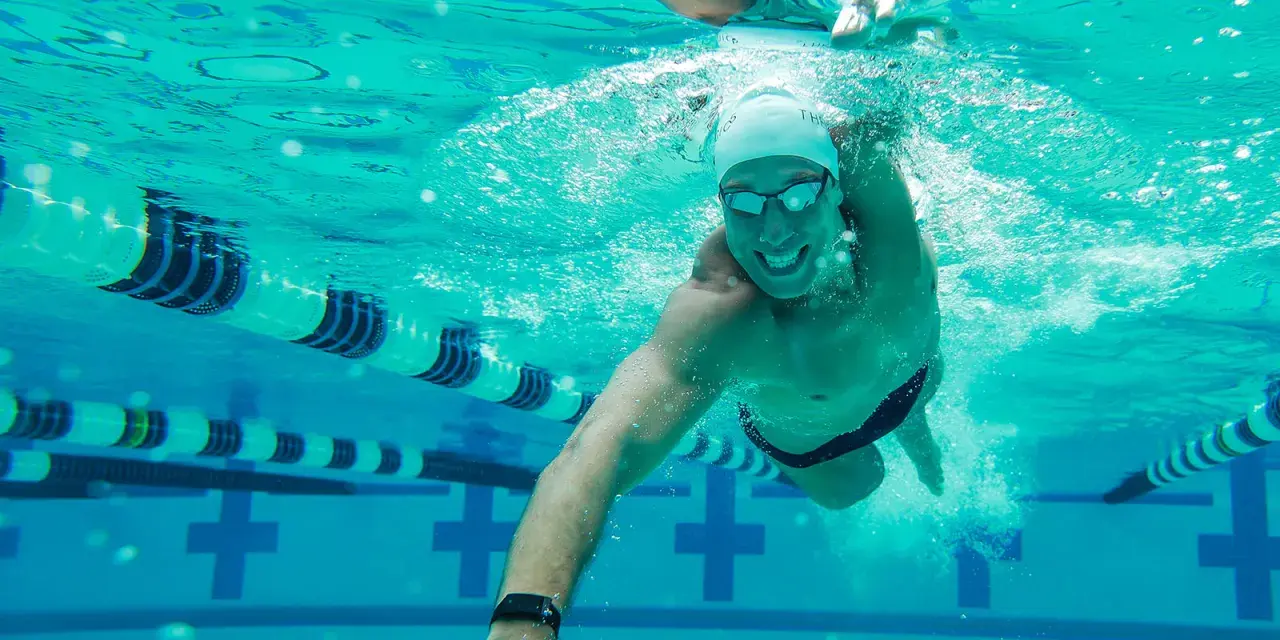
Simple swim training works best when it gives you structure without draining you. I like sessions that warm the body up properly, keep the main set short enough to stay focused, and finish before technique falls apart. This guide breaks down easy swim workouts that build fitness without turning the pool into a grind, with examples you can use in a 25m or 50m pool.
Quick takeaways for a calmer, more useful swim session
- Easy should mean controlled, not lazy: your breathing stays steady and your stroke stays tidy.
- A simple session usually works best with a warm-up, a short skill block, a main set, and a cool-down.
- For many recreational swimmers, 400m to 1,000m is enough to get fitter without feeling smashed.
- Rest is part of the workout; it keeps your form from collapsing on every repeat.
- Front crawl usually feels easier when the exhale, head position, and kick are under control.
- Progress works better when you add one repeat or trim a little rest, not when you turn every swim into a test.
What makes a swim session easy and still productive
When I say a swim is easy, I do not mean mindless. I mean a session that sits around RPE 3 to 5, where RPE is the rate of perceived exertion, or the 1-to-10 effort scale swimmers use to judge how hard work feels. At that level, you can stay relaxed enough to hold a decent line in the water, but you are still doing enough to improve fitness.
The best easy pool sessions usually have four parts. The warm-up gets your breathing under control. The skill work gives you a small technical focus. The main set does the real training without pushing you into a sprint. The cool-down lets your body settle before you leave the pool.
- Warm-up - 5 to 10 minutes of relaxed swimming to get the rhythm back.
- Skill work - short drills or mixed-stroke lengths that sharpen body position.
- Main set - short repeats or steady lengths done with enough rest to stay smooth.
- Cool-down - a few easy lengths to finish with control instead of fatigue.
That structure is the difference between a session that feels manageable and one that leaves you guessing why it felt so heavy. Once that shape is in place, the next step is choosing workouts that fit the day you are having.

Three pool sessions I would start with
If you want simple routines that still move fitness forward, I would start with these three. They are all built for a 25m pool, but the same distances work perfectly in a 50m pool if you count metres rather than lengths.
| Session | Total distance | 25m lengths | Best for | Effort |
|---|---|---|---|---|
| Reset swim | 400m | 16 lengths | Getting back in the water or keeping things light | RPE 3 |
| Fitness builder | 600m | 24 lengths | Building steady aerobic work | RPE 4 to 5 |
| Technique and stamina mix | 1,000m | 40 lengths | Longer easy training with structure | RPE 4 to 5 |
A 400m reset swim
This is the session I would choose after a few days off, on a busy weekday, or whenever I want to leave the pool feeling better than when I arrived.
- 100m easy swim, using front crawl, breaststroke, or a mix of strokes.
- 4 x 25m drill or kick, resting 15 to 20 seconds between repeats.
- 4 x 25m smooth swim, keeping the stroke quiet and the breathing steady.
- 100m easy cool-down.
The value here is not the distance. It is the rhythm: short enough to stay fresh, but organised enough that the swim still counts. If you only have 20 minutes, this is the one I would keep.
A 600m fitness builder
This is the kind of session that starts to build aerobic capacity without turning into a race. It is simple, repeatable, and easy to scale up or down.
- 100m easy warm-up.
- 4 x 50m drill-swim by 25m, resting 20 seconds.
- 4 x 50m steady swim at a controlled pace, resting 20 to 30 seconds.
- 100m easy cool-down.
The drill-swim repeats are useful because they break the stroke into manageable pieces. I like them for swimmers who rush the first length and then lose shape halfway through the rep.
Read Also: Advanced Swim Workouts - Build Speed & Avoid Burnout
A 1,000m technique and stamina mix
This version is longer, but it should still feel controlled. I use it when I want a proper fitness session without crossing into hard training.
- 200m easy warm-up.
- 4 x 50m kick or stroke drill, resting 20 seconds.
- 4 x 100m steady aerobic swim, resting 20 to 30 seconds.
- 4 x 25m relaxed build, resting 15 to 20 seconds.
- 100m easy cool-down.
The 100s give you the fitness work, while the 25s keep a little speed in the session without making it aggressive. That balance matters more than people think, especially when they are trying to get stronger without wrecking their shoulders or breathing pattern.
From here, the main job is adjusting the work so it suits the pool and your current level, not the other way around.
How to adjust the work to your pool length and current fitness
In the UK, most recreational swimmers train in 25m pools, so lengths are often the easiest way to track progress. A 50m pool changes the feel of the session because you get fewer turns and fewer push-offs, which can make the same swim feel slightly harder even when the distance is identical.
| Situation | What I would do | Why it helps |
|---|---|---|
| 25m pool | Count lengths and keep the set simple to track. | It makes pace and distance easier to manage. |
| 50m pool | Use the same metres, but expect less rest from the wall. | Fewer turns mean less free speed and less recovery. |
| You are very new to swimming | Cut each session by 25% and use more 25m repeats. | Shorter efforts keep technique together. |
| You can already swim 400m continuously | Add one extra 50m rep or slightly reduce rest. | Progress comes from small load changes, not huge jumps. |
If a session stops feeling controlled, shorten the set before you force it. That is not backing off; it is preserving the quality that makes the swim useful in the first place.
The technique cues that keep effort low
Most swimmers make easy sessions feel hard because the stroke leaks energy. I would rather fix one or two simple cues than pile on more distance. Small technical improvements often do more for comfort than extra fitness ever will.
- Exhale continuously underwater so you do not build tension before every breath.
- Keep the kick small and quiet; a big kick often lifts the heart rate without adding much speed.
- Stretch long from the fingertips instead of punching forward and crossing over the centre line.
- Turn the head just enough to breathe; for front crawl, one goggle in the water is a useful checkpoint.
- Rotate from the hips and torso rather than twisting the head and shoulders out of shape.
- Keep breaststroke compact if that is your chosen stroke; a huge glide can make the rhythm awkward instead of efficient.
If a swimmer asks me what changes the feel of the water fastest, I usually say breathing and body position. That is boring only until you experience how much easier the pool becomes when those two pieces are under control.
Once the stroke is calmer, the small bits of kit and timing support become more useful rather than more distracting.
The kit and timing tools that actually help
You do not need much gear for a good swim, and I am wary of overcomplicating this. A few simple tools make easy sessions smoother, but they should support the workout rather than define it.
- Goggles keep your eyes comfortable and help you maintain a stable breathing rhythm.
- Swim cap can make longer sessions less fiddly, especially in cooler UK pools.
- Kickboard is useful for short kick sets, but I would not lean on it for every session.
- Pull buoy helps isolate the upper body when you want to focus on the pull.
- Fins can improve body position and ankle feel, though they are a tool, not a shortcut.
- Watch or pace clock helps you keep rest honest and stop the workout from drifting.
The main trap is using equipment to hide weak technique. A pull buoy can be helpful, for example, but if your body position falls apart without it, the answer is not more buoy work. It is better balance, a cleaner exhale, and a more stable kick.
Once the gear is sorted, the bigger mistake tends to be how swimmers pace the session, not what they bring to the pool.
Common mistakes that make a light swim feel hard
I see the same problems again and again, and most of them have nothing to do with fitness level. They are pacing mistakes, not talent issues.
- Starting too fast and treating the first length like a race.
- Kicking too hard when the set really needs balance and control.
- Skipping the warm-up, which makes the first few lengths feel awkward and expensive.
- Resting too little on technique work, so the drill falls apart before it teaches anything.
- Doing every session the same way, which stalls progress and makes swimming feel repetitive.
- Ignoring pain or sharp fatigue, especially in the shoulders.
The easiest fix is to slow the first repeat down and treat the set as practice, not a performance. If your breathing is out of control by the second rep, the session is already too hard for the goal you set.
That leaves one question: how do you keep improving without turning every swim into a bigger and bigger workload?
The simplest way I would build progress from here
For most recreational swimmers, I would keep the week simple: one short recovery swim, one steadier aerobic swim, and one technique-focused session. If you only have time for two sessions, that still works. What matters is repeating a pattern you can sustain, not squeezing in the most ambitious plan on paper.
- Week 1 - choose one 400m reset swim and one 600m builder.
- Week 2 - add one extra 25m or 50m repeat to just one session.
- Week 3 - keep the distance steady but trim a little rest if form stays clean.
- Week 4 - repeat the same structure and check whether breathing, balance, and recovery feel easier.
I usually aim for one session at RPE 3, one at RPE 4 to 5, and only then, if I need it, a slightly harder set. That mix builds fitness without making swimming feel like another chore. If you finish the pool feeling like you could have done a little more, you probably got the balance right.
That is the version of swim training I trust most: simple enough to repeat, organised enough to improve, and light enough that you still want to come back next time.
