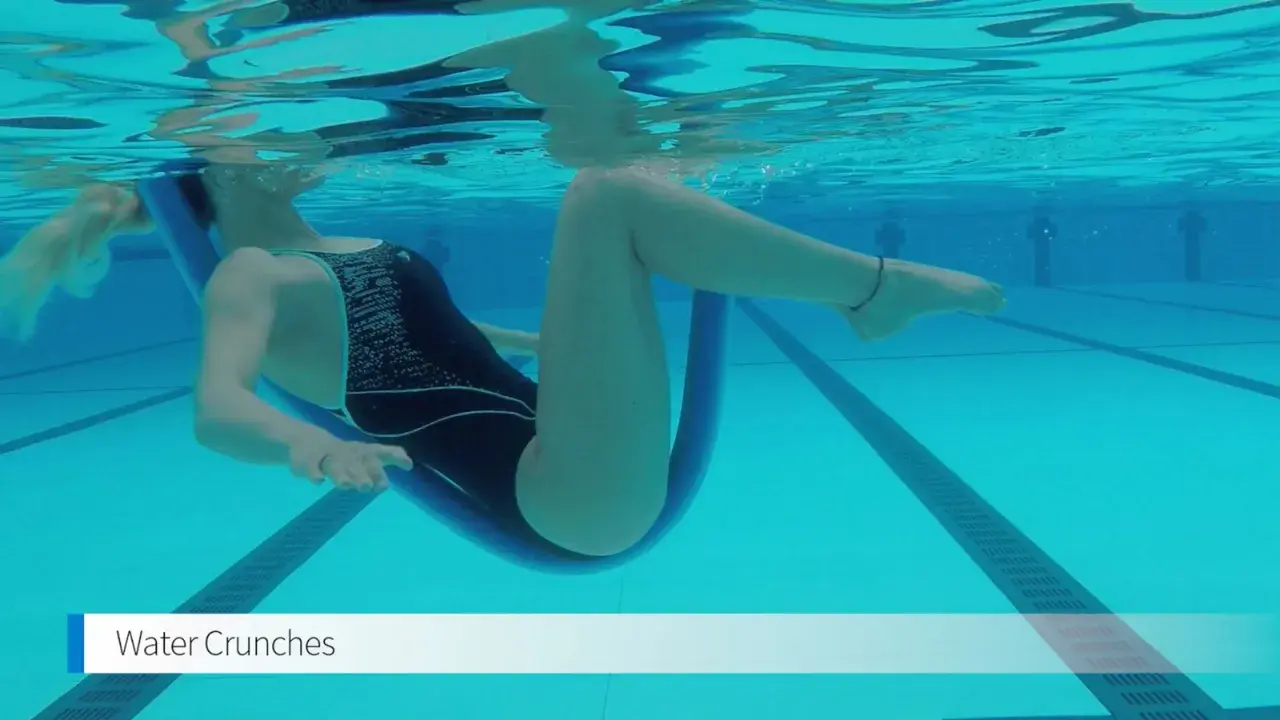
Swimming and core training overlap more than many people think. A strong midsection helps you stay streamlined, keep the hips high, and transfer force cleanly through every stroke. Water crunches are a simple pool-based drill for building abdominal control without the hard impact of floor work, and they make the most sense when you want a core exercise that fits into swim training rather than replacing it. In this article, I explain what they train, how to do them safely, where they help swimmers most, and how I would programme them into a short pool session.
Pool crunches work best as controlled accessory core training
- They are mainly a core-stability drill, not a shortcut to visible abs or fat loss.
- The best versions use slow, deliberate movement and just enough flotation support.
- For swimmers, the main payoff is better body line, trunk control, and force transfer.
- Most people get more from 2-3 sets of 8-12 clean reps than from high-rep rushing.
- If you feel the front of the hips more than the abs, the setup or cueing needs adjusting.
- They work well as a short add-on after technique work, easy swimming, or recovery sessions.
What these pool crunches really train
In the pool, the obvious target is the rectus abdominis, but that is only part of the story. The deeper stabilisers, especially the transverse abdominis and obliques, help keep the trunk organised while the water tries to move you around. That matters in swimming because a loose midsection leaks energy; a stable one helps you hold a cleaner line and connect the upper and lower body more efficiently.
I would not sell this drill as a miracle ab exercise. It is better than that, and more specific. A good pool crunch builds trunk control under resistance, which is exactly what you need when you are trying to keep the body long in freestyle, resist twisting in breaststroke, or maintain tension through turns and underwater phases. It also tends to be kinder to the joints than floor crunches, which makes it useful for swimmers who want core work without extra spinal loading.
That is why I see it as a performance drill first and an aesthetic drill second. The visible result may be a stronger-looking midsection, but the real value is that the torso learns to stay useful under pressure. Once that is clear, the next step is learning the cleanest way to perform the movement.

How to do water crunches correctly in the pool
Supported floating version
This is the version I would use most often. A small noodle or similar flotation support keeps the body aligned, but it should not do all the work for you.
- Stand in chest- to shoulder-deep water and place a pool noodle under your upper back so you can float with some support.
- Extend the legs, let the body lengthen, and keep the head neutral rather than cranking the chin forward.
- Brace lightly through the ribs and lower abdomen, then draw the knees toward the chest with a controlled curl through the trunk.
- Pause for a moment at the top, squeeze the abs, and avoid bouncing out of the bottom position.
- Return slowly to the start so the muscles work on the way down as well as on the way up.
For most swimmers, 2-3 sets of 8-12 repetitions is enough. If you prefer timed work, use 20-30 seconds per set and keep the motion crisp. I would rather see ten clean reps than twenty sloppy ones.
Read Also: Aerobic Swim Sets - Build Fitness, Not Just Fatigue
Standing alternative for busy lanes
If the pool is crowded, or if noodles are not practical, a standing version can still do useful work. In chest-deep water, keep one foot grounded, lift one knee and curl the torso slightly toward it, then alternate sides in a controlled rhythm. It is less direct than the floating version, but it still teaches the trunk to organise itself against the resistance of the water.
That alternative is useful in a typical UK leisure centre where space, lane rules, and equipment availability can change from session to session. I like having a version that does not depend on perfect conditions, because consistency matters more than the exact set-up.
Why pool versions fit swim training better than floor work
The pool changes the rules. Water gives resistance in both directions, so the exercise stays honest instead of relying on gravity alone. At the same time, buoyancy reduces impact, which is why these drills often feel friendlier on the back and hips than classic floor crunches.
| Factor | Pool version | Floor crunches |
|---|---|---|
| Impact | Low impact because buoyancy supports part of the body weight | More direct load on the spine and hips |
| Resistance | Water resists both the curl and the return | Resistance comes mostly from body weight and tempo |
| Swim-specific carryover | Better for body line, breathing control, and trunk tension in the water | Good general core work, but less specific to pool movement |
| Best use | Accessory work, warm-downs, recovery days, technique sessions | General strength work, home sessions, gym-based programming |
| Main limitation | Too much flotation can reduce the challenge if you lean on it | Can feel harsher for people with sensitive backs |
I would still keep dry-land core training in the mix. A swimmer needs more than flexion work: anti-rotation, anti-extension, and hip control all matter too. Pool crunches are an accessory, not a full programme. Used well, though, they bridge the gap between general fitness and the movement demands of swimming.
That bridge only works if the technique stays disciplined, which is where people usually go wrong.
Common mistakes that reduce the effect
- Using the hips instead of the abs. If the movement becomes a knee lift with no trunk curl, you have shifted the load into the hip flexors.
- Moving too fast. Water rewards control. Fast reps usually mean the support is doing most of the work.
- Over-arching the lower back. Keep the ribs down and shorten the range if your lumbar spine starts to take over.
- Leaning on too much flotation. If the noodle is making the exercise effortless, reduce the support or slow the tempo.
- Chasing fatigue instead of quality. Once the body starts splashing and twisting, the set is no longer doing what you want it to do.
My rule is simple: if the abs are not clearly doing the work, the drill has stopped being useful. That is not a reason to abandon it; it is a cue to clean up the setup and make the movement smaller and more precise.
A simple core set I would use with swimmers
- Swim or water-walk for 4-5 minutes to warm up the trunk and shoulders.
- Do 2 sets of 8-12 supported pool crunches with 30-45 seconds of rest.
- Add 2 sets of 20-30 seconds of tread water or flutter kicking to carry the tension into a more swimming-like position.
- Finish with 2 sets of 8 controlled side curls or standing twists on each side.
- Swim 4 x 25 metres at an easy to moderate pace, focusing on a long body line and quiet hips.
That session is short on purpose. Core work that drags on too long tends to spoil the rest of the swim session, especially if you are already doing technical or interval work. I would place it after a technique block or at the end of an easier pool day, not before hard main sets.
If you want progress, make one change at a time: slower tempo, less support, cleaner breathing, or slightly longer holds. The goal is not to smash yourself in the pool. The goal is to leave the water with better trunk awareness and a cleaner position for the next swim set.
What I would remember before adding them to your week
Used sensibly, this drill is a neat piece of swim-specific fitness. It gives you a low-impact way to train the abs, but more importantly it teaches the trunk to stay organised while the rest of the body moves around it. That is the kind of core work that actually shows up in the water.
I would use it when I want a short, joint-friendly accessory set, especially on days when I am already spending time in the pool. I would not rely on it as the only core exercise in the programme, and I would be cautious if a swimmer already has lower-back irritation or strong hip-flexor dominance. In those cases, a shorter range, less flotation, or a different core drill may be the better choice.
As a simple rule, keep the movement slow, keep the torso honest, and keep the session short. If those three things are in place, pool-based crunches earn their spot in a swimmer’s training week.
