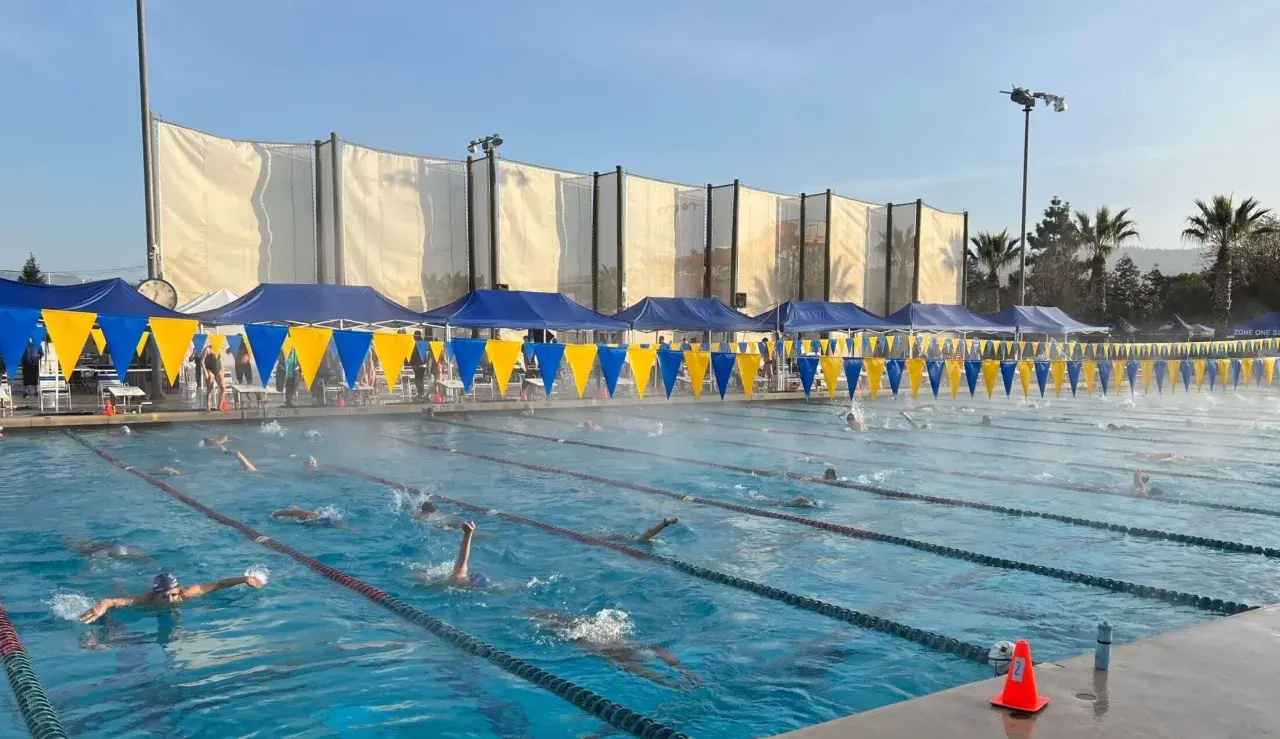
Shared lanes are where circle swim etiquette matters most, because a small mistake at the wall affects everyone behind you. I treat the setup as traffic management rather than a racing tactic: the goal is a predictable lane, tidy turns, and enough space for every swimmer to keep moving. In this guide I break down how the system works, how to join a busy lane safely, and how to use it as a real training tool instead of just surviving the traffic.
Shared lanes work best when every swimmer moves predictably and leaves the wall clear
- Lane rotation is usually the answer once a lane gets busy, but the pool’s posted rules always win.
- Before you enter, check the direction, the pace order, and whether the lane is split or rotating.
- Rest at the wall, not mid-lane, and keep the turn space open.
- Freestyle is easiest in a rotating lane; breaststroke, backstroke, and butterfly need more discipline.
- Used well, shared-lane swimming still supports technique, endurance, and pace control.
How lane rotation works in a shared pool
In practical terms, lane rotation means every swimmer stays on one side of the lane and travels in the same direction as everyone else, turning at the wall in a consistent pattern. In many UK pools the exact side is posted on the wall or set by the coach, so I never assume the pattern from one venue carries over to the next.
| Situation | Best setup | Why it works | Risk if you ignore it |
|---|---|---|---|
| One swimmer | Whole lane or a split lane if the venue prefers it | Simple and uninterrupted | You may crowd a second swimmer who joins later |
| Two swimmers of similar pace | Split lane or lane rotation, depending on local rules | Little overtaking and a stable rhythm | Unclear turns and accidental contact |
| Two swimmers of different pace | Lane rotation usually works better | Passing stays predictable at the wall | One swimmer gets trapped behind the other |
| Three or more swimmers | Lane rotation | Everyone gets a fair path | The lane turns into stop-start chaos |
The important part is not the shape of the path; it is whether everyone can predict the next wall, turn, and exit. Once that structure is clear, the lane behaves like a steady conveyor belt rather than a guessing game. That leads naturally to the part that trips most people up: entering the lane without interrupting the traffic.
How to set the lane up before you push off
Most lane problems start before the first length. I want three checks done before I push off: who is already in the lane, which side is being used, and whether anyone is about to turn.
- Watch one length before entering.
- Ask the fastest swimmer, coach, or lifeguard which side and direction are in use if it is not obvious.
- Let the swimmer at the wall finish their turn before you enter.
- Start your first length at a controlled pace so you can merge cleanly.
- Keep your turns and exits consistent with the lane pattern.
That sounds fussy, but it is faster than forcing a reset after a near miss. Once you are in, the lane should feel almost boring, and boring is good. After that, etiquette matters more than speed.
The etiquette that keeps everyone moving
The etiquette that matters most is the kind that other swimmers feel immediately: leaving the wall clear, not stopping in the middle of a length, and never forcing a pass through the middle of the lane. If someone behind you is clearly faster, let them through at the wall rather than making the whole lane negotiate around you.
- Rest in the corner of the lane, not on the T.
- Keep goggles, caps, and water bottle fixes to the wall.
- Overtake only where the lane is designed for it.
- Use foot taps only if that is the convention in your club or session; in casual public swimming, direct communication at the wall is safer.
- Stay calm if the lane pace changes. Move down a lane if your pace no longer fits.
Etiquette is not about being polite in the abstract; it is what keeps the session moving. In a busy public pool, clear behaviour beats assumptions, and in a club session, the coach’s system always comes first. Once that is clear, stroke choice becomes the next big variable.
Stroke adjustments that matter in a rotating lane
Different strokes behave very differently in a rotating lane, and that is where I see most mixed-ability problems. The right answer is not to swim harder; it is to pick the stroke or drill that fits the traffic.
Freestyle and backstroke
Freestyle is easiest because you can see where you are going and settle into a repeatable line. Backstroke is trickier because you cannot keep checking traffic, so I want swimmers to count strokes into the wall, keep a straight body line, and finish on their own side without drifting into the turning space.
Breaststroke
Breaststroke needs extra room because the pull and kick both widen the body position. In a crowded lane, a breaststroker who drifts into the middle of the lane causes more problems than a freestyle swimmer at the same speed, so stay disciplined with the line and avoid sudden changes in tempo near the wall.
Read Also: Hand Paddles - Swim Stronger, Smarter, Safer
Butterfly and drill work
Butterfly is the least forgiving choice in a busy lane, which is why I only use it when the lane is quiet or the session has been built for it. Drill work with fins, paddles, or a snorkel can be excellent for fitness, but extra equipment makes turns and overtakes less forgiving, so check the pool rules and keep your body line tight.
Once you match stroke to traffic, the lane becomes a training asset instead of a constraint. That is where the real fitness value starts to show.
How I turn lane sharing into a proper fitness set
A busy lane can still produce a strong session if you use it to sharpen pacing. I like it when the structure of the lane forces clean repeats: same push-off, same turn, same effort, repeat after repeat. For technique work, a send-off is simply the time between departures; for threshold sets, I mean the pace you can hold hard without losing form.| Training goal | Best repeat pattern | Typical rest | What it teaches |
|---|---|---|---|
| Technique | 25-50m controlled repeats | 10-20 seconds | Body line and tidy turns |
| Aerobic endurance | 100-200m steady repeats | 10-30 seconds | Rhythm and repeatability |
| Threshold | 100-200m firm repeats | 15-30 seconds | Holding form under load |
| Speed | 25-50m fast reps | 30-60 seconds | Clean acceleration |
These are starting points, not rules. A packed public lane may need a slower send-off, while a quiet club lane can handle tighter work. If I had to choose between quantity and quality, I would rather see 8 clean repeats than 10 messy ones, because clean work is what turns shared-lane swimming into real fitness.
- 8 x 50m at smooth aerobic pace, leaving the wall only when the lane is clear.
- 6 x 100m at threshold effort, keeping stroke count stable.
- 12 x 25m fast with full recovery, only if traffic stays predictable.
The lane should preserve rhythm, not force random accelerations. Once the session is built around that idea, most of the common lane problems become easy to spot.
The mistakes that slow a lane down fastest
Most lane conflicts come from a short list of habits that are easy to fix once you notice them. The pattern is almost always the same: the swimmer is either too unpredictable or too close to someone else’s turn.
| Mistake | Why it slows the lane | Better habit |
|---|---|---|
| Starting too close to the swimmer ahead | Forces braking at the wall | Wait for a clear gap before you leave |
| Stopping mid-lane | Blocks turns and overtakes | Rest only at the wall |
| Changing side halfway down | Creates head-on risk | Commit to one side and keep it |
| Assuming everyone knows your drill | Causes confusion | Tell the lane or simplify the set |
| Trying to pass mid-length | Invites collisions | Wait for the wall |
| Using the wrong lane for your pace | Creates constant pressure | Move to a better-speed lane |
The good news is that these mistakes are all fixable in one session. Once you stop improvising, the lane usually settles immediately. That brings me to the habit I want every swimmer to leave with.
The quickest way to make a busy lane feel calmer
Before you enter, watch one length, choose your side, and accept the lane’s rhythm instead of trying to force your own. That single habit does more for safety, pace control, and goodwill than almost any other pool-side trick.
If the lane breaks down, I do not fight it. I reset at the wall, let the faster swimmer through, and re-enter cleanly on the next opening. That keeps the session productive and stops small errors from turning into a crowded mess.
Used this way, shared-lane swimming is not a compromise; it is a practical training environment that lets you build fitness, sharpen turns, and improve discipline even when the pool is busy.