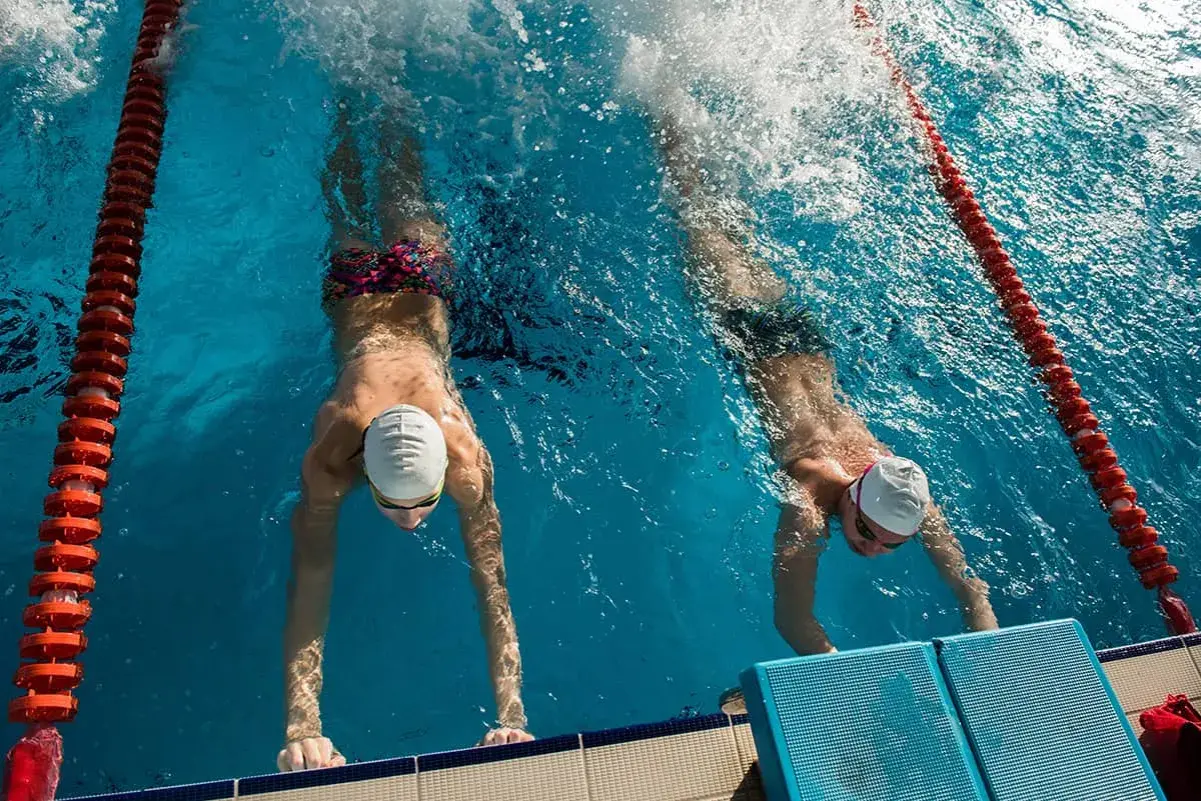
Learning how to do flutter kicks is less about making a lot of noise and more about building a tight, efficient leg action that supports the rest of your swim. I start with body position, then the hip-led motion, because the kick only works when the line of the body is clean. In this guide, I’ll show you the movement itself, the mistakes that waste energy, the drills that actually help, and how to use the kick in freestyle and backstroke.
Key points for a cleaner flutter kick
- Kick from the hips and keep the motion compact instead of trying to bicycle the legs.
- Keep the feet near the surface; big splash usually means extra drag, not more speed.
- Relax the ankles so the feet can act like a light blade in the water.
- Use the right rhythm for the distance you swim, not the same effort for every set.
- Practice with drills such as streamline back kick, vertical kick, and side kick.
- Back off if you cramp, then fix hydration, calf mobility, and training volume.

What a good flutter kick actually looks like
USMS coaches describe flutter kick as the glue that holds freestyle together, and that is the right way to think about it. The kick is not just propulsion; it keeps the hips high, supports rotation, and stops the stroke from feeling disconnected. A good version is small, quick, and balanced: one leg is moving down while the other is recovering up, with the action starting at the hip and only a light bend at the knee.
The simplest picture is this: your feet stay inside the body line, your knees never drive the movement, and the downbeat reaches only a modest depth before reversing. I like to think of it as a whip, not a bicycle pedal. Hip, knee, ankle, in that order. When the kick gets wide, splashy, or slow, it usually means the body is working against itself instead of moving as one unit.
That shape matters because a flutter kick is a small movement with a large job. It has to stabilize the body, help rotation, and contribute just enough propulsion without creating drag. Once that shape is clear, the next step is learning the movement in the water without overthinking it.
A simple way to practice the motion
I teach the kick in five short steps, and I keep them simple enough that swimmers can repeat them without losing the feel of the water.
- Set your body line first. Lie face down in streamline with your head neutral, your ears in line with your arms, and your hips near the surface. If you cannot hold the line, the kick will only hide the problem.
- Start from the hip. Let one leg press down while the other rises. The knee bends naturally, but it does not lead.
- Keep the ankles loose. A relaxed ankle lets the foot act like a fin. A stiff ankle turns the kick into a heavy leg lift.
- Think narrow and quick. The feet should stay close enough together that the kick feels compact. I would rather see a clean, steady rhythm than a hard, noisy one.
- Breathe without breaking the line. If you need to lift your head high to breathe, the kick has to fight sinking hips. Rotate just enough to breathe, then return to the same body position.
If you can hold that pattern for 15 to 25 meters without losing shape, you have the base. From there, the real work is cleaning up the habits that quietly waste energy.
The mistakes that create drag
The hard part is that bad kick habits often feel powerful. A splashy kick gives instant feedback, so swimmers keep repeating it even when it slows them down. I judge the kick by body position and rhythm first, not by how loud the water sounds.
| Mistake | What it does | What to do instead |
|---|---|---|
| Kicking from the knees | Drops the knees, kills the whip action, and adds drag | Start from the hip and keep the movement tight |
| Letting the feet pop out of the water | Creates noise, but the foot cannot push water if it is out of the water | Keep the kick right near the surface |
| Making the kick too big | Increases drag faster than propulsion and burns more energy | Shorten the amplitude and stay compact |
| Kicking out of rhythm with the stroke | Breaks rotation and makes the stroke feel choppy | Let the kick match the roll and timing of the arms |
| Rigid ankles | Turns the foot into dead weight | Relax the ankle and point the toes lightly |
Drills that build a better kick
Drills work because they isolate a single problem long enough for you to feel the correction. I do not use them as punishment sets; I use them to teach the nervous system what efficient kicking feels like.
| Drill | What it teaches | How I would use it |
|---|---|---|
| Streamline kicking on your back | Shows whether your knees are staying under control | Do 4 x 25 easy to moderate, resting 15 to 20 seconds |
| Vertical kick | Forces the kick to come from the hips instead of the knees | Use 4 to 6 rounds of 15 to 20 seconds with easy recovery |
| Side kick | Improves balance, alignment, and rotation timing | Do 4 x 25, switching sides every repeat |
| Wall kick | Helps you feel pressure on the feet and the direction of force | Use short bursts of 10 to 15 seconds against the wall |
| Snorkel kick | Keeps the head position honest and reduces breathing disruption | Use it for 4 x 25 smooth, compact repeats |
If you only have 10 minutes, I would pick streamline back kick and vertical kick first. Those two show the biggest technical leaks fastest. Once the movement is clean, the next choice is rhythm, because not every swim needs the same kick pattern.
Which kick rhythm fits which swim
I do not coach every swimmer into the same beat count. I choose the pattern that matches the event, the pace, and the athlete’s legs. That is the practical part people miss when they focus only on power.
| Rhythm | Best use | Tradeoff |
|---|---|---|
| Two-beat | Distance freestyle, controlled pacing, open-water efficiency | Less raw propulsion, so it can feel slower at first |
| Four-beat | Natural hybrid for swimmers who sit between easy and hard effort | Can become uneven if one side does most of the work |
| Six-beat | Sprints, starts, turns, and faster race tempo | Costs more energy and is harder to hold for long swims |
That tradeoff is why I want swimmers to practice both ends of the spectrum. A swimmer who only knows one rhythm usually has a harder time adapting when the pace changes.
What to do when your feet cramp or the kick feels heavy
As Swim England’s coaching advice notes, fatigue, dehydration, and tight calves are common triggers for cramp. In practice, that means I reduce the kick volume, keep the ankle work gentle, and treat mobility as part of the session rather than an afterthought.
- Back off the volume first. If the kick starts to cramp, do not keep forcing speed through it.
- Hydrate and replace electrolytes. This matters more during longer sessions, warm pools, and double practices.
- Stretch the calves and feet after the set. I prefer light, repeated calf stretches rather than forcing a hard point.
- Loosen the ankles before you swim. A few minutes of ankle circles, calf raises, or gentle mobility work can change the feel in the water.
- Use fins sparingly if you need help feeling the line. They can show you the body position, but they do not fix the kick by themselves.
If the kick feels heavy, the issue is often not strength. It is usually stiffness, fatigue, or too much movement at the wrong joint. Once those are under control, the kick starts to feel lighter and more useful almost immediately.
A short session that turns practice into habit
If I had one short session to clean this up, I would keep it simple and repeatable.
- 4 x 25 streamline kick on the back, easy and controlled.
- 4 x 15 seconds vertical kick with 15 seconds rest.
- 4 x 25 side kick, switching sides every repeat.
- 4 x 25 freestyle with a quiet two-beat kick.
- 2 x 25 easy swim, keeping the same body line and ankle relaxation.
That set works because it moves from feel to control to full stroke. The goal is not to kick harder every day; it is to make the legs stay quiet, rhythmic, and useful so the rest of the swim gets easier.
