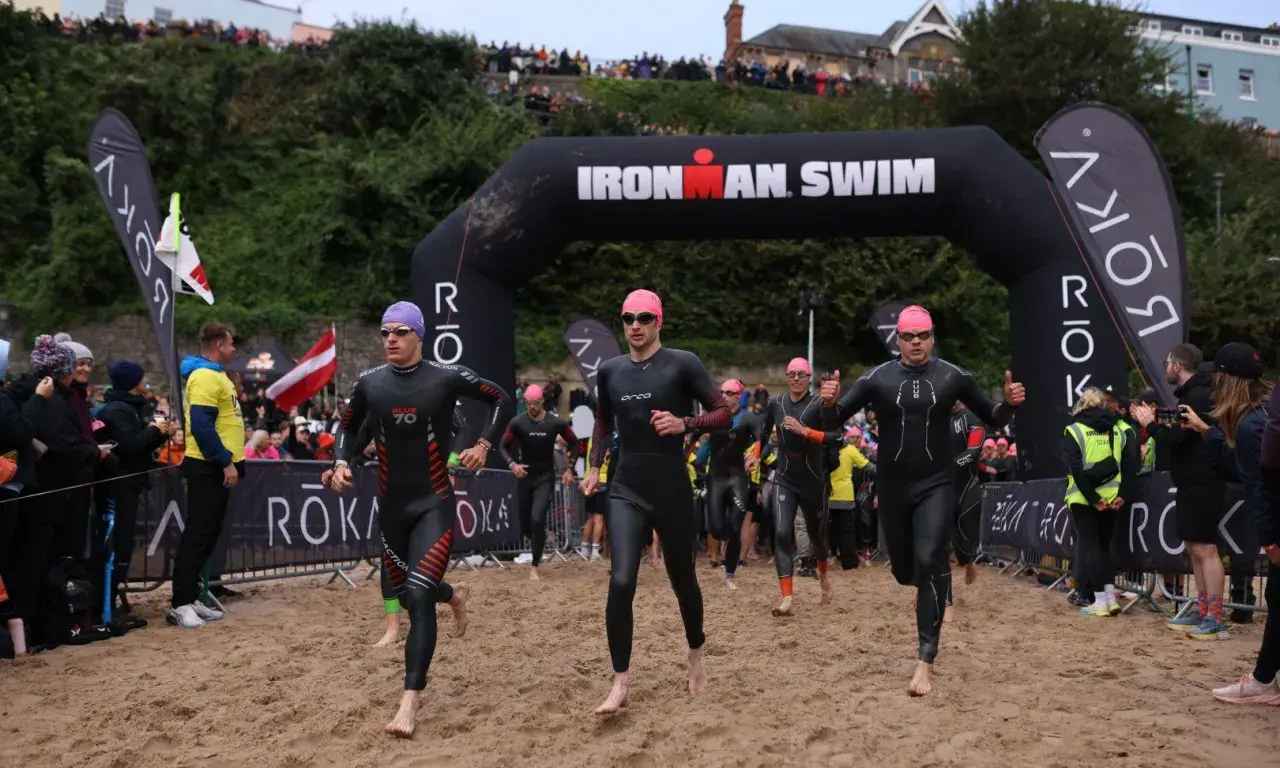
An Ironman swim is not just a long lap in open water. It is a 3.8 km problem of pacing, navigation, cold-water control, and staying composed enough to start the bike leg with something left in reserve. In this guide I focus on the parts that actually change race day: what the swim demands, which gear matters, how to train for British conditions, and how to avoid the mistakes that waste time before the race has even settled.
What matters most before race day
- The full-distance swim is 3.8 km, so efficiency matters more than brute force.
- A common full-distance swim cutoff is 2 hours 20 minutes, but the athlete guide for your race is the final word.
- UK open-water racing often means cold water, chop, and reduced visibility, so sighting and composure matter as much as fitness.
- IRONMAN rules require the official swim cap and do not allow the bib, fins, paddles, snorkels, or flotation aids in the swim.
- For British racing, wetsuits are compulsory below 15.9°C and optional up to 22°C for most age-group events.
- The best swim plan is usually a controlled start, honest seeding, and a steady build to the exit.
What the Ironman swim really asks of you
I treat this part of the race as a skills test first and a fitness test second. Yes, you need the engine to cover 3.8 km, but the bigger difference between a smooth swim and a messy one is usually how well you handle the first few minutes, the turns, the contact, and the exit. A strong pool swimmer can still lose time if they panic in chop or waste energy zig-zagging across the course.
The real target is not “swim hard”. It is swim efficiently enough to protect the rest of the day. In practical terms, that means a calm start, a stroke you can hold when your breathing gets noisy, and enough awareness to stay on course without lifting your head every few seconds. I would rather see a slightly slower first kilometre than a blow-up that leaves you gasping at the turn buoy. Once that idea clicks, the rest of the planning becomes much easier, starting with the kit that supports it.
Get the kit right before you chase fitness
Swim fitness matters, but the wrong gear can create avoidable problems before you even reach the water. In 2026 IRONMAN rules, the official swim cap has to be worn, and if you are using a wetsuit, a neoprene cap can help in cold water only when wetsuits are allowed. The bib stays out of the swim, and items such as fins, paddles, snorkels, socks, pull buoys, and other flotation aids are not part of the race. That sounds basic, but a surprising number of race-day issues start with gear that was never tested properly.
| Item | What I look for | Why it matters |
|---|---|---|
| Wetsuit | Snug on the shoulders, no neck pressure, and no restriction when you reach forward | Better buoyancy, less drag, and lower energy cost |
| Goggles | One clear pair and one tinted or mirrored backup pair | Light changes, glare, and failures happen more often than athletes expect |
| Swim cap | Official cap plus a thin backup cap if the race allows one under the official cap | Compliance first, warmth second |
| Anti-chafe | Neck, underarms, back of the neck, and any point where the suit rubs | A tiny friction point in the swim can become a major irritation on the bike and run |

Train for UK open water, not just pool speed
Pool speed helps, but British open-water racing asks for more than a good pace per 100 metres. You need comfort in colder water, a stable breathing pattern, and the habit of sighting without destroying body position. British Triathlon's current rules are a useful benchmark here: for most age-group events in Britain, wetsuits are compulsory below 15.9°C and optional up to 22°C. That matters because many lakes, reservoirs, and coastal venues sit in the temperature range where the suit changes not only warmth but also how you feel in the first 200 metres.
Read Also: Cassandre Beaugrand - Master Her Triathlon Race Strategy
Build three skills that pool training misses
- Sighting - lift just enough to see a landmark or buoy, then return to a long, flat bodyline.
- Breathing control - practise exhaling fully so the first cold-water shock does not make your stroke frantic.
- Drafting awareness - learn to sit near feet or hips without fighting every wave of contact.
If I only had one open-water session per week, I would make it a skills session, not a hard interval day. The return on investment is better. A short swim with sighting practice, turns around buoys, and a few minutes swimming near others teaches more about race day than another mindless straight-line set. For athletes who want a simple volume guide, this is the range I would use as a starting point.
| Race profile | Weekly swim volume | Main focus |
|---|---|---|
| New to open water | 5-8 km over 2-3 sessions | Technique, relaxed breathing, and one steady continuous swim |
| Building toward a first finish | 8-12 km over 3-4 sessions | Race-pace work, sighting, and longer sustained efforts |
| Experienced age-group athlete | 12-18 km over 4-5 sessions | Threshold sets, drafting practice, and fatigue resistance |
Race-day pacing and navigation
The first mistake many athletes make is treating the start like a pool sprint. I prefer a controlled build. In a rolling start, self-seeding honestly is a bigger advantage than most people admit, because it gives you clearer water and less pressure to surge just to match the people around you. If you start too far forward, you pay for it in the first 300 metres. If you start too far back, you waste energy fighting through traffic that was never yours to chase.
| Race phase | What I do | What I avoid |
|---|---|---|
| First 500 metres | Settle breathing, keep the stroke long, and find clean water | Sprinting into turbulence or lifting the head too often |
| Middle of the swim | Sight every few strokes, hold rhythm, and stay near a sensible line | Chasing every buoy with a last-second correction |
| Final section | Build gradually and prepare for the exit and the run to T1 | Throwing away form with a panic finish |
Navigation is not glamorous, but it saves real time. I tell athletes to use a landmark as a primary reference and the buoys as course confirmation, not the other way around. That keeps you moving straight when visibility drops or the sun is low. And if the water gets rough, focus on the exhale and body position first; a stable stroke almost always beats an aggressive one in messy conditions. Once the pacing is under control, the remaining losses usually come from avoidable mistakes.
The mistakes that cost minutes before fitness runs out
The swim often goes wrong in boring, repeatable ways. These are the errors I see most often, and every one of them is fixable:
- Starting in the wrong speed group and spending the first kilometre dodging people who swim at a different pace.
- Using brand-new goggles, a fresh wetsuit, or a cap setup that has never been tested in open water.
- Looking up too high or too often, which breaks balance and makes the legs sink.
- Overkicking early, especially when cold water makes the legs feel heavy and the heart rate jumps.
- Ignoring the course map and then making large, late corrections around turn buoys.
- Trying to “win” the swim when the better objective is to arrive at T1 calm and functional.
I would also add one practical point that athletes often ignore: if you feel panicked, slow down immediately and reset. IRONMAN rules allow swimmers to stop or rest during the swim, and if you need help, you can signal a lifeguard or safety craft. That is not weakness; it is basic race management. The goal is to complete the swim well enough that the rest of the triathlon is still available to you, which is why race-week preparation matters just as much as training volume.
The race-week checks I would not skip
- Review the athlete guide for the exact start format, cutoff times, and swim exit layout.
- Pack two pairs of goggles and test both in the water before race day.
- Confirm whether the event is wetsuit legal, especially if the venue is in cool British water.
- Apply anti-chafe before you leave for the start, not after you are already cold.
- Walk the entry, exit, and transition route if the venue allows it, so nothing feels unfamiliar on the morning.
When those checks are in place, the swim stops feeling like a gamble and starts feeling like the first controlled part of your race. I would still expect it to feel hard, because 3.8 km in open water is supposed to do that, but hard is different from chaotic: swim straight, breathe early, stay honest about your pace, and keep enough reserve to make T1 efficient.
