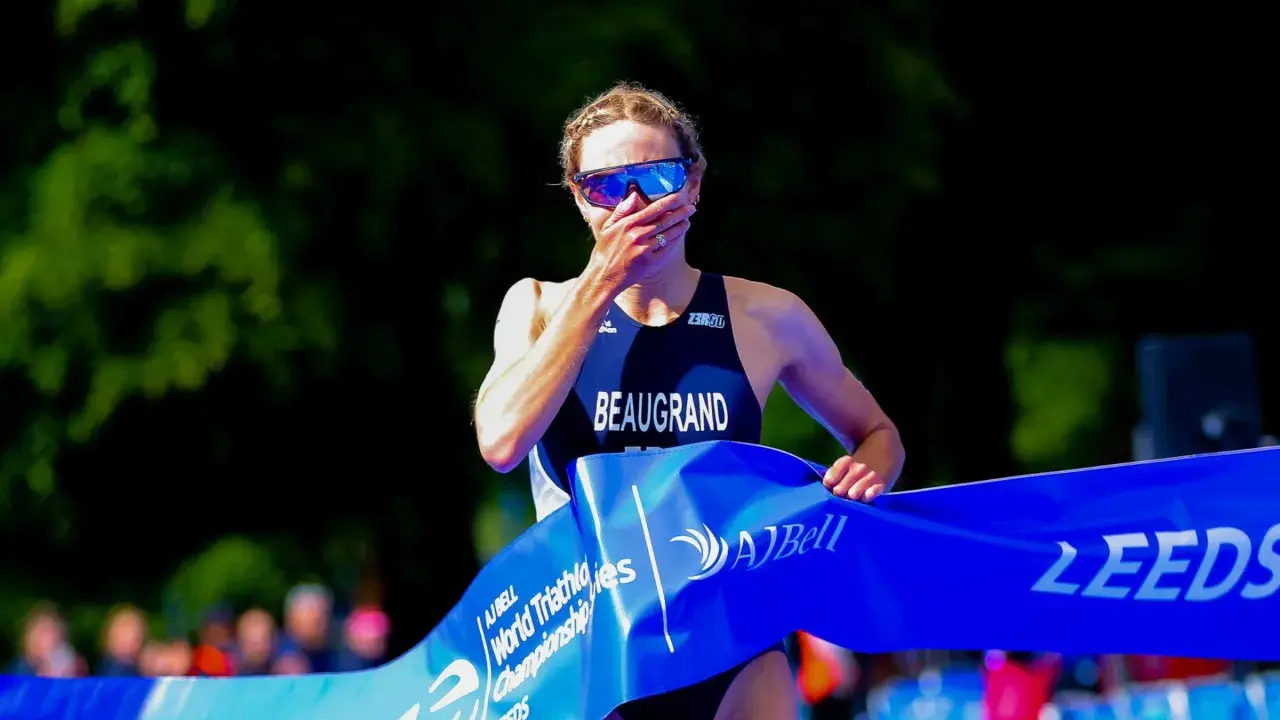
Cassandre Beaugrand is one of the clearest examples of how modern triathlon is won: fast in the water, tidy through transition, and ruthless on the run. In this article, I break down who she is, why her results matter, and what her racing style can teach swimmers and age-group triathletes who want to improve their own performance. It also puts her recent form into context so the headline results mean something more than a medal list.
Key details to know
- French triathlete born in 1997, now established as an Olympic and world champion.
- World Triathlon lists her with 109 starts, 62 podiums and 38 wins.
- Her 2026 wins in Alghero and Quiberon show she is still setting the pace.
- Her biggest edge is a front-pack swim followed by a finishing run that still bites.
- For swimmers, her career is a reminder that efficient water work shapes the whole race.
How she moved from junior promise to the top of the sport
Her rise has been steady rather than accidental, and that is part of what makes it so convincing. The early years brought junior European medals, a mixed relay silver at the 2014 World Championships in Hamburg, and a second place at the Junior World Championship in Edmonton. A difficult 2015 slowed the climb, but it did not change the direction.
By 2018, she was showing the full package: a powerful swim, an efficient upright run style, and the confidence to win at elite level in Hamburg. From there, the list keeps building. A strong 2022 season, a near-miss in 2023 behind Beth Potter, then the breakthrough run in 2024 with Olympic gold in Paris and the world title later that same season.
That kind of progression matters because triathlon rarely rewards one-off brilliance for long. It rewards athletes who keep upgrading the same race model until it becomes difficult to beat. That is the thread running through her career, and it sets up the numbers very clearly.
Why the results are more impressive than they first look
Numbers can become background noise if you see them too often, but hers are worth reading twice. 109 starts, 62 podiums and 38 wins is not normal elite consistency; it is a profile built on turning strong positions into real race outcomes. At that level, even a small conversion advantage is a major weapon.
What I find more interesting than the medal count is the balance in the profile. There are no signs of a one-dimensional specialist who only wins when the race is shaped perfectly for her. There have been difficult patches too, including the kind of off-day every top athlete has to survive, but the long-term line still points sharply upward. That is usually the mark of someone with both physical range and race intelligence.
The latest chapter only strengthens that reading. In 2026, she quickly returned to winning in Alghero and Quiberon, which tells you the Olympic title was not a peak she has already moved past. It was a marker. From here, the more useful question is how she keeps turning those results into repeatable race control.

Why her swim, bike and run combination is so hard to beat
Modern draft-legal triathlon is usually decided by positioning before it is decided by raw endurance. A strong swim keeps you in the right group, a calm transition saves seconds you cannot afford to lose, and a run with real speed finishes the job. Beaugrand links those pieces better than most women in the field.
| Race leg | What she does well | Why it matters |
|---|---|---|
| Swim | Gets near the front early and avoids wasting energy chasing. | In draft-legal racing, being in the right pack is often worth more than a few extra seconds of raw pace. |
| Transition | Moves cleanly through T1 and T2, the two handovers between swim, bike and run. | Those seconds are small on paper, but in sprint racing they can decide whether you stay with the leaders. |
| Bike | Rides efficiently rather than wastefully. | That leaves more reserve for the run, where races are often won. |
| Run | Has a 5 km finish that can break a tactical race open. | If the field is still compact at T2, her finishing speed becomes a major problem for everyone else. |
That is why I would describe her as a race-shaper, not just a race-finisher. She does not simply respond to the race that unfolds; she helps create it. And once you understand that, her 2026 form becomes much easier to read.
What her 2026 wins say about her current level
So far in 2026, the signal has been very clear: she remains the benchmark. Winning in Alghero and then again in Quiberon showed that her speed still travels well across different courses and conditions. It also showed that a strong field does not automatically disrupt her rhythm.
The Quiberon victory was especially revealing because it came after a race that never truly gave her breathing space. She was pressed hard, yet still found the closing gear when it mattered. That is the difference between being a contender and being the athlete everyone else has to plan around. One difficult race in the past does not reset that picture.
Even the Paris winning time of 1:54:55 matters here. It proves she is not just a sprint-distance specialist who can survive longer racing; she can still deliver when the standard-distance demands become real. For athletes and coaches, that is useful because it shows how speed and endurance can coexist instead of competing with each other.
What swimmers and triathletes can copy from her race model
If I were coaching a swimmer who wanted to move into triathlon, I would not start with fancy gear or complicated race hacks. I would start with the same principles Beaugrand seems to use so well: secure the swim position, protect the transition, and keep enough quality for the run. Those habits are far more repeatable than trying to force heroics later in the race.
- Train the first 300 metres of the swim. That is where front-pack positioning is won, and where many athletes panic or waste energy.
- Practise open-water sighting and contact. Good pool speed is useful, but triathlon swimming is won by staying calm while others surge around you.
- Make transitions automatic. T1 and T2 are not decorative details; they are part of the race and should be rehearsed under fatigue.
- Build a run that still works off the bike. A fast 5 km after hard swimming and riding is a different skill from a standalone track session.
- Keep technique ahead of equipment. Better body position, cleaner turns and more efficient strokes will usually save more time than another purchase.
That last point is the one people often resist. It is easier to buy something than to improve movement quality, but movement is what decides the race. That is why her example is so useful for a swimming-focused audience.
What her rise means for French triathlon and the next few seasons
Her influence is bigger than her own medal shelf. She has helped set a new expectation for French women in triathlon: race aggressively, swim with intent, and refuse to wait for luck. That changes how rivals prepare, because a field that knows it must chase from the water starts the race with a tactical problem already attached.
For the wider sport, she is also a useful reference point for how the modern women’s field has evolved. The best athletes now need a complete package, not just one great discipline. Swimming still matters enormously, but it matters most when it allows the bike and run to stay on your terms. That is the pattern she keeps reinforcing.
For anyone following triathlon from a performance angle, the practical takeaway is simple: start with the swim, because that is where so many of her races begin to open. Build enough water speed to stay out of trouble, then make transitions, pacing and finishing speed serve that advantage. In the current field, that is still one of the most reliable ways to race like a winner.