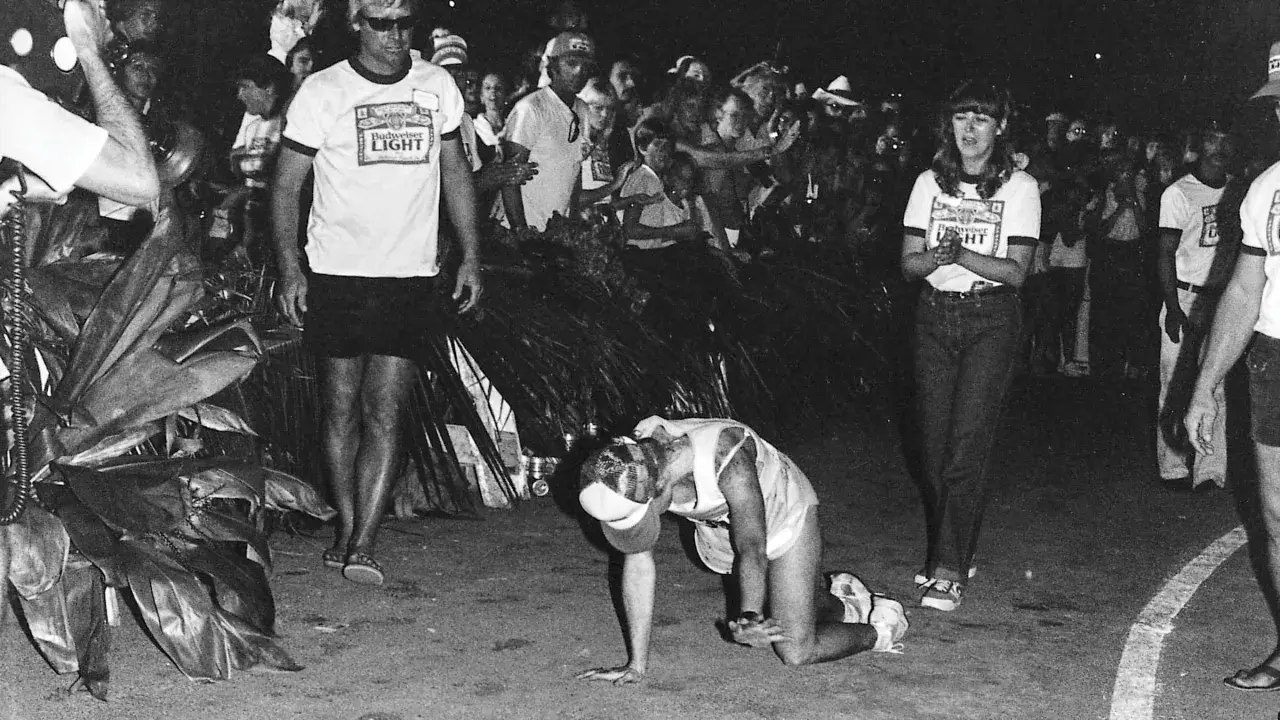
The Julie Moss Ironman story is one of endurance sport’s clearest examples of why pacing, hydration, and composure matter more than bravado. What happened in Kona in 1982 was dramatic enough to become triathlon folklore, but the real value for today’s athlete is practical: it shows how quickly a race can unravel when effort is unmanaged, and what a disciplined finish actually looks like.
The finish that made triathlon impossible to ignore
- Julie Moss collapsed near the finish of the 1982 IRONMAN World Championship in Kona and crawled to the line.
- Kathleen McCartney passed her for the women’s win, but Moss’s effort became the defining image.
- The moment helped push triathlon from a niche endurance test into mainstream attention.
- For modern athletes, the story is really about pacing, hydration, and managing late-race fatigue.
- For swimmers, it is also a reminder that a controlled opening leg protects the rest of the day.

What happened in Kona in 1982
On February 6, 1982, the IRONMAN World Championship in Kona produced the image that most people still associate with the race: Julie Moss, a young college student from San Diego, collapsing just yards from the finish and crawling toward the line. By that point she had already survived the full weight of the day: the swim, the bike, and nearly the entire marathon after it. Exhaustion and dehydration caught up with her at the worst possible moment.
Kathleen McCartney passed Moss for the women’s title, and the result mattered less than the visual record that followed. ABC’s Wide World of Sports aired the scene, so the finish reached far beyond the triathlon community. That is the reason the story still works after all these years: it was not neat, and it was not comfortable, but it was unmistakably real.
I think that rawness is why the moment still feels current. It showed the public what long-course triathlon actually is, not as a glossy test of fitness, but as a long negotiation between discipline, pain, and the point where the body stops cooperating. That public reaction is exactly why the image kept growing after race day, which leads to the deeper reason it became iconic.
Why the finish resonated far beyond the result
There are plenty of famous wins in endurance sport. Moss’s finish is different because people remember the struggle, not the placing. The final crawl condensed everything the sport asks for into one frame: pace, fear, stubbornness, and the willingness to keep moving when dignity is already gone. That is a powerful combination, and it is easy to understand why viewers responded to it immediately.
IRONMAN later built much of its identity around that moment. The brand’s “Anything is Possible” message is tied to the 1982 finish, and for good reason. The slogan works because the race itself looks impossible until someone shows, visibly, that forward motion can continue even after breakdown starts. I read that less as a romantic idea and more as a warning: if you want a meaningful finish, you need enough control early in the race to survive the late stages.
That distinction matters. Moss did not become iconic because she looked perfect. She became iconic because she was ordinary enough for people to see themselves in her, and determined enough to keep going anyway. Once that image spread, the story moved beyond one athlete and started reshaping the sport itself.
How the moment changed women’s triathlon
Moss’s finish helped prove that women belonged at the centre of the sport, not on its margins. IRONMAN’s own history places her among the defining figures of the event, and the Hall of Fame recognition that followed in 1994 underlined how much her performance had altered the race’s identity. In practical terms, she did not just finish a race. She helped make it easier for the next generation of women to imagine themselves on that start line.That is a big point, because triathlon was still building its public image in the early 1980s. Coverage of a woman pushing through visible collapse challenged a lazy assumption that endurance sport was only about speed or strength. It showed something more interesting: resilience under pressure. For younger athletes, especially women entering long-course racing now, that matters because role models shape what feels possible long before training plans do.
The historical significance is also why Moss and McCartney remain linked in the sport’s memory. Their 1982 duel is remembered not as a simple win-loss story, but as a moment that made triathlon more legible to the wider public. The legacy is cultural, but the useful part for athletes is much more concrete, and that is where the training lesson begins.
Training lessons modern athletes can actually use
The temptation is to turn Moss’s finish into a story about toughness. That is only half right. The better lesson is about control. A full IRONMAN is 140.6 miles, or 3.8 km of swimming, 180 km of cycling, and 42.2 km of running, with up to 17 hours available for most athletes to finish. Those numbers are brutal enough without adding avoidable mistakes early on. The race is long, but the real danger is starting like it is short.| Race issue | What Moss’s finish teaches | What to do now |
|---|---|---|
| Opening too hard | The marathon exposes every error made earlier in the day. | Swim and bike at a pace you can repeat, not a pace that flatters you for 20 minutes. |
| Underfuelling | Dehydration and empty energy stores can turn a race into survival mode. | Practise drinking and fuelling in training, not just on race day. |
| Form breakdown | Once posture and cadence go, the finish becomes much harder. | Use long bricks and late-run form cues so fatigue does not erase technique. |
| Mental panic | Keeping moving is better than freezing when the body starts to fail. | Decide in advance what “safe finish” means if your day goes sideways. |
For swimmers, the first lesson is especially important. A calm, efficient swim saves far more than ego-driven speed at the start, because every extra surge in the water raises the cost of the bike and run that follow. If I were coaching a UK age-group athlete, I would say this plainly: the goal is not to win the first 400 metres, the goal is to arrive at T1 under control and still able to execute the rest of the race.
That means open-water skills matter. Sighting, drafting, wetsuit comfort, and a relaxed breathing pattern all pay off later in the day. You do not need heroic swim pace to have a strong Ironman; you need a swim that leaves something in the tank. Moss’s story is a reminder that the race punishes every small mistake once fatigue starts compounding.
What I would keep from Julie Moss before every long race
If I strip the story down to one line, it is this: finish strength is built long before the finish line. That is why Moss’s 1982 race still matters in 2026. It is not a licence to glorify collapse. It is a reminder that courage works best when it is supported by pacing, nutrition, and honest self-management.
The most useful way to remember the race is not as a celebration of suffering, but as proof that preparation has to include the final hour, not just the early miles. That applies whether you are racing Kona, an age-group Ironman, or a local long-course event in the UK. Train the swim so you stay calm, train the bike so you do not burn matches, and train the run so form survives fatigue. If those pieces are in place, you give yourself a real chance to finish with purpose instead of merely survive.
That is the lasting value of Julie Moss’s Ironman moment: it is dramatic, yes, but it is also brutally practical. It tells me that endurance sport rewards the athlete who respects the distance, and that the strongest finish is often the one built on restraint long before the last mile begins.