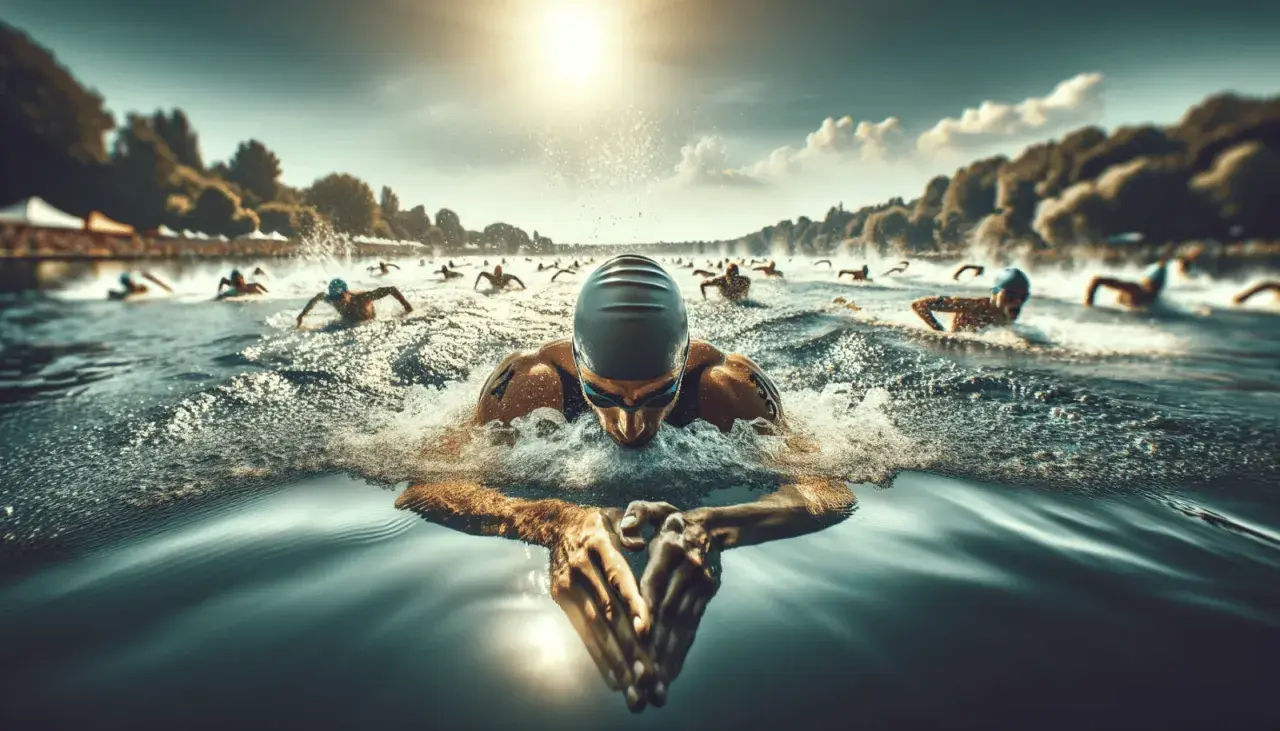
The breaststroke triathlon question is less about style and more about control: when does a slower stroke help you breathe, sight, and settle your effort without giving away too much time? In this guide I break down when breaststroke makes sense, when it should stay brief, and how to train it so it becomes a useful race tool rather than a panic move. I also focus on U.S. race realities, where open-water conditions, crowded starts, and wetsuit decisions can change the swim in a few minutes.
What matters most when you use breaststroke in a triathlon swim
- Use it as a reset, not as your default race stroke.
- It helps most when the water is choppy, crowded, or mentally overwhelming.
- Keep the stroke compact; wide knees and long glides waste time fast.
- Practice short switches in training so breaststroke feels deliberate, not improvised.
- Check the athlete guide, because race formats and course details can vary by event.
Why breaststroke still has a place in triathlon swimming
Open-water racing rewards calm decision-making as much as raw speed. World Triathlon's current training guidance even says athletes can switch from crawl to breaststroke or backstroke when necessary, which tells me breaststroke is best treated as a tactical reset, not a sign that the swim has gone wrong.
I use it when an athlete needs a clearer view, a cleaner breath, or a brief mental pause after a messy start. That is not the same as building the whole swim around it, and that difference matters once the race begins to stretch out.
That tradeoff leads directly to the real question: in which moments does the stroke help, and when is it simply costing you time?
When it helps and when it costs you time
Breaststroke is useful in very specific moments, but it is not free speed. Every long glide creates drag, and every extra second spent upright or drifting is time you do not get back on the bike.
| Race situation | Breaststroke can help | Better choice if... |
|---|---|---|
| Choppy water | Yes, because the stroke can feel more stable and easier to breathe through | You can keep freestyle without losing rhythm or swallowing water |
| Dense start pack | Yes, as a short reset to avoid panic and regain orientation | You have clear water and can draft cleanly in crawl |
| Sighting near buoys | Yes, because the head-up moment is built in | Your freestyle sighting is already efficient |
| Long straight sections | Usually no, because continuous crawl is faster and smoother | You need to stabilize breathing or calm your heart rate |
| Approaching the exit | Sometimes, if you need a quick reset before standing | You can keep freestyle momentum into the shore or ramp |
My rule is simple: if breaststroke buys you orientation, breathing space, or calm, it may be worth it; if it turns into a long glide with no purpose, it is usually expensive. That tradeoff becomes even more important in shorter races, where a few lost seconds are easier to feel in the final result.

How to use it without disrupting your race rhythm
Most athletes make the same mistake: they switch to breaststroke too late, then stay there too long. The smarter move is to use it in brief, deliberate segments, almost like pressing a reset button.
- After a chaotic start, take 2 to 4 strokes of breaststroke to find space and check direction.
- When the water gets messy, use it long enough to breathe cleanly, then return to crawl before you stall.
- Near a buoy, it can help you look up, judge your line, and avoid extra zigzags.
- If your breathing starts to unravel, use one short breaststroke cycle to settle it, then rebuild cadence immediately.
USA Triathlon also encourages beginners to get comfortable with breaststroke because it uses less energy than front crawl. That is true in the right context, but only if the stroke stays compact and purposeful; a lazy breaststroke with a huge glide can burn more time than it saves effort.
Once you can switch strokes without losing rhythm, the next step is making that switch automatic in training rather than hoping it appears on race day.
How to train it so it actually works on race day
I would not add breaststroke to a triathlon swim plan as a full second program. I would train it as a skill that shows up in small doses inside race-specific sets.
Useful pool sets
- 8 x 50m as 25 freestyle and 25 breaststroke on 15 to 20 seconds rest. This teaches you to switch strokes without losing composure.
- 4 x 100m with the first 15 seconds in breaststroke after every turn, then freestyle to the wall. Good for learning recovery after congestion.
- 6 x 75m with open-water-style sighting every 6 to 8 strokes, then 1 to 2 breaststroke cycles before resuming crawl. This builds stroke switching under fatigue.
- 1 x 400m steady, inserting 5 to 10 breaststroke cycles only when breathing or navigation breaks down. The point is control, not a separate pace set.
Practice in the same conditions you expect on race day, including wetsuit use if the event allows it, because an unfamiliar suit changes how a short breaststroke reset feels. The swim should feel familiar long before the horn goes off; that is what turns a backup stroke into a real option.
Good training makes the stroke available. The next problem is avoiding the habits that quietly make it slow.
The mistakes that make breaststroke slower than it needs to be
- Over-gliding. The biggest speed killer is hanging on the glide after the kick has already finished.
- Opening the knees too wide. That creates drag and makes the stroke feel heavy.
- Lifting the head too high. You do not need to sit upright to sight or breathe.
- Using it for comfort instead of a purpose. If nothing changes after the stroke, it was probably a delay.
- Waiting until you are exhausted. By then, breaststroke becomes a survival pattern instead of a tactical choice.
I coach athletes to ask one question before they switch: what am I trying to fix right now? If the answer is breathing, sighting, or contact in traffic, the stroke has a job. If the answer is simply that the water feels awkward, then the answer is usually a shorter reset, not a long detour.
That leads to the final piece of the puzzle: deciding, in the middle of a race, whether breaststroke belongs in the next 10 seconds.
A simple decision rule for U.S. age-group races
In most U.S. age-group triathlons, your swim strategy should be conservative early and decisive later. The first 200 to 300 meters are where the field starts to sort itself out, so I would rather see a strong freestyle start with brief breaststroke resets than a long breaststroke opener that leaves you behind the main pack.
- Start with crawl if you can hold clean form in traffic.
- Switch to breaststroke only when it solves a real problem.
- Return to crawl as soon as the problem is gone.
- Use the final stretch to rebuild cadence so the bike leg starts smoothly.
If your race is non-draft, the same idea still holds, but the pressure is different: you are racing the clock more than the pack. If it is draft-legal or packed with athletes near your level, small orientation errors and wide breaststroke glides add up even faster.
The goal is not to eliminate breaststroke from your toolbox. The goal is to make sure every time you use it, you know exactly why it is there.
The race-day rules I would keep on a sticky note
If your freestyle is steady, keep breaststroke short and surgical. If the water gets rough, crowded, or mentally noisy, use it to breathe, sight, and reset, then get back to crawl before the glide starts costing you position. The best triathletes are rarely the ones who use the most strokes; they are the ones who switch cleanly and know why.
In the last 24 hours before racing, I would rehearse that decision once more: start calm, sight often, avoid novel gear, and do not let one awkward moment turn into a long survival swim. That discipline usually matters more than whether breaststroke shows up for six strokes or sixty.