A clean flip turn can decide whether a race feels controlled or chaotic. In pool swimming, the wall is not a pause; it is part of the stroke cycle, and the swimmers who handle it well carry speed, stay compact, and get back into line faster. I am going to show what the turn is doing for your race, how to execute it, which mistakes slow it down, and how the rules change from stroke to stroke.
The fastest wall turn keeps your speed alive
- Carry momentum into the wall instead of braking early.
- Keep the rotation tight so your feet land quickly and squarely.
- Finish in a firm streamline, because the push-off is part of the turn.
- Short-course races reward wall skills more often than long-course races.
- Freestyle and backstroke use somersault-style turns; butterfly and breaststroke require a legal two-hand touch first.
What the wall turn is really doing for your race
I think of the wall as a transfer point. You arrive with horizontal speed, convert it into a compact rotation, then leave the wall with as little loss as possible. If the approach gets slow, the rotation gets wide, or the push-off opens up too soon, the turn leaks speed and the next length starts from a deficit.
That matters even more in short-course yards, where the wall comes around repeatedly. In a 100-yard race, you make three turns; in a 200, you make seven. Every one of those transitions is a chance to gain time or give it away.
Once you see it that way, the mechanics stop looking abstract and become a sequence you can train.
The mechanics that make it fast
I usually break a clean wall turn into four pieces. Each one is simple on its own, but the turn falls apart if you rush one and ignore another.
Keep the approach honest
Do not glide into the wall just because you can see it. A soft finish makes the turn harder, not easier. Keep the stroke rate alive into the final stroke or two, and resist the instinct to lift your head to check distance.
Tuck before the wall, not on it
The compact part of the movement starts before your hands leave the water. Chin down, eyes neutral, knees tucked, hips following. I want the body to rotate as one unit rather than bending in pieces.
Plant the feet in a strong line
The feet should find the wall quickly and in a position that lets you push straight back, not off to the side. If your knees are too wide or your body is twisted, the push loses force and the streamline becomes messy.
Lock in the streamline before you breakout
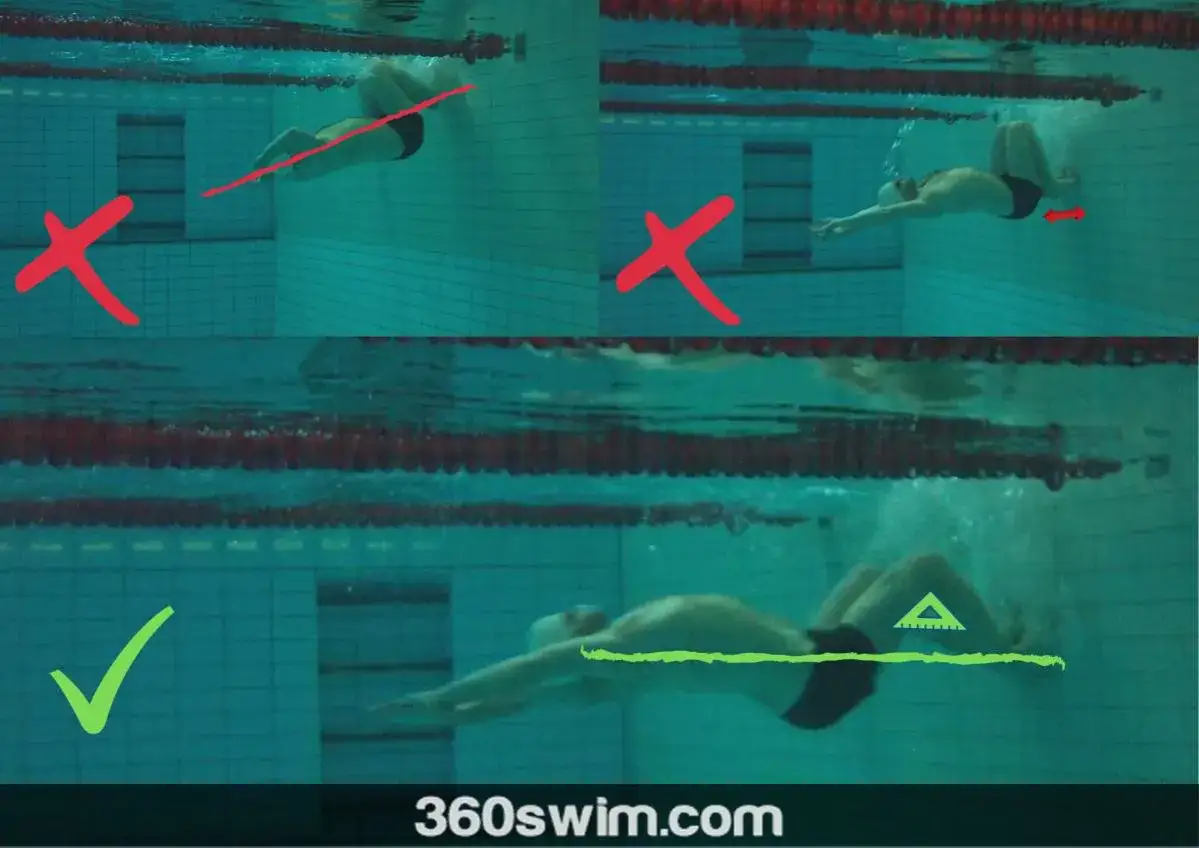
Hands stacked, elbows tight, head between the arms. A fast push without a true streamline is unfinished business. The breakout should feel like a continuation of the push, not a separate restart.
Once the motion is clean, you can teach it faster with the right drills.
Drills that build a clean rotation
The best drills are the ones that isolate the part you keep missing. I do not usually throw swimmers into endless wall repeats first; I build the body control away from the wall, then add distance, then add speed.
- Mid-pool somersaults help you learn a compact tuck without the pressure of hitting the wall. They are useful when the rotation feels rushed or oversized.
- Wall-approach and stop drills let you count the last few strokes and judge where the turn should begin. This is the quickest way to fix poor spacing.
- Streamline push-offs train the line after the feet leave the wall. If the streamline leaks, the whole turn leaks.
- Turn-and-glide repeats teach patience underwater. Many swimmers pop up too early because they never feel what a controlled breakout is.
A small set of 8 to 12 high-quality repeats usually teaches more than a long set done half-alert. I would rather see three excellent wall entries than thirty sloppy ones.
The mistakes that cost the most time
Most turn problems are not mysterious. They are usually the result of one bad habit repeated under pressure. The table below is the one I use when swimmers tell me they “just lose time at the wall.”
| Mistake | What it does | What to fix |
|---|---|---|
| Slowing down into the wall | Removes the speed you need for a clean rotation and a strong push | Finish the length with intent and keep the stroke rhythm alive |
| Lifting the head early | Breaks bodyline, adds drag, and makes the tuck awkward | Keep the head neutral and let the chin guide the rotation |
| Flipping too far from the wall | Leaves you stretched out and short on foot placement | Start the rotation later and use drills to learn distance |
| Planting the feet unevenly | Creates a crooked push-off and wastes force | Practice controlled foot placement and a square push |
| Breaking streamline too soon | Kills the speed you just earned off the wall | Hold the line through the underwater phase before you breakout |
The interesting part is that most of these errors happen before the actual wall contact. That is why I coach the approach first: if the entry is right, the rest becomes much easier to clean up.
How the rules change the turn by stroke
Not every race uses the same wall skill. Freestyle and backstroke use the somersault-style turn most swimmers picture first, but butterfly and breaststroke are different because the rules require a legal two-hand touch before the swimmer may leave the wall. In USA Swimming competition, those stroke rules still matter, so technique only counts if it is legal in the event you are swimming.
| Stroke | Wall action | Coaching note |
|---|---|---|
| Freestyle | Somersault-style turn | Best place to carry speed and stay compact |
| Backstroke | Somersault-style turn | Distance judgment matters because the wall is behind you |
| Butterfly | Two-hand touch, then legal turn | Stay on the breast before leaving the wall |
| Breaststroke | Two-hand touch, then legal turn | Touch timing and body position matter more than speed alone |
| Individual medley | Depends on the stroke change | Learn the legal transition for each leg, not just the fastest motion |
That distinction matters for training too. A swimmer who only practices freestyle turns may feel confident in practice but still lose time or risk a disqualification in the wrong event if the rule set changes.
With those constraints in mind, practice becomes easier to organize.
What I would practice this week
If I were trying to improve this skill in a normal training week, I would keep the plan simple and measurable. The goal is not to “work on turns” vaguely; the goal is to make the wall predictable enough that you stop thinking about it during a race.
- Two warm-up minutes on land with tucked somersaults and compact body positions.
- One short wall set of 6 to 8 turns at controlled speed, focusing only on approach and foot placement.
- One race-pace set where you keep the same turn cue every time, such as chin down or hands tight.
- One breakout check where you count how many strokes it takes before the line falls apart or the tempo changes.
The best cue is usually the simplest one. If a swimmer is overthinking, I reduce the instructions to one phrase: close the body, find the wall, and leave it in a line. That is usually enough to expose where the real problem lives.
The wall is part of the stroke, not a break
A good wall turn does not look dramatic. It looks efficient, almost boring, because the swimmer carries speed in, rotates tightly, and leaves without a scramble. That is why I treat it as a race skill rather than a pool trick.
If you only remember one thing, make it this: the fastest wall is the one that never interrupts your rhythm. Once the turn becomes a continuation of the swim instead of a separate event, the next length starts cleaner, faster, and with much less waste.