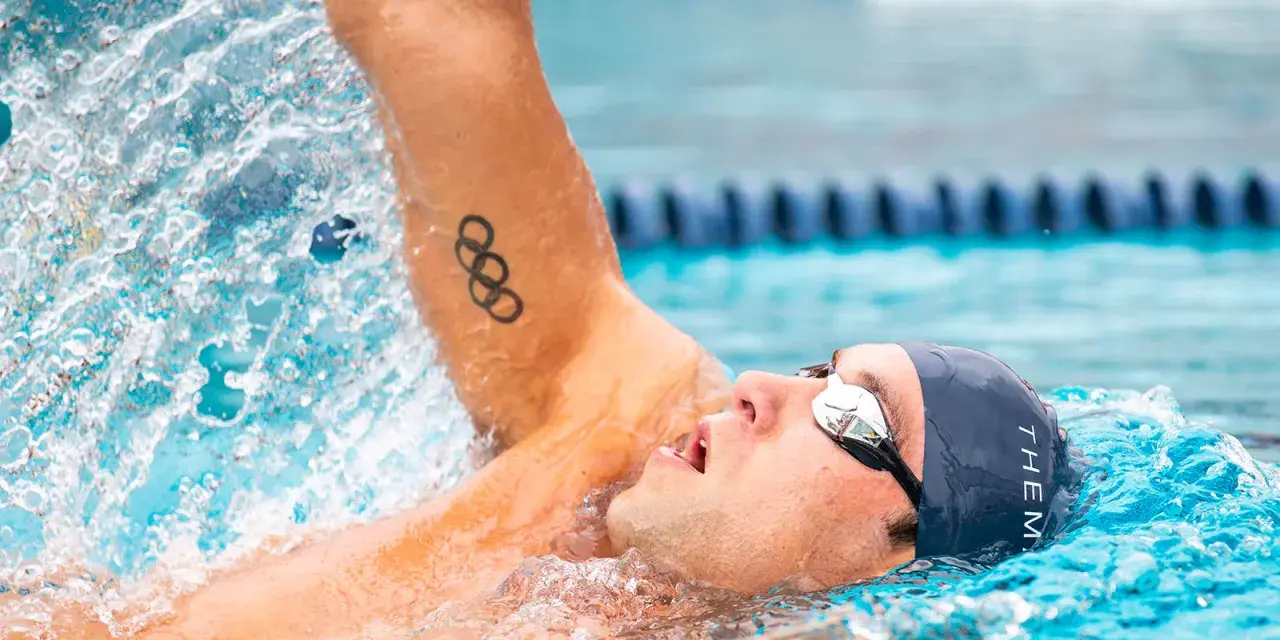
A clean backstroke position is less about looking tidy and more about holding a body line that stays high, long, and calm under load. In this guide, I break down what that shape should look like, why small alignment errors slow you down, and how to correct them with drills that actually carry over into real swimming. I also cover the habits that make swimmers feel stable while quietly creating drag.
What matters most in backstroke alignment
- Keep the head still and neutral, with the eyes looking straight up or slightly back.
- Stay long and near-horizontal, with the hips close to the surface.
- Allow controlled body roll of roughly 30 to 45 degrees instead of swimming flat.
- Use a small, quick flutter kick from the hips to support balance, not to rescue poor posture.
- Fix drag first; speed comes easier once the line is cleaner.
What a strong backstroke body line looks like
From the side, I want to see a swimmer who looks long, narrow, and almost buoyant enough to skim the surface. The head, hips, knees, and feet should all sit close enough to the waterline that the body does not create a large “hump” or sag through the middle. In other words, the shape should feel supine, which simply means lying on the back, but not passive; it still needs tone through the trunk so the body does not fold.
The best cue I use is this: long, not stiff. A good line is active, not rigid. The chest sits high because the lungs help with flotation, the lower back stays controlled rather than over-arched, and the body rolls just enough to let each arm recover and catch cleanly. That controlled roll is the part many swimmers miss, which is why the next question is not “how do I swim harder?” but “how do I stop leaking shape?”
Why alignment matters more than a harder pull
Backstroke is a long-axis stroke, which means the body rotates around a line from head to heels. That rotation helps the shoulders move freely and lets the arms work in a stronger position, but it only pays off if the body remains narrow in the water. If the hips drop, the water has more surface area to push against, and every recovery and every pull becomes more expensive.
This is where many swimmers misread the problem. They feel slow, so they try to pull harder or kick harder, but the real issue is often drag. A smaller correction in head position or pelvic control usually gives a bigger return than extra effort in the arms. I have seen swimmers gain speed simply by making the line cleaner, without changing stroke rate at all. Once that idea clicks, the technical work becomes much more precise.
How to set the position from head to feet
If I were rebuilding this from scratch, I would start at the top and work down. That keeps the cues simple and stops swimmers from trying to fix everything at once.
Head
Keep the head quiet and neutral, with the eyes looking straight up or slightly back. Do not chase the wall behind you, and do not tuck the chin to check where you are going. A small head lift can be enough to make the hips sink, because the body works a bit like a seesaw: move the chest one way, and the lower half responds. I like the cue “eyes to the sky” because it is simpler than overthinking neck angle.
Chest and ribs
Let the chest stay buoyant, but do not flare the ribs so much that the lower back arches hard. The goal is a controlled torso, not a hollow shape. If a swimmer feels like the stomach is sagging, I often ask them to gently lengthen through the ribs and think about keeping the core wide rather than tense. That usually improves stability without making the stroke look forced.
Hips and pelvis
The hips should ride close to the surface. If they sit too low, the legs become heavy and the kick turns into an expensive rescue job. One useful cue is to let the pelvis tilt just enough to flatten an exaggerated lower-back arch. I prefer that to telling swimmers to “arch more,” because too much arch usually creates the exact sinking problem they are trying to fix.
Legs and feet
The legs should stay long with only a slight bend at the knee. The kick is a quick flutter, driven mainly from the hips, with the feet just below the surface and the toes pointed. A wide knee bend or a bicycle-like kick is almost always a sign that the line has broken somewhere above. If the legs are doing too much, the body position is usually too low or too tense.
Once these pieces are in place, the stroke starts to feel less like survival and more like controlled movement. The next step is spotting the faults that make swimmers think they are aligned when they are not.
Common faults that quietly sink the hips
Most backstroke problems are not dramatic. They are small posture leaks that compound over the length of a repeat. Here is the version I look for first when a swimmer is struggling.
| Fault | What it looks like | Why it hurts | Cleaner cue |
|---|---|---|---|
| Looking toward the feet | Chin drops and the neck stiffens | The hips sink and drag increases | Keep the eyes up and the neck quiet |
| Over-arching the lower back | The body looks open but unstable | The line breaks and the lumbar spine works too hard | Lengthen the torso and keep the ribs controlled |
| Bicycle kicking | The knees bend too much and the feet drop | Energy is wasted on lift instead of propulsion | Use a short flutter kick from the hips |
| Swimming too flat | The shoulders and hips stay square all the time | The catch and recovery become less efficient | Let the body roll 30 to 45 degrees |
| Head wobble during recovery | The body snakes from side to side | Stability drops and the stroke feels noisy | Fix the head first, then let the shoulders move around it |
One more thing: fins can hide weak posture if you use them too early. They may make the swim feel faster, but they also reduce the feedback that tells you your hips are sinking. That is why I would rather see a swimmer hold a clean line at lower speed than mask the problem with extra equipment. With the main faults clear, the next job is to train the correct shape until it becomes automatic.
Drills that make the position feel natural
I prefer drills that give immediate feedback. If the body line collapses, the swimmer should feel it straight away. That is much better than chasing vague “better technique” cues that disappear the moment pace increases.- Backstroke cup drill - Balance a small cup of water on the forehead and swim easy backstroke without spilling it. This keeps the head still and quickly shows whether the swimmer is lifting or rocking.
- Side balance kicks - Kick on one side with one arm extended and the other at the thigh, then switch sides. This teaches balance, hip height, and controlled rotation without the distraction of full arm cycles.
- Six-kick switch - Stay on one side for six kicks, then rotate to the other side. It is a good way to link body roll to timing rather than forcing the body to lie flat.
- Single-arm backstroke - Swim with one arm while the other stays still, then change sides. This exposes any loss of hip height during recovery and helps the swimmer feel how the torso supports the stroke.
- Back kick in streamline - Push off on the back with arms overhead and hold a narrow line while kicking. This is the simplest way to find out whether the kick is supporting the body line or just churning water.
I usually prescribe these in short sets like 4 x 25m or 6 x 25m, with 15 to 20 seconds of rest. That is enough to keep the swimmer focused without letting fatigue hide the technical problem. Once the position is consistent in drills, the challenge becomes keeping it intact when the pace rises.
How to keep it together when pace and fatigue rise
This is where backstroke gets honest. A swimmer can look excellent at easy speed and then lose shape the moment stroke rate increases. The first thing to watch is the head: if it starts to move, everything else usually follows. The second is the hips: if they sink late in a repeat, the problem is often fatigue in the trunk rather than a weak kick.
At faster pace, I do not want swimmers to freeze the torso in an attempt to stay flat. That usually backfires. A better goal is to keep the body long while allowing enough rotation to support each arm entry and catch. The stroke should stay smooth even when the tempo rises. If it only works when you are relaxed, it is not yet robust enough for race swimming.
For backstroke starts and turns, the same idea applies in a different shape: stay narrow, keep the core engaged, and avoid breaking the line when you transition. A clean streamline into and off the wall often protects the rhythm of the whole length. That is why training posture is not a cosmetic detail; it is part of how you hold speed under pressure.
The version of backstroke alignment worth training every session
The strongest body position is not a frozen plank. It is a long, buoyant line that rotates just enough to support each arm cycle, with the head quiet, the hips near the surface, and the kick compact. If I had to reduce the whole topic to one rule, it would be this: fix alignment before you ask for more speed.- Check the head first, then the hips, then the kick.
- Use drills when the line breaks, not after the whole session is already lost.
- Keep the roll controlled instead of forcing the body flat.
- Expect a little movement, but not a lot of wasted motion.
When those pieces line up, the stroke looks calmer, feels easier, and usually gets faster without a dramatic change in effort. That is the standard I would train for in any good backstroke set.