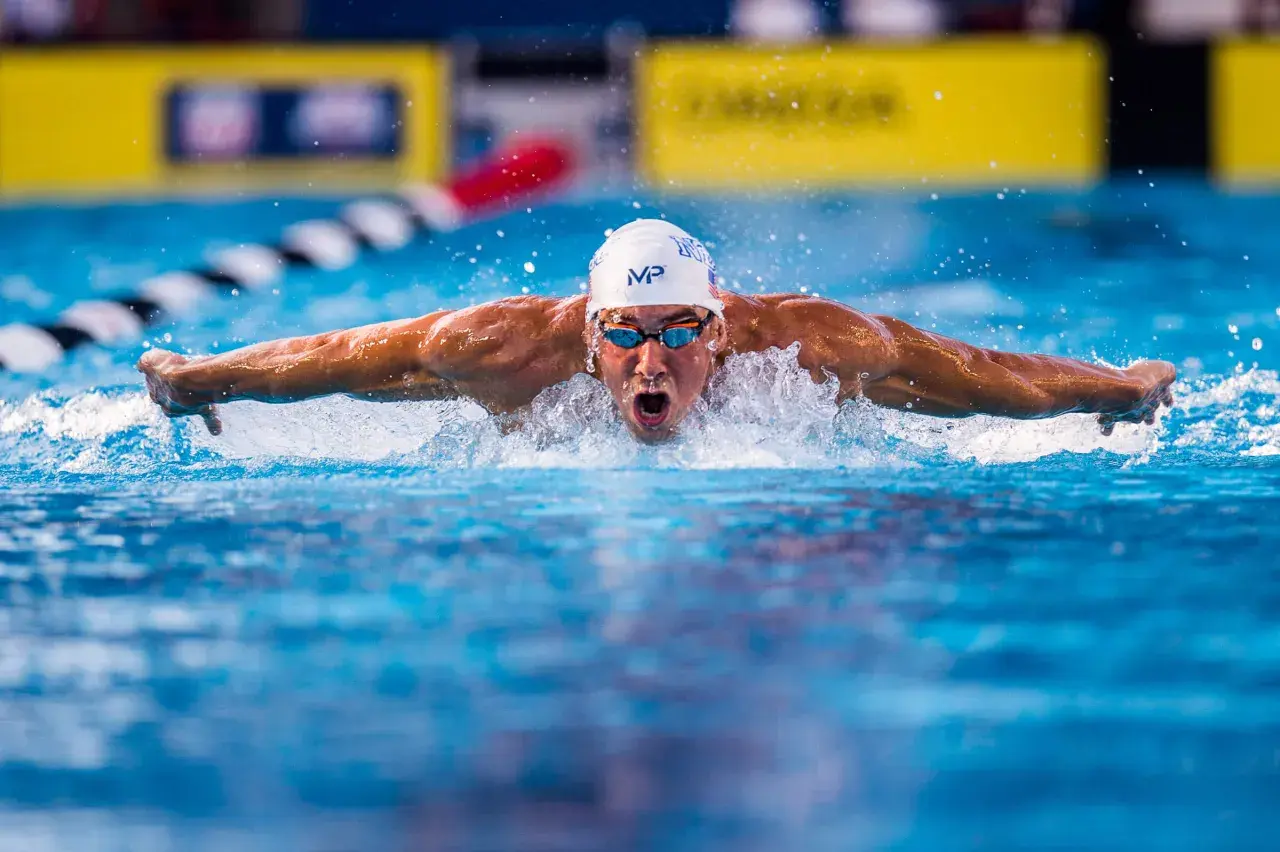
Michael Phelps’ butterfly is still worth studying because it was never just about power. The race blended body line, timing, breathing discipline, and a very serious underwater game, which is why it remains useful for swimmers who want practical speed, not just a famous name to admire. In this article I break down what made his fly so effective, where the real gains came from, and what you can realistically copy in club training.
The useful lessons from Phelps’ butterfly are simpler than the legend suggests
- His speed came from connection between the entry, catch, kick, breath, and breakout, not from one magical move.
- The underwater phase mattered as much as the surface stroke, especially off starts and turns.
- His best fly was efficient, which meant less drag and fewer wasted movements on every cycle.
- Most swimmers should copy the principles of rhythm and line, not try to imitate his exact tempo or physique.
- If you train in a 25m pool, the wall skills become even more valuable because you see them more often.
What people usually want from Phelps’ fly is not a history lesson. They want to know why it looked smooth, why it held speed when other butterfly swims fall apart, and whether there is anything in that style they can actually use. Official Olympic records show he won the men’s 100m butterfly in 51.250 and the 200m butterfly in 1:54.04, so this was not aesthetic swimming for its own sake; it was race-winning technique.

How his butterfly stroke worked stroke by stroke
The first thing I look at in a strong butterfly is whether the swimmer keeps the stroke connected. Phelps did that exceptionally well. He did not look as if he was forcing every phase separately; instead, the recovery, catch, kick, and breath fed into one another, which is what makes a fly stroke look powerful without looking frantic.
Body line and entry
The butterfly starts with the body staying long and close to the surface. Phelps’ best races show a clean entry and a stable line through the torso, which matters because every unnecessary rise or twist costs speed. The point is not to be flat in a dead way; it is to stay streamlined while the body undulates just enough to support the stroke.
Catch and pull
In butterfly, the catch is the moment the forearm and hand begin to hold water. What stood out in Phelps’ fly was that he did not rush this phase. He let the chest press down, anchored the water early, and then drove the body forward through the pull rather than muscling the arms alone. That is a small distinction, but it is the difference between a stroke that carries you and one that merely churns.
Kick timing
The butterfly dolphin kick is often described as two kicks per arm cycle: one kick helping the hands enter and one helping the recovery and exit. Phelps used that rhythm in a way that looked calm, not exaggerated. In practical terms, the kick was doing more than propulsion; it was organising the whole stroke. If the kick is late or mistimed, the stroke feels broken. If it is synced well, the fly feels almost elastic.
Breathing and rhythm
Breathing is where many swimmers lose the shape of the stroke. Phelps kept the breath low and purposeful, so the head did not climb and the hips did not sink. Every breath in butterfly is a small speed tax, so the real goal is to pay that tax without wrecking the line. That is why his fly looked controlled even at very high pace.
The broader lesson is simple: his butterfly worked because it stayed coordinated under stress. Once you see that, the next question is not just how he swam, but where the race was actually won.
Why the underwater phase was a genuine weapon
In a World Aquatics interview, Phelps made the point that elite races are often decided by what happens after the wall, not just what happens during the visible strokes. That matches what I see in butterfly coaching all the time: the underwater dolphin kick is not a side skill, it is part of the race engine.
Research on elite swimming backs this up. One study on sprinters found that start and turn work can account for almost one-third of total race time, which is a big deal in a race that only lasts around a minute or two. In other words, if the underwater phase is weak, the surface stroke has to do too much rescue work.
That matters even more in a 25m pool, which is the standard many swimmers train in across the UK. More walls mean more chances to gain or lose free speed. A swimmer with mediocre underwaters can look acceptable in training and still leave a lot of time on the board once the race gets serious.
For butterfly, I would think about the wall in three parts:
- Push-off gets you into a tight streamline.
- Dolphin kicks keep the speed high while drag is still low.
- Breakout timing decides whether the first surface stroke feels smooth or forced.
If the breakout is too early, you give up underwater speed. If it is too late, you lose momentum and surface in a compromised position. The sweet spot is the one that preserves speed without running into oxygen debt too early, and that is a judgement skill as much as a strength skill.
What to copy and what not to copy
This is where a lot of swimmers go wrong. They copy the silhouette of a champion instead of the underlying principles. That usually leads to a messy fly stroke that looks impressive for one lap and breaks down the moment fatigue rises.
| Phelps principle | Why it mattered | How to adapt it |
|---|---|---|
| Long body line | Reduced drag and kept the hips higher | Keep the head neutral and let the chest drive the wave, not the shoulders |
| Connected kick rhythm | Linked the pull to the recovery instead of breaking the stroke apart | Practise a steady two-kick pattern with consistent timing |
| Relaxed recovery | Saved energy and prevented the shoulders from looking forced | Let the arms swing forward cleanly without shrugging or snatching |
| Strong underwater work | Created free speed off starts and turns | Train push-offs and breakouts as separate race skills |
| Controlled breathing | Protected the stroke shape under pressure | Breathe only when the body rise is already helping you |
What not to copy is just as important. Do not copy his body proportions, because you do not get to choose those. Do not copy race tempo without first earning the fitness to hold it. And do not assume butterfly has to feel like a fight every length. The best versions of the stroke feel powerful, but they are still organised.
For UK swimmers, I would also say this: if you spend a lot of time in short-course metres pools, the wall work deserves as much attention as the stroke count. That is not glamorous, but it is often where the biggest time gain sits.
The mistakes that break butterfly rhythm fastest
If I am fixing butterfly, I usually start with the same few errors. They are common, they appear at all levels, and they tend to snowball once fatigue arrives.
- Lifting the head to breathe causes the hips to drop. Keep the breath low and forward, not upward.
- Pulling too deep creates a big, slow finish and wastes shoulder effort. Keep the catch efficient and the finish tidy.
- Kicking from the knees makes the stroke look busy without generating enough forward drive. The kick should start from the core and hips.
- Rushing the recovery makes the stroke rate higher but not faster. Speed is not the same as hurry.
- Ignoring the breakout leaves easy metres on the table. The first surface stroke should feel like part of the underwater sequence, not a reset.
The breath is usually the biggest tell. If the head movement is too big, almost everything else starts to fall apart behind it. That is why I like to film one lap before changing anything else: the video shows whether the problem is the stroke itself, the timing, or the way the swimmer is entering the breath.
What Phelps’ butterfly still teaches swimmers in 2026
The real value of Michael Phelps’ fly is not that it was perfect in some abstract sense. It is that it showed how much speed comes from habits that repeat cleanly under pressure. A great butterfly is not built on one heroic pull; it is built on a rhythm that survives the whole race.
If I were coaching this today, I would focus on three priorities first: a cleaner body line, better underwater speed, and a breath that does not interrupt the stroke. Those are the parts most swimmers can improve fastest, and they usually produce more time savings than chasing extra power in the arms.
So the practical takeaway is this: study Phelps for principles, not cosplay. Build the line, sharpen the turn, protect the rhythm, and let the stroke feel connected. That is the part worth carrying into the next session, because it is the part that actually travels from pool to pool.