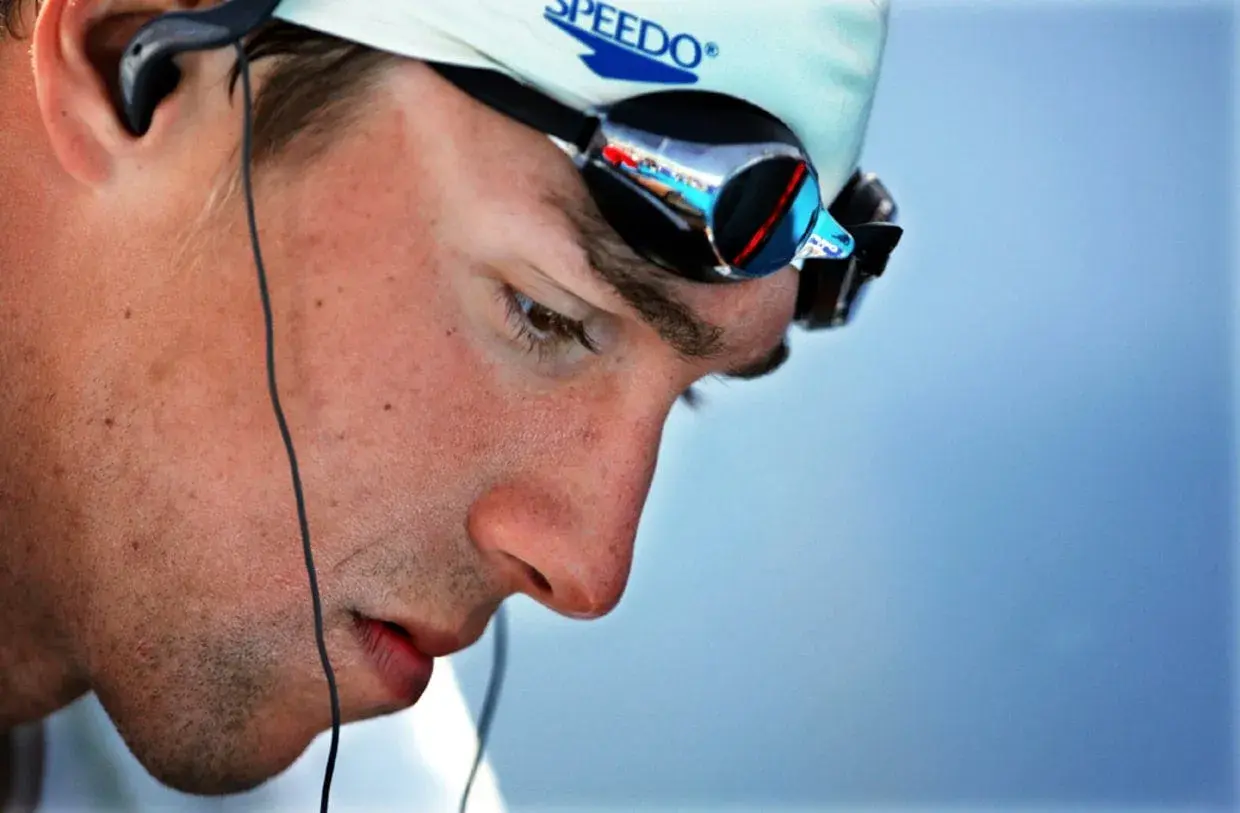
Michael Phelps visualization is really about mental rehearsal: building a race in the mind so clearly that the body can execute it under pressure. What made his approach useful was not vague positivity, but precision, repetition, and a willingness to rehearse mistakes as well as perfect swims. For swimmers, that makes it one of the most practical mental tools in the sport, especially when training needs to turn into cleaner starts, sharper turns, and calmer finishes.
What this mental routine actually teaches swimmers
- It works best when the body is calm first, then the race is played back in vivid detail.
- The useful version includes starts, turns, stroke rhythm, finishes, and likely problems like bad goggles or a messy breakout.
- Visualization helps swimmers stay composed, but it does not replace aerobic work, technique drilling, or race-specific pace sets.
- A good starter routine takes 5 to 10 minutes and becomes more useful when tied to one clear goal.
- The biggest payoff is confidence under pressure, not fantasy confidence.
What Phelps’ mental rehearsal actually looked like
The most important thing to understand is that Phelps did not treat mental rehearsal like a motivational slogan. He treated it like part of training. The version often described by his coach was a “mental videotape” built from the same logic as a race plan: get the body relaxed, then run the performance in detail until it feels familiar.
That detail matters. I do not mean generic images of standing on a podium or swimming fast. I mean seeing the start, breakout, stroke rhythm, turn count, underwater line, finish, and even the awkward moments that can ruin a race if they catch you off guard. A swimmer who rehearses only the perfect outcome is practicing a fantasy; a swimmer who rehearses the actual race is building readiness.
Phelps’ routine also appears to have included sensory detail. In practical terms, that means the feel of the water, the pressure on the catch, the timing of the breath, the number of strokes to the wall, and the body language after the finish. That level of specificity is what turns visualization from “thinking happy thoughts” into a usable skill. Once you see that distinction, the rest of the method makes more sense.
That leads to the real question: why does this work so well in swimming, where races are short, technical, and unforgiving?
Why it worked so well in swimming
Swimming is a sport where tiny errors compound quickly. A slightly late breath, a sloppy turn, or one extra stroke into the wall can decide a race. Visualization helps because it reduces uncertainty before the race starts, which means there is less room for panic when the race becomes messy.
I think that is the hidden strength of Phelps’ approach. It was not just about confidence; it was about decision-making under pressure. If your mind has already rehearsed the race, your body is not encountering every turn, every tempo change, or every problem as if it were brand new. That gives you a calmer nervous system and, more often than not, cleaner execution.
There is also a strong fit between mental rehearsal and the way swimming is trained. Swimmers repeat the same strokes, turns, and starts thousands of times. Visualization extends that repetition when you are out of the water, which is valuable because technique in swimming depends on timing and consistency. The mind is not replacing the pool; it is reinforcing what the pool has already taught.
And when pressure rises, the benefit becomes more obvious. A swimmer who has already pictured leaking goggles, a missed tempo cue, or a difficult last 50 is less likely to unravel when one of those things happens. That is one reason the method has lasted far beyond Phelps himself and still belongs in serious swim training.

How I would build it into swim training
If I were coaching a swimmer today, I would keep the routine short, specific, and repeatable. The goal is not to spend half an hour daydreaming. The goal is to create a repeatable mental rep that matches the race you actually need to swim.
| Step | What to do | Why it helps |
|---|---|---|
| 1. Calm the body | Use 60 to 90 seconds of slow breathing and a simple body scan from head to toes. | A relaxed body makes the image clearer and keeps the routine from turning into mental noise. |
| 2. Run one race | Picture one specific event from blocks to finish, with strokes, turns, breathing pattern, and tempo. | Specific rehearsal builds familiarity and gives the brain a concrete race script. |
| 3. Add one problem | Imagine one realistic issue, such as foggy goggles, a bad start, or a crowded lane, and rehearse the response. | Pressure feels smaller when you have already practiced the fix. |
| 4. End with one cue | Close with a short cue word such as “long,” “quick hands,” or “strong finish.” | A cue word keeps the image connected to execution instead of drifting into abstraction. |
For a swimmer new to this, 5 minutes is enough. Once the routine feels natural, I would stretch it to 10 or 15 minutes, especially before key sessions or meets. A recent trial in adolescent swimmers used 15-minute daily imagery paired with breathing work over 10 weeks and found encouraging performance gains, which is exactly the kind of practical signal coaches should pay attention to: this is not just theory, but it works best when it is structured.
The biggest rule is simple: choose one race or one skill. If you try to visualize an entire meet, you usually end up visualizing nothing with enough detail to matter. That narrow focus is what makes the routine transferable from imagination to the lane line.
Once that structure is in place, the next trap is easy to spot: people often do visualization badly even when they mean well.
The mistakes that make visualization weak or fake
I see the same errors over and over when swimmers try mental rehearsal for the first time. The first is being too vague. “I will swim well” is not visualization; it is a wish. If the image does not include race-specific detail, it will not help much when the pressure hits.
The second mistake is only rehearsing the perfect version. That sounds positive, but it is incomplete. Real races include noise, fatigue, and the occasional mistake. If you never rehearse a correction, you are training yourself to panic the first time something goes wrong.
The third mistake is using visualization as a substitute for pool work. That is the wrong tradeoff. Mental rehearsal supports technique, conditioning, and race pace; it does not replace them. A swimmer with weak turns or poor aerobic support will not fix that by thinking harder.
The fourth mistake is doing it in a distracted state. If your phone is buzzing, your posture is tense, and your mind is scattered, the image will be shallow. The routine works better when you build a small ritual around it: same place, same breathing pattern, same race focus. Consistency gives the mind a cue that it is time to train.
The fifth mistake is overcomplicating it. You do not need a ten-point script on day one. You need one clear race, one problem, and one cue. That simplicity is part of why the method survives real training schedules.
Those mistakes matter because mental rehearsal is only useful when it fits into the rest of the week, not when it floats above it as a separate self-help exercise.
How to blend imagery with race prep, recovery, and fitness work
The best use of imagery is layered into the week. I like it most in three places: after technical work, before sleep, and on meet day before the warm-up or right after it. Each moment serves a different purpose, and using all three is more effective than relying on one dramatic session before a race.
After technical work, visualization helps lock in what you just felt in the water. That is useful after starts, turns, underwater work, and pace sets because the body still has the movement pattern fresh in memory. Before sleep, it can calm the day’s noise and give the mind a single performance image to hold onto. On meet day, it is best kept short and sharp, so it supports confidence without making you mentally tired.
It also belongs alongside dryland and recovery work. If a swimmer is building more strength in the core, shoulders, or legs, the image should reflect that stronger body position. If recovery is the focus, the mental script should stay simple and efficient rather than overloaded. Visualization works best when it is connected to what the training block is actually trying to improve.
One practical way to think about it is this: dryland builds capacity, pool training builds skill, and imagery helps make both easier to access when fatigue or pressure shows up. That combination is where the method becomes more than a motivational trick.
And once you see it that way, the final step is obvious: make the routine small enough that you will actually keep doing it.
The routine I would put in place before the next meet
If I had to give a swimmer a starting plan this week, I would keep it very plain. Pick one event. Write down three race details you always want right. Add one likely problem and one response. Then rehearse the whole thing for 5 minutes a day for 7 days.
- Race detail 1: the first 15 meters.
- Race detail 2: the turn and underwater line.
- Race detail 3: the last stroke count into the wall.
- One problem: goggles, pace, or nerves.
- One cue: a word that reminds you how the race should feel.
That is the version of mental rehearsal I trust most: small, repeatable, and tied directly to swim performance. The lesson from Phelps is not that imagination beats training; it is that the right image can make training stick when the race gets loud.