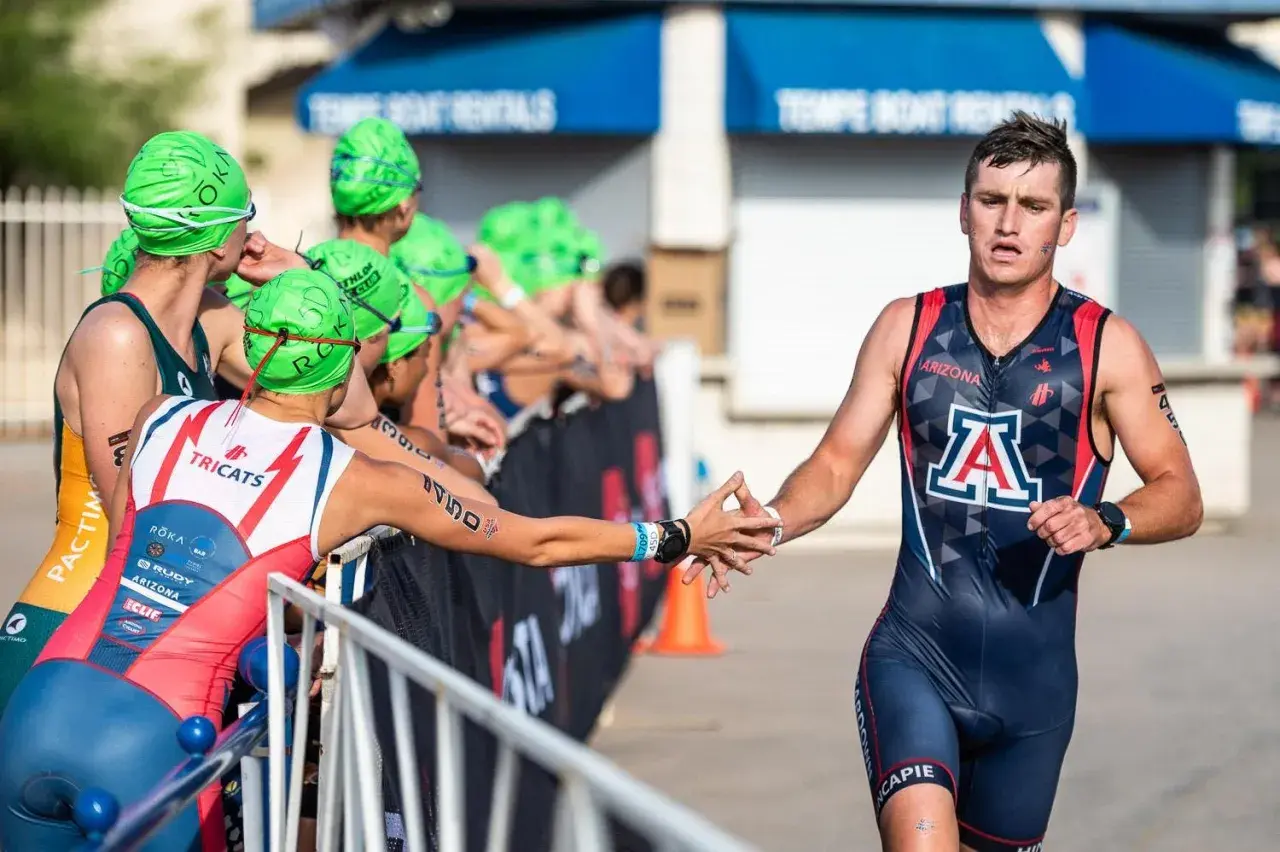
NCAA triathlon is best understood as women’s collegiate triathlon: a sprint-distance, draft-legal race that rewards swimmers who can also handle the bike pack and close hard on the run. In 2026, it sits at an interesting point in college sports, still an emerging NCAA event but far enough along to matter for recruits, coaches, and programs building long-term depth. I’ll break down how the races work, how teams are scored, where the club pathway fits, and what swimmers need to learn before they can race it well.
What matters most before you compare programs
- The NCAA still treats women’s triathlon as an emerging sport, not a full championship sport yet.
- The standard race is 750m swim, 20k bike, and 5k run.
- Draft-legal racing makes positioning and pack riding as important as raw fitness.
- Team results are shallow, so every place and every transition matters.
- By 2026, the sport is expanding fast enough that program support and coaching depth are real differentiators.
- Swimmers have a strong starting point, but they still need bike handling and run durability to convert it into results.
What the sport really is in 2026
The biggest misconception is that college triathlon already looks like a finished, fully mature NCAA championship sport. It does not. The NCAA still places triathlon in its Emerging Sports for Women program, which is designed to move a sport toward championship status once sponsorship and participation benchmarks are strong enough. That matters because the framework shapes funding, roster planning, and how seriously schools treat new programs.
What makes 2026 notable is the momentum. The sport is no longer a niche experiment sitting on the edge of college athletics. Sponsorship counts have climbed, and Conference Carolinas’ move to sponsor women’s triathlon gives the sport a new kind of visibility at the conference level. From my perspective, that is the clearest sign that this is becoming a real collegiate pathway, not just a development project.
For athletes, that means the decision is not only about loving triathlon. It is also about choosing a school where the support structure matches the demands of a three-discipline sport. Once you understand that, the race format itself starts to make more sense.

How race day works from the pool to the finish line
The collegiate format is compact, fast, and tactically messy in a good way. USA Triathlon describes the standard race as sprint-distance and draft-legal, which means the field races 750 meters in the water, 20 kilometers on the bike, and 5 kilometers on the run. That shorter distance does not make it easier; it simply makes every mistake more expensive.
| Leg | What it looks like | What matters most |
|---|---|---|
| Swim | Fast open-water start, tight packs, quick positioning | Start speed, sighting, and staying calm in traffic |
| Bike | Draft-legal riding with groups, corners, and constant pressure | Pack handling, line choice, and safe acceleration |
| Run | A hard 5K after the bike | Cadence, composure, and holding form under fatigue |
| Transitions | Two quick changeovers between disciplines | Clean habits and rehearsed movement |
Draft-legal racing is the detail that changes everything. Instead of riding alone against the clock, athletes work in packs, respond to surges, and need the confidence to sit close to other riders without wasting energy or drifting out of position. In practice, that means the best collegiate triathletes are not just fit. They are race aware. The first athlete to panic in transition or over-breathe in the swim can lose more ground than the physical gap would suggest.
Once the format is clear, the next question is how teams actually build around it.
How team scoring changes the recruiting picture
Team scoring is one of the reasons this sport is so interesting to coaches. At regional championships, programs can enter up to 10 athletes, while nationals narrow that to seven competitors, with the top five finishers scoring points. That creates a very specific recruiting problem: one star is useful, but depth usually wins the day.
I think that is where a lot of swimmers underestimate the sport. In a traditional pool setting, a single dominant performance can carry a relays-first program or change a dual meet. In collegiate triathlon, a mid-pack athlete who stays steady in all three legs can be more valuable than someone with a flashy split and weak race management. The scoring model rewards reliability.
- A swimmer who exits the water with the front group is immediately useful.
- A cyclist who can hold position in a draft-legal pack adds real team value.
- A runner who does not collapse after the bike often becomes the hidden difference-maker.
- An athlete who practices transitions can save more time than a pure fitness gain would.
This is why recruiting conversations in the sport are so different from what many swimmers expect. The question is rarely, “Can you swim fast enough?” It is more often, “Can you compete cleanly in a format where five athletes have to deliver?” That distinction leads naturally to the other path college athletes should know about.
How it compares with club racing and other college pathways
If your school does not sponsor a varsity roster, that does not mean the college triathlon path is closed. It just changes shape. The club route gives students a way to race nationally without varsity status, while women’s varsity triathlon sits inside the NCAA structure at sponsoring schools. For men, the organized collegiate path is typically club-based rather than NCAA varsity.
| Pathway | Best for | Main upside | Main trade-off |
|---|---|---|---|
| Women’s varsity triathlon | Athletes at schools with an official program | Coaching, travel, and varsity support | Limited number of rosters |
| College club triathlon | Students at schools without varsity triathlon | Broad access and a national racing scene | Less institutional support |
| Open-age sprint racing | Athletes chasing deeper fields and broader competition | Useful for development and benchmark testing | Less of a college-centered identity |
That comparison matters because the right pathway depends on the school, not just the athlete. A fast swimmer at a non-sponsoring campus still has options, but the experience will look different from a varsity roster with dedicated coaching and travel support. Once you sort out the pathway, the real question becomes how swimmers adapt to the sport itself.
Why swimmers adapt quickly but still need new skills
This is the part I care about most, because swimmers often arrive with the best engine for the first leg and the wrong assumptions about the other two. Pool fitness translates well, but it does not automatically solve open-water sighting, pack navigation, or the stress of running hard after a bike segment. A strong swimmer can absolutely thrive here, but only if the athlete learns to race, not just to perform one discipline well.
The most common adjustment points are straightforward:
- Open-water sighting means lifting the eyes without breaking rhythm.
- Draft-legal bike handling means riding close, safely, and efficiently in a group.
- Transitions matter because small mistakes compound fast in a short race.
- Run durability is the final filter, especially when the legs are already loaded from the bike.
From a swimming perspective, the biggest edge is not just raw speed. It is efficiency under pressure. Athletes who can keep a clean stroke when the start is messy usually handle the rest of the race better too. The ones who struggle often do not fail because they lack talent; they fail because they underestimate how much the sport asks for outside the pool.
That is why the next step is not buying more gear. It is understanding whether the program, the coaching, and the environment can support the learning curve.
What I would ask before committing to a program
If I were advising a recruit or a coach, I would focus on the questions that affect daily training rather than the marketing language on a school’s athletics page. The right program is usually the one that can teach the details well and repeat them consistently.
- Who coaches the swim-bike-run integration, not just the swim side?
- How often do athletes get group bike sessions and safe outdoor riding space?
- Is there enough transition space to practice mounts, dismounts, and race flow?
- How are scholarships or aid packages actually structured?
- How many athletes travel to major races, and what earns a travel spot?
- Is there a real plan for open-water preparation and race simulation?
If I had to reduce all of this to one practical point, it would be simple: collegiate triathlon is a serious opportunity for swimmers, but only when the school treats the sport as a complete performance system. The programs that will matter most are the ones that build clean habits early, support the bike and run pieces honestly, and give athletes enough structure to turn a good swim into a complete race.