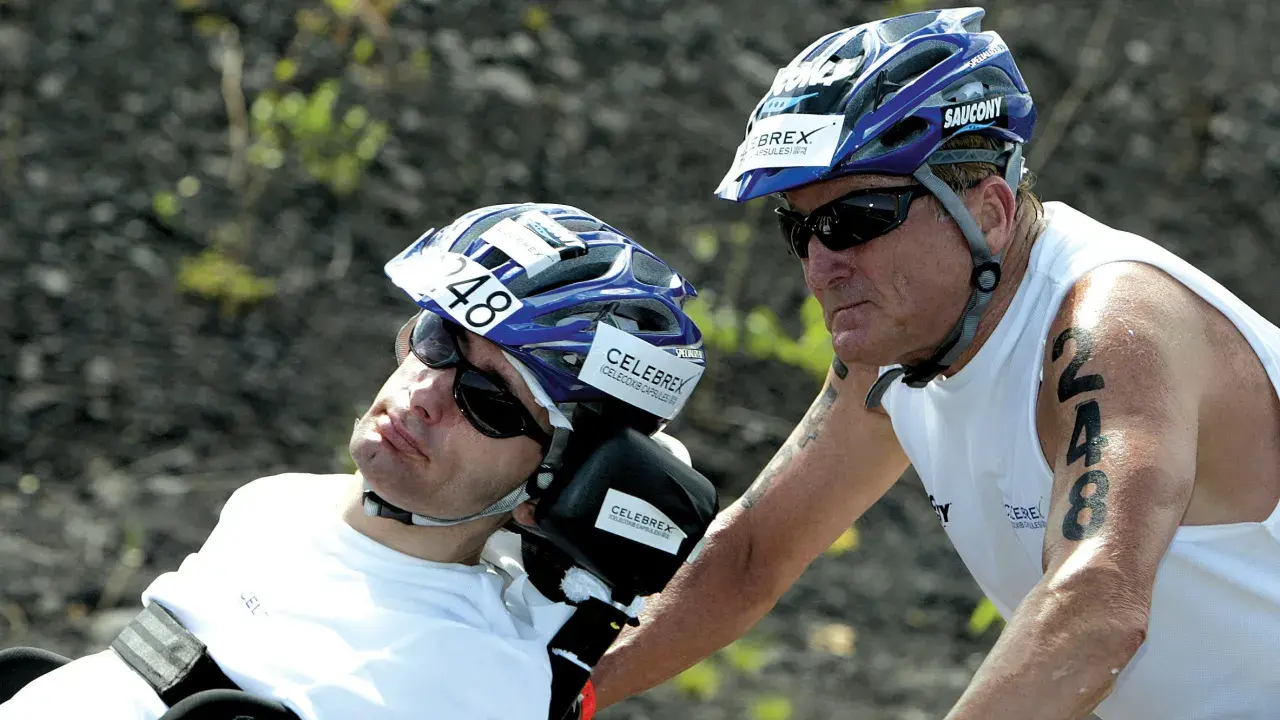
Dick Hoyt’s Ironman story is best understood as a partnership that solved a hard sporting problem with patience, adaptation, and trust. The useful details are in how Team Hoyt handled the swim, bike, and run, why their Kona finish mattered so much to triathlon, and what endurance athletes can still learn from the way they raced. For swimmers and triathletes, it remains a rare example where equipment, pacing, and purpose all mattered as much as fitness.
The Kona finish that made inclusion impossible to ignore
- Team Hoyt became the first duo to complete the IRONMAN World Championship in Kona in 1989, then returned to finish again in 1999.
- Their 1989 result was 14:26:04, built on a 1:54:06 swim, an 8:01:30 bike, and a 4:30:27 run.
- Rick Hoyt had cerebral palsy, so Dick used a tow boat, a custom bike setup, and a wheelchair-style run rig to move through each leg.
- The story matters because it changed how triathlon thought about inclusion, support, and what a real finish could look like.
- For athletes today, the best takeaway is that long-course success depends on rehearsal, logistics, and calm execution under stress.
Before Kona became the headline, the Hoyts had already built a shared racing identity. Rick wanted to compete with his father, and Dick, who was not a natural runner at the start, learned the sport from the ground up. That matters because their Ironman results were not a lucky exception; they were the product of a system they refined over time, which is exactly how any serious endurance project succeeds.
When they first turned their attention to the world championship, they were not chasing a publicity moment. They were trying to make a difficult course workable for a father-son team with very different physical needs. That mindset explains why the rest of their race plan was so deliberate, and it is the reason the 1989 finish still feels more impressive than many faster times.

How Team Hoyt handled the swim, bike and run
| Leg | What they used | Why it was hard |
|---|---|---|
| Swim | Dick towed Rick in a special inflatable boat | Open-water control, straight-line tracking, and constant awareness all had to be managed at once. |
| Bike | Rick rode in a specially built seat on the front of the bike | Power output, balance, feeding, and hydration all had to work together while carrying extra load. |
| Run | Dick pushed Rick in a custom wheelchair or jogger | The marathon still demanded stamina, cornering skill, and a pace that could be held for hours. |
| 1989 result | 14:26:04 total | The finish proved the method could work in Kona conditions, not just in smaller races. |
The numbers tell you how demanding that day was, but they do not fully capture the mechanics. On the swim, Dick had to change his stroke and check on Rick every 15 to 20 strokes, which is a reminder that endurance racing is often a series of small corrections rather than one heroic burst. On the bike, the combined weight of Dick, Rick, and the bike was reported at 376 pounds, so every climb asked for real strength, not symbolism.
That is why I think the swim leg is the most revealing part of the story for triathletes. In open water, the challenge is not only speed; it is straight-line efficiency, control under pressure, and the discipline to keep moving without wasting energy. Team Hoyt had to do all of that while carrying a second person, which is about as clear a definition of execution under stress as you will ever see.The 1989 finish came after a first attempt in 1988, and that detail matters. It was not a one-off event staged for applause. They came back, adjusted, and finished the race the hard way. In triathlon, that kind of revision is often what separates a hopeful attempt from a durable performance.
Why the Kona finish changed triathlon
Team Hoyt became the first duo ever to complete the IRONMAN World Championship in Kona, and that achievement changed the visual language of the sport. Until then, many people still treated the race as a test for individual bodies that fit a narrow definition of athleticism. The Hoyts showed something more important: with the right support structure, endurance sport could include athletes whose participation had previously been dismissed or ignored.
I do not think the impact came only from the finish itself. It came from the fact that the finish was real, repeatable, and public. A decade later they returned and finished again, which proved the 1989 result was not a novelty. That is why their legacy lasted: they did not just inspire spectators, they changed expectations about who belonged on the course.
The broader triathlon world noticed. Their 2008 induction into the IRONMAN Hall of Fame formalised what athletes had already understood for years, which is that the Hoyts were not just part of the race’s history, they were part of the reason the race’s history widened. Once that happened, inclusion stopped being an abstract idea and became a standard that organisers and athletes could actually point to.
What swimmers and triathletes can learn from their race plan
For me, the most valuable lesson is not sentimental. It is practical. If you strip the story down to race craft, the Hoyts were excellent at solving the details that most people underestimate.
- Treat the swim as a control problem, not just a fitness test. Sighting, which means checking direction by lifting the eyes briefly above the water, is essential in open water. If your line is poor, you spend energy for no gain.
- Rehearse transitions. Transitions are the handovers between swim, bike, and run, and they are where messy logistics turn into lost minutes. The Hoyts understood that the race was only as strong as each handover.
- Build a support protocol. Nutrition, hydration, equipment checks, and communication all need roles. A long-course race is much easier when every job is assigned before the start.
- Choose the right adaptation, not the most impressive-looking one. A setup that is stable, repeatable, and safe is worth far more than one that looks clever but breaks under race stress.
That is why this story still speaks to swimmers as much as to triathletes. Technique is not only about what happens in a pool lane; it is about whether your movement still works when the water gets rough, the pace gets awkward, or your body is carrying more responsibility than usual. If your stroke, breathing pattern, or open-water rhythm falls apart when conditions change, the problem is not effort. It is unfinished preparation.
From a coaching standpoint, I would rather see an athlete who has rehearsed those realities than one who has a faster pool split but no race-day structure. The Hoyts understood that instinctively, and it is one reason their story feels so durable.
Why this story still matters in 2026
The triathlon scene in 2026 is more inclusive than it was when the Hoyts first arrived in Kona, but the basic lesson has not changed. The sport still rewards athletes and support teams that respect the demands of the course, prepare for the conditions, and make room for different bodies without lowering the standard of the event itself.
That balance is what makes the Hoyts so important. They never asked the race to become easier. They showed how the race could become broader. For anyone training for long-course events, especially in the UK where weather, wind, and open-water variability can shape the day, that is the real takeaway: the best performance is the one where the plan survives contact with reality.
If I had to reduce the whole story to one practical sentence, it would be this: endurance success is rarely about one dramatic effort, and almost always about a structure that holds together long enough for belief to become a finish line.