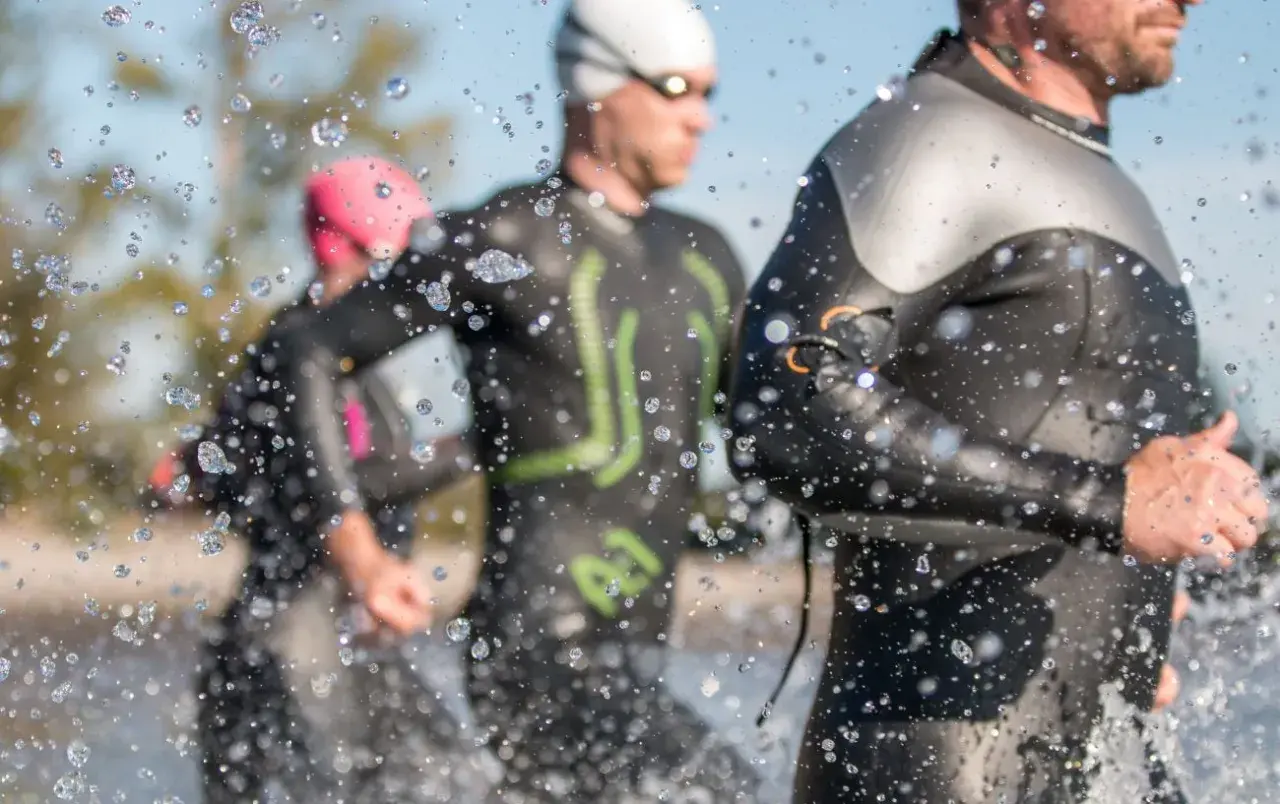
The practical side of ironman wetsuit rules comes down to three things: water temperature, suit legality, and what happens to your race if the conditions turn borderline. I read this as a performance decision, not just a gear detail, because a suit can be legal and still change your eligibility for awards if the event shifts into a special wetsuit division. This article breaks down the cutoffs, the equipment limits, and the decisions I would make before race morning.
What matters most before race morning
- Age-group, relay, and Open Division athletes may wear wetsuits at or below 24.5°C / 76.1°F.
- Professional athletes have a lower limit: wetsuits are allowed only up to 21.9°C / 71.5°F.
- Above 28.8°C / 83.8°F, wetsuits are banned; in some U.S. races, a separate non-competitive wetsuit wave may still be offered.
- A legal wetsuit cannot exceed 5 mm thickness, including overlapping panels in a two-piece design.
- If wetsuits are banned, swimwear must be 100% textile and cannot extend past the elbows or knees.
- The final decision is made close to race day, so the morning water ruling matters more than the air temperature.
The temperature line that decides everything
When I strip the issue down, the race is decided by water temperature, not by how chilly the morning feels on shore. For age-group athletes, relay teams, and Open Division athletes, wetsuits are allowed up to and including 24.5°C / 76.1°F. Professionals have a tighter limit at 21.9°C / 71.5°F, while anything above 28.8°C / 83.8°F is a hard no for everyone.
| Athlete group | Wetsuit rule | What it means in practice |
|---|---|---|
| Age-group, relay, Open Division | Allowed up to 24.5°C / 76.1°F | You can race in a wetsuit and stay in the normal competitive field. |
| Professional athletes | Allowed up to 21.9°C / 71.5°F | A slightly warmer swim can push pros into a no-wetsuit start. |
| All athletes | Prohibited above 28.8°C / 83.8°F | No wetsuit is legal, even if the water still feels manageable. |
| All athletes | Mandatory below 16°C / 60.8°F | The swim becomes a wetsuit swim by rule, not by preference. |
There is one U.S.-specific wrinkle worth knowing. In some USA Triathlon-sanctioned events, IRONMAN may allow age-group athletes to wear wetsuits in the band between 24.5°C and 28.8°C, but only in a separate non-competitive wetsuit division. That keeps the start line open, yet it usually removes eligibility for age-group awards and championship slots. The practical lesson is simple: allowed does not always mean fully race-eligible.
Once you know the temperature band, the next question is whether your suit itself passes the equipment test.

What counts as a legal wetsuit
A legal suit is not just a warm suit. It has to meet size, coverage, and construction limits, and that is where a lot of athletes get surprised. The current 2026 IRONMAN rulebook keeps the definition fairly strict, especially once you start adding panels, caps, or extra neoprene accessories.
- Thickness may not exceed 5 mm. If the suit has two or more pieces, the combined thickness of any overlapping sections also cannot exceed 5 mm.
- Coverage is broad, but not unlimited. A wetsuit may cover any part of the body except the face, hands, and feet.
- The outer layer must fit tightly. If the suit floats away from the body or looks oversized, that is a bad sign.
- A race kit can be worn underneath. That part is allowed, which matters if you want a smooth transition plan.
- A neoprene cap is allowed when wetsuits are allowed. If you use one, the official swim cap must still be worn on the outside.
- Neoprene booties are a separate rule. They are only allowed when the water is 18.3°C / 65°F or colder.
I would also be cautious with anything that adds unusual buoyancy or arm coverage in a nonstandard way. Standard triathlon wetsuits are usually the safest choice because they are built for this exact rule set, while odd flap designs or extra neoprene add unnecessary risk. If I were advising an athlete for a first Ironman swim, I would keep the suit simple, legal, and already tested in open water.
That matters even more when the race turns hot and the wetsuit disappears from the plan entirely.
What changes when wetsuits are banned
When the water is too warm, the swimwear rules get stricter than many athletes expect. If wetsuits are prohibited, your swimwear must be 100% textile, which means no neoprene and no rubberized materials such as polyurethane. It may include a zipper, and shoulder-to-elbow sleeves are allowed, but the garment must not cover the neck, extend past the elbows, or extend past the knees.
That is also why buoyancy shorts and neoprene bottoms are a problem. They are not a clever workaround; they are simply not allowed in a no-wetsuit swim. If you planned to rely on compression gear, check the cut carefully, because any textile race kit worn underneath still has the same coverage limits and cannot extend past the elbows or knees.
- Allowed in a no-wetsuit swim: textile swimsuits, textile race kits within the coverage limits, and a zipper.
- Not allowed: neoprene shorts, neoprene bottoms, neck coverage, sleeves past the elbow, or legs covered past the knee.
- Common mistake: assuming a compression layer is automatically legal just because it feels thin.
This is the part of the rule set that catches people on warm, calm mornings, because the race still has a dress code even when the wetsuit is off the table. From there, the enforcement piece becomes just as important as the gear itself.
How the rule is enforced on race day
The official call is not guesswork. IRONMAN’s 2026 rules and race guides make clear that the water temperature ruling is the one that matters, and many events publish a preliminary decision the day before with a final ruling on race morning. Race officials then monitor athletes at the start, so this is not a rule you can quietly ignore and hope to get away with.
That is why the weather app is a weak predictor. Air temperature, wind, and sunshine can feel dramatic on the beach while the actual swim water barely moves. I always tell athletes to trust the event ruling, not the forecast, because that ruling controls whether wetsuits are legal, mandatory, or banned.
If your race lands in the gray zone between the normal cutoff and the absolute ban, the key question is not just whether you can wear a wetsuit. It is whether doing so changes your competitive status. In a separate non-competitive wetsuit wave, you may still get to swim, but you should expect different eligibility rules than the main age-group field. That distinction is easy to miss and expensive to assume away.
Once the enforcement logic is clear, the real value is in choosing a suit that helps you swim faster without flirting with a rules problem.
How I would choose a suit for a specific course
For an Ironman swim, fit matters more than marketing claims. A suit that is technically legal but restrictive across the shoulders or too hard to remove in T1 can cost more time than it saves. I care about three things first: body position, breathing comfort, and how cleanly the suit comes off after the swim.
- Prioritize shoulder freedom. Overly tight shoulders make breathing and sighting worse, especially late in a long swim.
- Test the suit in open water. Pool tests are useful, but they do not tell you how the suit behaves when you are sighting, turning, and starting hard.
- Practice the exit. If you need ten extra seconds to peel it off, practice until that is no longer true.
- Do not size down aggressively. A suit that feels fast on the hanger can become a breathing problem in the water.
- Keep the design conventional. Standard triathlon wetsuits are easier to defend if anyone questions legality.
For long-course racing, I would rather have a slightly less buoyant suit that lets me breathe well than a super-stiff suit that feels fast in the store. The swim is long enough that comfort and rhythm usually beat theoretical gains. Once you are confident in the suit, the biggest remaining risks are the mistakes athletes repeat every season.
The mistakes that cost people time or eligibility
The fastest way to create stress on race week is to treat the wetsuit decision as a last-minute guess. The same errors show up over and over, and most of them are avoidable with a little discipline.
- Using air temperature as the decision-maker. The water rule controls the swim, not how warm it feels on land.
- Skipping the athlete guide. Event-specific notes can confirm whether a separate wetsuit division exists and how it affects eligibility.
- Assuming every U.S. race offers a fallback. Some events allow a non-competitive wetsuit wave, but not all do.
- Showing up with a suit over 5 mm. That is an avoidable DQ risk and not worth the gamble.
- Forgetting the mandatory-wetsuit threshold. Below 16°C / 60.8°F, the rule flips from optional to required.
- Trying brand-new gear on race day. New neoprene can feel different enough to affect breathing, sighting, and the first 200 meters.
The other mistake I see is athletes overcomplicating the swim with extra neoprene accessories or odd workarounds. When the rule set is tight, the safest path is usually the simplest one. If your gear needs an explanation, it probably needs a second look.
My race-week checklist for a clean swim decision
If I were preparing for an Ironman swim in the United States, I would keep the process very direct. The goal is not to win the argument with the rulebook; the goal is to show up with the right gear for the actual conditions.
- Check the athlete guide for the event-specific wetsuit ruling and any special division rules.
- Confirm whether the race offers a separate wetsuit wave if the water is warm but still below the absolute ban.
- Lay out a legal suit, goggles, swim cap, and any backup items the night before.
- Practice getting into and out of the suit exactly the way you will do it on race morning.
- If the forecast points to warm water, rehearse a no-wetsuit swim in legal textile gear so the feel is familiar.
My rule of thumb is simple: treat the wetsuit as a conditional advantage, not a default. Know the temperature band, know your suit, and know whether the start line you choose still leaves you eligible for the result you want. That is the difference between a calm race morning and a last-minute scramble at transition.
