For UK races, the right benchmark depends on the course, the water, and the kind of athlete lining up on the start. I’ll break down the usual finish-time bands, what changes them, and how I would approach a first race or a time goal with a bit more precision.
Key points at a glance
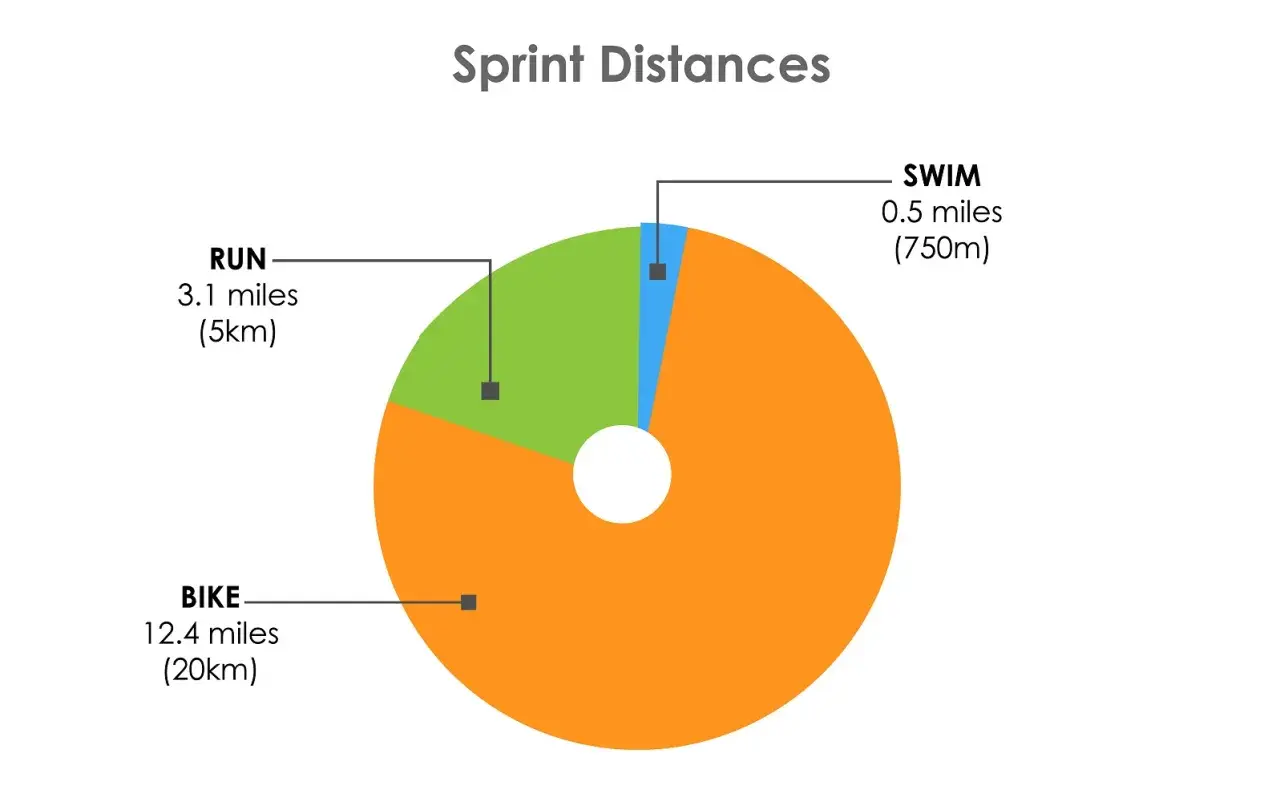
- Most UK sprint events are 750m swim, 20km bike, and 5km run, although some pool-based races use a 400m swim.
- For the average field, 75 to 90 minutes is a realistic expectation; sub-60 is a very strong result.
- First-timers often finish somewhere between 1:20 and 1:45, depending on swim comfort and course difficulty.
- Transitions are not background noise; they can add or save several minutes in a race this short.
- Open water, wind, hills, and a technical bike course can change the clock far more than fitness alone.
What counts as a sprint triathlon in the UK
The standard sprint format in the UK is simple on paper: 750m swim, 20km bike, and 5km run. British Triathlon also notes that some sprint races use a 400m pool swim instead of open water, which is one reason finish times are not perfectly comparable from event to event.
That difference matters more than people expect. A 750m open-water swim with a mass start, sighting, and possibly a wetsuit is not the same challenge as a controlled pool swim. Add a flat closed-road bike course at one venue and a windy, hilly route at another, and the final time can move by a surprising amount even when the athlete is equally fit.
From where I sit, that is the first thing to understand before you compare your result with someone else’s. Once the format is clear, the next question is what a good or typical time actually looks like.
The finish-time bands that actually help
British Triathlon puts most competitors in the 75 to 90 minute window for a sprint race, with top athletes finishing in under an hour. That is a useful reference point because it reflects a real race population, not just elite performances or optimistic beginner estimates.
I find it more helpful to think in bands than in one “correct” number. Here is the range I would use when I talk about sprint-distance expectations in the UK.
| Finish-time band | Who it usually fits | What it usually says about the race |
|---|---|---|
| Under 60 minutes | Elite athletes and very strong age-groupers | Fast swim, efficient transitions, and strong bike-run fitness |
| 60 to 75 minutes | Competitive club racers | Well-rounded athlete with good pacing and little wasted time |
| 75 to 90 minutes | Typical field | The most common range for solid recreational and age-group finishers |
| 90 to 105 minutes | Newer athletes and cautious first-timers | Completely normal if the swim, transitions, or bike handling are still developing |
| 105 minutes and above | Very new triathletes or tougher courses | Often driven by open-water nerves, hills, wind, or long transitions |
One reason people get confused is that “average” means different things in different guides. A broad mixed-population estimate can drift toward 1:30 to 1:45, while a more race-focused field tends to sit closer to the 75 to 90 minute bracket. Both can be true, depending on who is being measured.
If you are racing your first sprint triathlon, I would not judge success by a single number. I would judge it by whether you stayed controlled, avoided big mistakes, and finished with enough left to run the last 5km properly. That leads straight into the question of where the minutes really come from.
Where the time is won or lost
In a sprint race, each leg is short enough that small inefficiencies show up immediately. That is especially true in the swim, where poor sighting, panic breathing, or getting boxed in can cost more than most athletes realise. It is also true in transitions, which are often treated as dead time even though they are part of the result.
| Segment | Realistic target for a strong beginner | Why it matters |
|---|---|---|
| Swim | 13 to 20 minutes | Comfort in open water and straight-line swimming can save several minutes |
| T1 | 1 to 3 minutes | Simple, rehearsed routine avoids costly hesitation |
| Bike | 35 to 50 minutes | Wind, hills, and pacing discipline have a big effect on a short course |
| T2 | 1 to 2 minutes | Fast shoe change and a smooth exit keep the run from becoming messy |
| Run | 24 to 32 minutes | Run pace is usually decided by how hard the bike was ridden |
For a beginner aiming at a clean first race, Triathlete’s beginner benchmark is a useful reality check: roughly 13 to 14 minutes for the swim, 35 to 40 on the bike, 24 to 27 on the run, plus around five minutes for both transitions. I would treat that as a good-day target for a fit newcomer on a calm, flat course, not as a universal expectation.
The practical lesson is simple. If you can improve your swim efficiency and cut sloppy transitions, you may gain the same amount of time as a lot of extra training elsewhere. That is why course conditions deserve their own section.
Why one course can be much slower than another
Two sprint triathlons with the same distance can produce very different finish times. The biggest reasons are usually the ones people underestimate before race day.- Open water is usually slower and more chaotic than a pool swim because of sighting, contact, and race starts.
- Wetsuit-legal swims can help some athletes, but only if they are comfortable breathing and staying relaxed.
- A hilly or technical 20km bike course can add several minutes without any change in fitness.
- Wind matters more than most runners expect, especially on a short bike leg.
- A long run from the water to transition, or from transition to the bike mount line, quietly inflates the clock.
- Draft-legal racing can be faster on the bike, while non-draft races reward steady solo pacing.
That is why I never compare a flat pool-start sprint with a windy coastal event as if they were the same test. If you want a fair benchmark, compare only like with like. A 1:15 on one course may be more impressive than a 1:08 on another if the conditions were uglier.
Once you accept that course context matters, the next step is to set a target that matches your actual strengths instead of chasing a time that looks good on paper.
How to train toward the time you want
If you care about the clock, I would build a sprint plan around three priorities: swim efficiency, controlled bike effort, and a run that survives the bike. In short races like this, the biggest mistake is to train each discipline in isolation and hope the race will magically fit together on the day.
- For the swim, I would focus on relaxed breathing, a straighter line, and a pace you can hold without tightening up.
- Open-water practice matters if your race is not in a pool; even a couple of sessions can reduce panic and improve sighting.
- For the bike, I would ride evenly instead of chasing every surge. A sprint triathlon punishes reckless effort surprisingly fast.
- For the run, I would include short brick sessions so the first kilometre does not feel like a shock to the legs.
- For transitions, I would rehearse the sequence until it is boring. Boring is fast.
I also think swimmers have an edge here if they make the water leg calm and clean. A technically efficient 750m swim does not need to be dramatic; it just needs to waste less energy than the athletes around you. In a sprint, that can be worth more than people think, because the bike and run are short enough that one messy leg distorts the whole result.
So if you are trying to hit a specific time, the smartest question is not “How hard can I go?” It is “Which part of the race is leaking time for me right now?” That answer usually gives a better training target than any generic plan.
The target I would set on a first start line
If I were setting a first-race target for a new athlete, I would keep it honest and practical. For someone who can already swim continuously and is comfortable on a bike, I would start with 1:25 to 1:45 on a typical UK sprint course. For a stronger all-rounder, 1:10 to 1:25 is a sensible first competitive goal. If you are already a serious club athlete, sub-75 is a fair standard, and sub-60 is genuinely fast.
The one adjustment I would always make is course difficulty. Add time for open water, hills, wind, technical corners, or a crowded transition area. Remove the fantasy of a “perfect” day unless you are actually racing on a perfect course. That sounds blunt, but it is the quickest way to set a goal you can use.
My practical view is this: choose a target that lets you race with control, not panic. A clean sprint with a steady swim, a sensible bike, and a runnable last 5km is usually a better result than forcing an aggressive split early and paying for it later.
