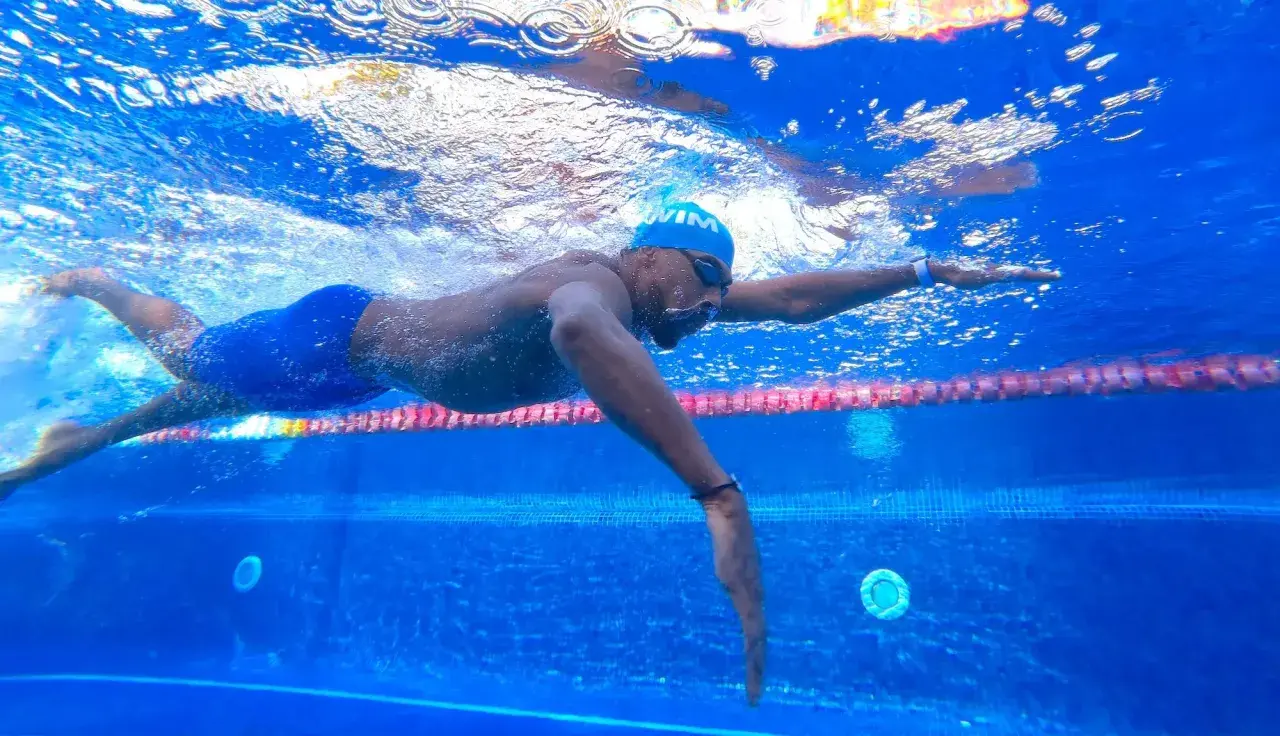
VO2 max is the upper limit of how much oxygen your body can use during hard exercise, and in swimming it matters because you are asking your engine to work while breathing is restricted and body position is easy to spoil. The practical answer to how to increase my vo2 max is to train near that ceiling often enough to force adaptation, while keeping enough easy work in the week to recover and build a stronger aerobic base. In pool terms, that means hard intervals, efficient technique, and a plan that is structured rather than random.
The fastest route to better aerobic power in the pool
- High-intensity intervals are the main driver when the goal is to lift oxygen uptake, especially work done near 3 to 5 minutes per repeat.
- Shorter 50s and 100s can still work if the pace is hard enough and the rest is controlled, but they should not turn into sloppy sprinting.
- Stroke economy matters because less drag and better propulsion mean more of your oxygen is spent on speed, not waste.
- One or two quality hard sessions a week is usually enough for most swimmers, provided the rest of the week is genuinely easy or technical.
- Recovery is not optional, because the fitness gain happens after the session, not during it.
What VO2 max means for swimmers
VO2 max is not just a lab number. In swimming, it is the ceiling that helps you hold pace when the set gets uncomfortable, the arms start to feel heavy, and breathing feels a little rushed. A higher VO2 max usually gives you more room to sustain hard pace, but it is not the only thing that matters. Technique, turn speed, pacing, and the ability to tolerate fatigue all change how useful that aerobic ceiling actually is.
I like to think about two layers here. The first is the engine, which is your oxygen delivery and use. The second is stroke economy, which is how much oxygen you waste moving through the water. If two swimmers have similar fitness but one leaks energy through a poor body line, the cleaner swimmer will look fitter almost immediately. That is why the smartest answer to this topic always mixes physiology with pool skills, and it leads directly to the training methods that create the strongest adaptation.

Swim sessions that reliably push aerobic capacity
The strongest evidence points in the same direction: hard interval work beats random medium effort swimming when the goal is to raise VO2 max. In practice, I would build sets that let you spend enough time near your limit to trigger adaptation without letting every rep collapse into survival mode. A useful rule is that the work itself does not need to be huge. Many effective sessions only keep you in the hard zone for a small part of the total workout, but they do that work very well.
| Session type | Example | Why it helps | Best use |
|---|---|---|---|
| Long VO2 intervals | 5 x 400m or 6 x 3 minutes at a hard, controlled pace with 1 to 2 minutes easy recovery | Keeps oxygen demand high long enough to matter | Best all-round choice for most swimmers |
| Middle-duration repeats | 10 to 12 x 100m on a send-off that gives 15 to 25 seconds rest | Builds a strong oxygen response without losing race-specific rhythm | Useful when you want quality and speed together |
| Short hard repeats | 16 x 50m at a pace you can keep technically clean, with short rest | Raises intensity quickly and works well when time is limited | Good as a variation, but easy to overcook |
| Threshold support | 8 to 12 x 200m at a strong steady pace with 15 to 20 seconds rest | Raises the pace you can hold before fatigue rises sharply | Supports VO2 work, but does not replace it |
One swimming study found that 60-second efforts at roughly 95% to 105% of vVO2max, the pace that elicits VO2 max, produced a stronger oxygen response than much shorter bouts. That lines up with what I see in good training plans: short sprints are useful, but the best VO2 sets are usually long enough to make your breathing system work hard, not just your anaerobic system. If you only remember one practical point from this section, make it this one: slightly longer hard repeats usually beat chaotic all-out efforts. That is the bridge to building a week that actually absorbs the work.
Build the aerobic base that lets hard work land
VO2 training works best when it sits on top of a decent aerobic base. If every swim is hard, the quality of the hard swim drops, and the easy work never gets easy enough to build anything. For most recreational swimmers, I would rather see one true VO2 session and one threshold-style session each week than three half-hearted hard sessions. The rest should be easy enough that you can hold a clean stroke and leave the pool feeling better than when you got in.
This is also where technique stops being a vague nice-to-have. Small mechanical gains make your aerobic work more effective because they lower the oxygen cost of every length. The biggest wins usually come from the boring details: head position that does not lift the chest, a stable body line, a catch that starts to hold water earlier, and turns that do not waste momentum. I also like a short drill block before the main set, usually 6 to 10 minutes, because it reminds the body what efficient swimming feels like before fatigue arrives.
- Keep breathing controlled so you do not yank your body line apart on every inhale.
- Use drills to tidy one problem at a time, not to replace the real swim set.
- Use paddles or a pull buoy only if your mechanics stay stable under load.
- Do not let technique work become so gentle that it stops carrying over to the main set.
That balance between endurance and efficiency is what makes the later recovery work worthwhile, because the body can only adapt to what it can actually absorb.
Recover well enough to adapt
I would not do VO2 work on a tired system and expect a clean result. The body needs enough recovery to turn a hard session into adaptation, and that means more than just taking the next day off. As a practical rule, leave at least 24 to 48 hours between true VO2 sessions, especially if the set involved strong pulling, fast turns, or race-pace work. If you keep trying to force intensity before you are ready, the week starts to feel flat and the target splits drift away.
Sleep and fuel matter here. A swimmer who trains hard but sleeps poorly is usually carrying around a hidden performance tax. I would aim for 7 to 9 hours of sleep most nights, and I would not do the hardest set of the week under-fuelled. You do not need a complicated sports nutrition system to get this right. Eat a normal meal or snack before training if the session is demanding, drink enough to avoid obvious dehydration, and get a proper recovery meal afterwards with both carbohydrate and protein.
- Persistent pace drop across the second half of a set.
- Heavy arms or legs that do not clear by the next day.
- Sleep that gets worse as training load rises.
If those signs show up together, I would reduce intensity before adding more metres. That keeps the training block usable rather than heroic on paper and blunt in practice.
A weekly structure that fits a real swim programme
Here is the structure I would use for a fit adult swimmer who wants better aerobic power without turning every day into a race. It is simple on purpose. The exact metres will vary by age, ability, and pool time, but the pattern is what matters. A recreational swimmer might live in the 1,500 to 2,500 metre range per session, while a stronger club swimmer may sit closer to 2,500 to 4,000 metres. The point is not to chase volume for its own sake. The point is to place each type of stress where it does the most good.
| Day | Focus | Example |
|---|---|---|
| Monday | Easy aerobic swim | Technique work, relaxed swimming, and smooth breathing |
| Tuesday | VO2 max set | 6 x 3 minutes hard with enough rest to keep quality high |
| Wednesday | Recovery or rest | Light swim, mobility work, or a complete break |
| Thursday | Threshold or CSS work | 10 x 200m at a strong steady pace with short rest |
| Friday | Dryland strength or easy swim | Pulling strength, trunk control, shoulder stability, or a relaxed pool session |
| Saturday | Mixed aerobic and skill work | Drills, turns, and moderate continuous swimming |
| Sunday | Off | Full rest or an easy walk and mobility |
I like this type of week because it gives intensity a job, rather than letting it bleed into every session. It also leaves room for strength work, which helps the shoulders, trunk, and legs tolerate the pool better over time.
How I would measure progress without chasing a watch estimate
Wearable VO2 estimates can be useful, but in the pool they are still only trend data. I would not obsess over a single number from a watch, especially if the reading comes from a wrist sensor that is less reliable in water. A better approach is to repeat the same small set of tests every 4 to 6 weeks and look for improvement in pace, repeatability, and recovery. That tells you far more about real fitness than a one-off estimate.| Marker | What it tells you | How to test it |
|---|---|---|
| Repeatability | Whether you can hold pace without fading | 10 x 100m on a fixed send-off |
| Race-relevant speed | How your hard pace is improving | 400m time trial or a broken 400m set |
| Recovery | How quickly your system settles after hard work | Check heart rate and breathing 60 to 90 seconds after a hard repeat |
| Efficiency | Whether you are using less effort for the same speed | Compare stroke count and pace on the same swim set |
The best sign of progress is usually not one heroic rep. It is a smaller drop-off across the whole set, a calmer breathing pattern at the same pace, and a stroke that still looks organised late in the session. That is the kind of improvement that actually carries over to meets, open water swims, and harder training blocks.
What I would change first in the next four weeks
If I were rebuilding a swimmer’s VO2 work from scratch, I would make four changes before I touched anything else. First, I would keep one session per week centred on longer hard intervals, ideally 3 to 5 minutes per repeat or hard 100s with short rest. Second, I would keep one threshold session in the programme so the aerobic base keeps rising underneath the hard work. Third, I would make the easy swimming truly easy, because that is what lets the quality sessions stay sharp. Fourth, I would treat recovery as part of training, not as downtime after the “real” work.
- One hard VO2 session each week.
- One threshold or CSS session each week.
- Easy technical swimming around those sessions.
- Two short strength sessions if your shoulders and trunk need support.
That combination is usually enough to raise aerobic capacity without wasting energy on gimmicks. If the goal is better performance in the pool, the cleanest path is still the same: train hard enough to create an adaptation, then recover well enough to keep it.
