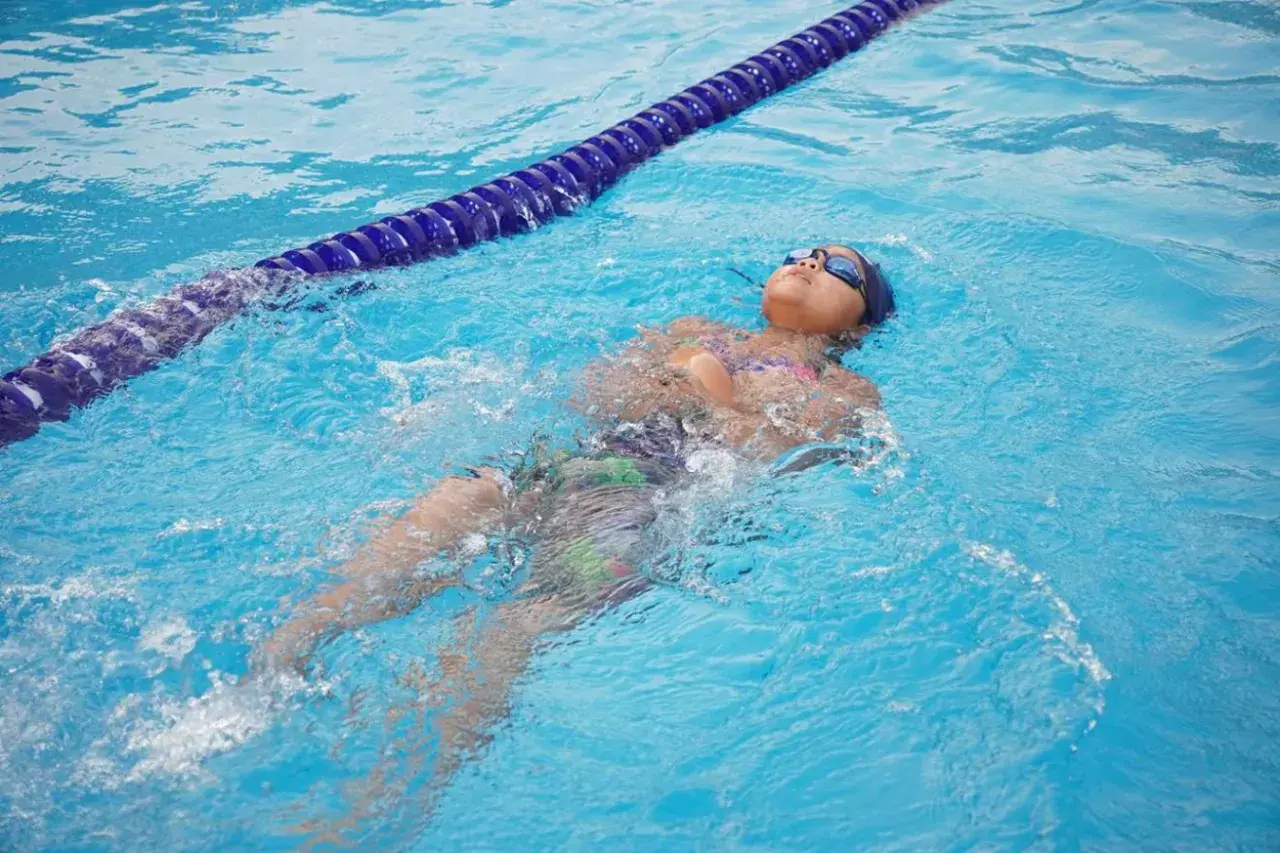
What matters most when you need to stay afloat
- Stay vertical and relaxed; tension, not depth, is what usually makes beginners sink faster.
- Use a compact kick that creates lift instead of a wide, noisy one that burns energy.
- Let your hands help with small sculling motions, but do not let them do all the work.
- Practice in short rounds first, then build toward a calm one-minute hold.
- The Red Cross includes floating or treading water for one minute in its water-competency sequence.
- In cold or rough water, endurance drops fast, so the skill should be paired with good judgment and, when relevant, a life jacket.
Build the body position first
The easiest way to stay afloat is to make your body smaller, calmer, and more balanced in the water. I tell beginners to think of a loose sitting position: torso upright, hips under the surface, chin level, and shoulders relaxed. If you throw your head back or arch your lower back, your hips usually sink and your legs have to work harder just to recover.
Breathing matters as much as posture. Keep your exhale steady and your inhale quick but controlled, because long breath holds create tension that spreads through the whole body. When your breathing stays calm, the rest of the movement becomes easier to organize. Once that position feels familiar, the next question is which kick gives you the most lift for the least effort.

Choose a kick that gives you lift, not just motion
There is no single kick that works for every swimmer, but some patterns are clearly more efficient than others. When I teach this skill, I usually start with the simplest motion a swimmer can repeat cleanly, then move toward a more stable pattern once their balance improves. The goal is not to look busy; the goal is to keep your head up with minimal energy loss.
| Technique | What it feels like | Best use | Main trade-off |
|---|---|---|---|
| Eggbeater | Alternating circular leg motion in a seated position | Longer treading, water polo, artistic swimming | Harder to learn at first |
| Upright breaststroke or frog kick | Compact out-and-around leg sweep | Beginners who need immediate lift | Can get sloppy if the knees spread too wide |
| Flutter kick plus sculling | Fast, small kicks with hand support | Short holds or transition moments | Fatiguing if the legs do all the work |
| Bicycle kicking | Pedaling motion many beginners invent naturally | Temporary survival movement | Usually wastes energy and gives poor lift |
The eggbeater is the most efficient of the common patterns because it keeps lift more continuous, but that does not mean every swimmer should start there on day one. A compact breaststroke-style kick is often easier to feel, and that early success helps people relax enough to refine the technique later. The legs do the heavy lifting here, but the hands decide whether you stay steady or wobble, which is the part I would tackle next.
Let your hands steady the water, not fight it
Sculling is the hand action that helps keep you upright, and it is more subtle than most beginners expect. Your hands should stay in the water, near the surface, with soft elbows and palms angled to catch and redirect water rather than slap at it. Small side-to-side or figure-eight motions work better than hard downward pushes, which usually create fatigue before they create useful lift.
- Keep your hands in front of or slightly out from your shoulders so they can stabilize your balance.
- Use relaxed wrists and bent elbows; rigid arms waste energy fast.
- Feel pressure on both sides of each palm instead of trying to “push” the surface down.
- Match hand rhythm to your kick so the movement feels continuous, not choppy.
If your shoulders start burning before your legs do, your hands are probably doing too much. The point of sculling is support, not a second full stroke. Once that support becomes automatic, you can practice the whole skill in short, controlled rounds instead of hoping you last by accident.
Practice in a sequence that builds confidence
I prefer short, repeatable drills because they teach control without overwhelming a beginner. Start in chest-deep water near a wall, ladder, or lane line, where you can recover quickly if your form breaks down. Many U.S. swim programs treat the ability to tread or float for one minute as a basic benchmark, but that time should be built gradually rather than forced on the first attempt.
- Hold the wall, then find your vertical posture with your feet off the bottom.
- Tread for 10 to 15 seconds, rest, and repeat five times.
- Build to 30-second holds with calm breathing.
- Move to 45 seconds, then to a full minute without rushing your kick.
- Practice with your hands low, then with one hand doing more of the work, then with both hands light.
- Try the drill in slightly deeper water only after you can stay composed in shallow water.
That progression matters because it teaches your body to stay organized under mild fatigue, not just when everything feels perfect. If you get cold, shaky, or overly winded, stop the drill and recover first, because cold water and panic change the equation quickly. The next thing to clean up is the set of mistakes that drain energy long before they should.
Fix the mistakes that drain energy fast
Most beginners do not sink because they are weak; they sink because they are working inefficiently. I see the same errors again and again, and each one has a simple correction if you catch it early.
- Holding the breath creates tension. Keep exhaling calmly and breathe in between movements.
- Kicking too wide wastes effort. Keep the legs compact and purposeful.
- Looking up hard forces the hips down. Keep the chin neutral instead.
- Trying to “stand” in the water makes the body rigid. Stay loose and let the water support you.
- Overusing the arms tires the shoulders fast. Let the legs and hands share the job.
- Panicking after one bad breath breaks the rhythm. Reset the posture and simplify the movement.
The fastest improvement usually comes from removing one bad habit, not from adding five new cues at once. Once those habits are under control, the skill becomes much more reliable in the situations that matter most.
What to do when the water gets rough or cold
Treading water is a useful survival skill, but it is not a substitute for a real exit plan. If you can reach a wall, dock, ladder, or boat, do that instead of burning energy staying in place. In open water, wind, waves, and cold can make even a decent tread feel twice as hard, which is why I treat conditions as part of the technique, not an afterthought.- On a boat, wear a U.S. Coast Guard-approved life jacket rather than relying on endurance alone.
- In colder water, shorten your practice intervals because heat loss raises fatigue quickly.
- If you start to gasp or lose rhythm, simplify immediately and move toward support if it is available.
- For children and newer swimmers, supervision matters more than technique, even when the drill looks easy in the pool.
If you want a practical target, aim to stay calm, vertical, and controlled for one minute without frantic splashing or a strained face. Once you can do that consistently, you have a skill that actually holds up when you need it, not just one that looks good for a few seconds in ideal water.
