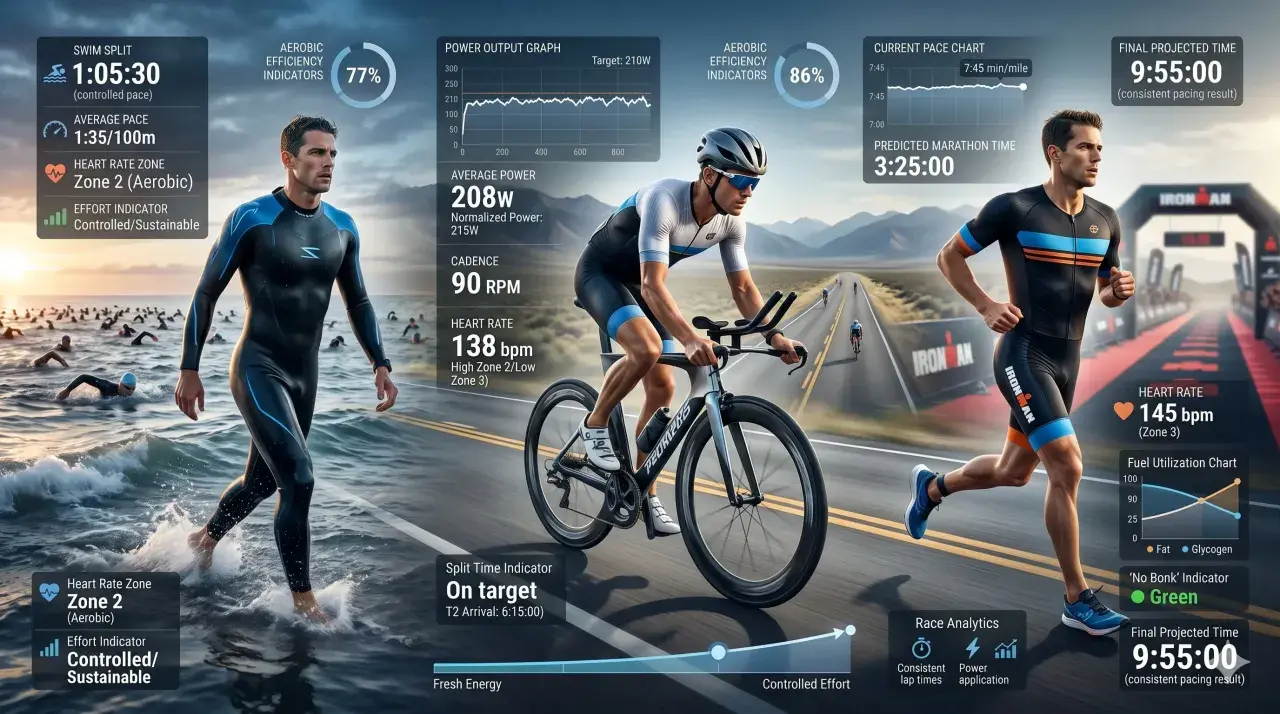
The run is where triathlon racing stops feeling theoretical and starts feeling honest. For swimmers stepping into the sport, the challenge is not simply getting better at running; it is learning how to run well after the swim and bike have already spent some of your freshness. In triathlon running, the first kilometre is rarely the place to prove fitness, and that single detail changes everything from pacing to nutrition to transition setup.
What matters most on the run leg
- The run should start under control, not at open-run pace.
- Short-course racing rewards turnover; long-course racing rewards restraint and fueling.
- T2 needs to be simple, rehearsed, and boring if you want a smooth start.
- Brick workouts help, but they do not replace regular standalone runs.
- The fastest run split usually comes from the bike you chose, not just from the shoes you wear.
Why the run feels different after the bike
The run after cycling is not the same sport as a fresh road run. Your quads are already loaded, your hip flexors have been holding a compact position, and your breathing is usually higher than it would be at the same pace in a standalone race. I tell athletes to treat the first 8 to 12 minutes as a reset window, not a verdict on their fitness.
That matters because triathlon does not punish effort evenly. If the bike was too hard, the run reveals it quickly. If the transition was frantic, the run starts with a stress spike you did not need. And if the weather is hot, the cost shows up even faster because dehydration and heat load make pace feel more expensive than it should.
What looks like a “bad run” is often just a poor handoff from the bike. Once you see that, the solution becomes more practical: protect the legs earlier so the run has something left to work with. That leads directly to pacing, because the right run plan starts before T2 even ends.
How to pace the run by race distance
Pacing the run is where most triathletes either save their race or quietly unravel it. I like to think in terms of effort first and pace second, because the right answer depends on distance, course profile, heat, and how hard the bike already was. As a starting point, short-course athletes can usually afford a slightly firmer opening than long-course athletes, but nobody should sprint out of T2 and hope the damage does not show up later.
| Race type | Run segment | Early-race approach | Common mistake |
|---|---|---|---|
| Sprint | 5 km / 3.1 mi | Settle the first kilometer, then build if breathing stays controlled. | Running the first 1 km like a standalone 5K time trial. |
| Olympic | 10 km / 6.2 mi | Start smooth, aim for even splits, and press only after the legs respond. | Chasing pace too early because the finish still feels far away. |
| 70.3 | 21.1 km / 13.1 mi | Run by effort, keep the stride compact, and let pace float with the course. | Trying to “make up time” after a hard bike. |
| Ironman | 42.2 km / 26.2 mi | Protect the aerobic ceiling, fuel steadily, and stay honest with effort. | Comparing yourself to open-marathon splits. |
If you want a simple rule I use often, here it is: in sprint and Olympic races, begin a touch slower than your fresh 5K rhythm and only press if the stride feels natural after the first mile or so. In half and full distance racing, I would rather see a conservative first 10 to 15 minutes than a heroic first kilometer that costs three minutes later. The best pacing plan is the one that still works when the bike was a little harder than expected, which is why T2 matters so much.

How to set up T2 so the run starts clean
T2 should reduce friction, not create it. When I look at fast transition setups, the pattern is always the same: the athlete knows exactly where everything is, nothing requires a decision, and the body can switch from bike mode to run mode without extra noise. That is especially important in the United States, where many age-group races mix variable weather, busy transition areas, and long course days that reward calm execution.- Place your run shoes so they are easy to find at a glance, not buried under extras.
- Use elastic laces only if you have tested them in training.
- Decide before race morning whether you will wear socks, because that choice affects everything else.
- Keep your nutrition visible and reachable so you do not waste seconds hunting for it.
- Use a race belt, hat, or visor only if they make the run easier, not because they look race-ready.
I like transition setups that look almost boring. If a setup saves 10 seconds but creates panic, it is not actually saving anything useful. The real goal is to leave T2 with a clear head and quiet legs, because that is what lets the run begin under control instead of in survival mode. That kind of calm usually comes from practice, which brings us to the training itself.
How to train for the run off the bike
Brick training is simply a bike ride followed immediately by a run, but the value is bigger than the definition suggests. It teaches your legs how to change patterns, helps your breathing settle faster, and shows you what race pace actually feels like when the bike has already done some damage. USA Triathlon has long pointed athletes toward regular brick work in the final stretch before race day, and that advice matches what I see in practice: once the race is close, the run needs to be rehearsed in the exact state it will be raced in.
That said, bricks are a tool, not the entire plan. If every run is tied to a bike session, your pure run fitness can stall. I prefer a mix that keeps most running on fresh legs while still giving you enough bike-to-run exposure to make the transition feel normal.
- Use one short brick each week in the final 6 to 8 weeks before the race.
- Keep the run portion short at first, usually 10 to 20 minutes, and keep the intensity controlled.
- Once you are adapted, add a few segments at planned race effort instead of turning every brick into a test.
- In longer races, include occasional longer bricks so you can practice pacing and fueling under fatigue.
- Keep at least some standalone runs in the week so your mechanics stay honest.
The best bricks feel almost underwhelming while you are doing them, and that is a good sign. They should build confidence, not leave you cooked for the rest of the week. Once the body knows how to make the switch, the next limiter is usually fuel, and that is where many races are quietly lost.
Fueling and hydration that carry into the final miles
The run punishes underfueling faster than the bike because you start it already closer to the edge. I like to think of fueling as a chain, not a last-minute fix: if the bike is underfed, the run inherits the problem no matter how disciplined you are in T2. That is why the smartest athletes do not wait for the run to “need” fuel. They arrive there with the tank already supported.
For many age-group athletes, a practical starting point looks like this:
- In sprint racing, eat normally before the start and use on-course fuel only if the heat or duration makes it necessary.
- In Olympic racing, one small carbohydrate hit on the bike or right before T2 is often enough if you tolerate it well.
- In 70.3 racing, 30 to 60 grams of carbohydrate per hour is a useful starting range.
- In Ironman racing, 60 to 90 grams per hour is common when the gut is trained for it.
- In warm conditions, small sips every 10 to 15 minutes usually work better than waiting until thirst turns into panic.
Fluid needs vary more than most athletes expect, but many runners end up somewhere around 14 to 27 ounces per hour, or roughly 400 to 800 milliliters, depending on sweat rate and course support. I would still treat that as a range, not a target to force. If you have trained with caffeine, that can help late in the race, but it should never be a first-time experiment on run day. Once fueling is predictable, the remaining losses are usually mechanical and mental, which is where the common mistakes show up.
Common mistakes that erase a good swim and bike
Most run blowups are not mysterious. They are the predictable result of one or two earlier decisions that felt harmless at the time. I see the same patterns over and over, and the frustrating part is that they are all fixable.
- Racing the first mile because the legs finally feel free.
- Overbiking and then expecting the run to rescue the day.
- Taking race-day risks with shoes, socks, or laces that were never tested in training.
- Skipping bricks and assuming race fitness will appear automatically in T2.
- Overstriding because the pace looks slow on the watch.
- Ignoring heat, humidity, wind, or hills and sticking to a pace that made sense on paper only.
If I had to name the biggest mistake, it would be this: athletes often judge the run by how fast it looks, not by how much they have left at the finish. A controlled split that stays together is almost always better than a fast first half followed by a survival shuffle. That is why the pre-race checklist matters more than many people think.
The details I check before race morning
Before I ever think about pace, I want the course and the plan to feel familiar. I want to know where the aid stations sit, what the first two kilometers feel like, and where I am most likely to be tempted into a mistake. That kind of familiarity is calming, and calm is useful when the body is already under stress.
- I know the first section of the run course, including any turns, climbs, or exposed areas.
- I know whether I am carrying my own fuel or relying on aid stations.
- I have a simple effort cap for the first 10 to 15 minutes after T2.
- I have already rehearsed my shoes, belt, hat, and any nutrition in transition.
- I have a heat plan, which may include shade, fluids, or a lighter cap if the forecast demands it.
- I know the one adjustment I will make if the bike was harder than expected.
The run leg in a triathlon is rarely won by aggression. It is won by restraint, repetition, and a clean transition from the bike to a pace you can actually hold. When the swim has been steady, the bike has been honest, and the first mile is handled with discipline, the final stretch stops being chaotic and starts becoming manageable, even when it still hurts.
