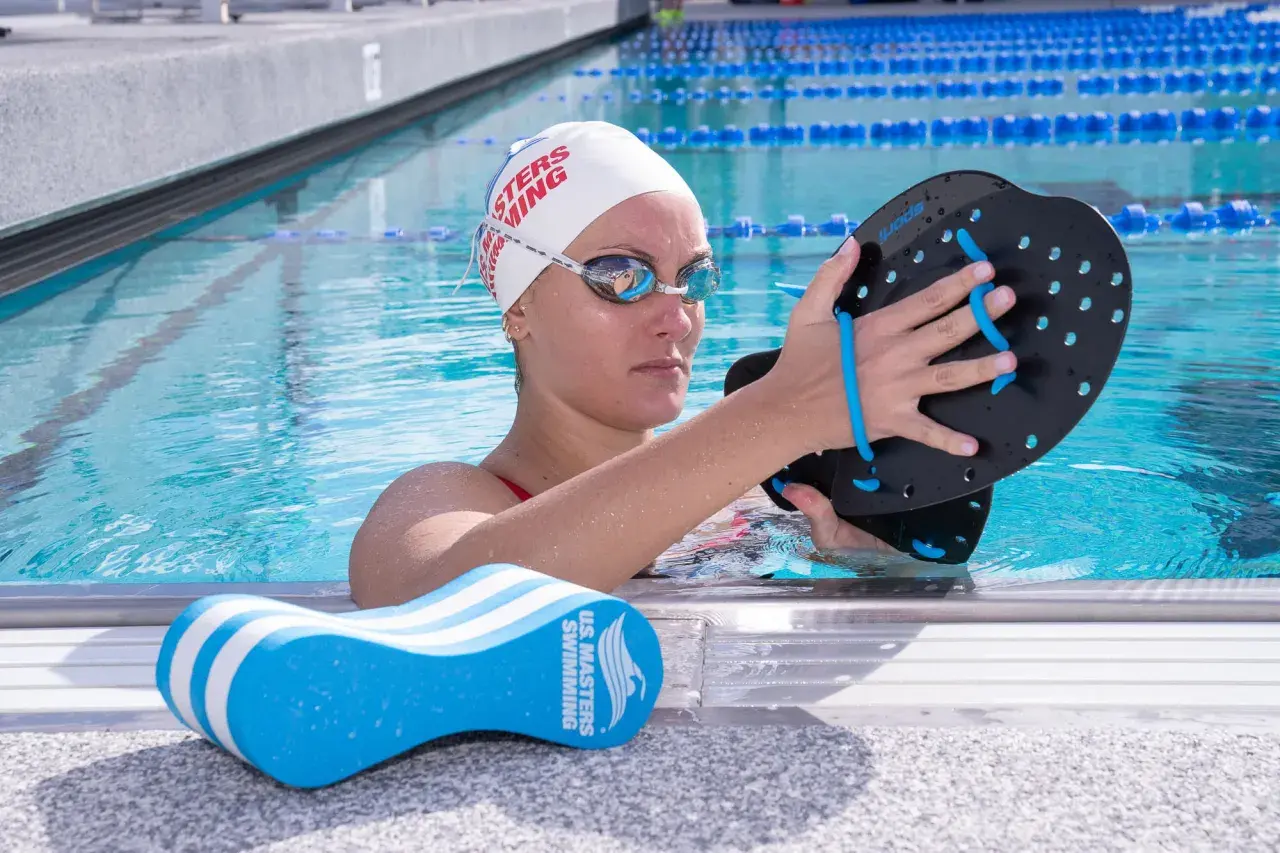
Paddles can sharpen your catch, expose flaws in your stroke, and build upper-body strength, but only when they are used with control. This guide explains how to use swim paddles without turning them into a shoulder tax, with practical advice on fit, stroke mechanics, drills, and the mistakes that usually lead to bad habits. I focus on the parts that actually matter in training, so you can make the equipment work for technique instead of just resistance.
Key points to keep in mind
- Start small. Fingertip or sculling paddles are usually the best entry point because they give feedback without overwhelming your shoulders.
- Let the water hold the paddle. If you have to cinch the straps hard, the size or shape is probably wrong.
- Use paddles to improve your catch, forearm position, and straight-back pull, not to force a faster pace.
- Keep the work short at first. A few controlled repeats are more useful than a long pull set.
- Stop immediately if pain shows up. Good paddle work should feel demanding, not sharp or unstable.
What paddles actually change in the water
I like to think of paddles as feedback tools first and resistance tools second. By increasing the surface area of your hand, they make it easier to feel where pressure is leaking, where the catch is weak, and whether your pull is staying aligned with the water. That is why US Masters Swimming describes paddles as a way to improve technique by enhancing feedback, not just as a way to make swimming harder.
They can also help you build strength, but only when your stroke stays clean. If the paddle shows you that your elbow is dropping, your hand is crossing over, or your catch is too shallow, that is useful information. The goal is not to overpower the tool; it is to let the tool reveal how efficient your stroke really is. Once that mindset is in place, choosing the right paddle becomes much easier.

Choose the right paddle for your goal
Not every paddle is meant for the same job. Some are built to help you feel the water, others are meant to build power, and a few are designed mainly to make technique mistakes obvious. US Masters Swimming puts fingertip and sculling paddles in the starter category, and that matches what I see in practice: smaller tools usually teach better habits before bigger tools add load.
| Paddle type | Best for | What it teaches | Main caution |
|---|---|---|---|
| Fingertip or sculling paddles | Beginners, drill work, and learning water feel | Early catch awareness and steady pressure | Not ideal for long, hard main sets |
| Technique paddles | Refining hand entry and forearm position | Cleaner catch, better alignment, smoother pull | Too much surface area can overload the shoulder |
| Strength paddles | Advanced swimmers doing short power work | More force through the pull and better distance per stroke | Only useful if your stroke already holds together under load |
| Strapless or feedback-driven paddles | Swimmers who want immediate technique feedback | Palm pressure, catch quality, and body control | If it slips or wobbles, the stroke is telling you something |
If you are unsure, I would always start smaller than your ego wants. A paddle that is slightly too modest is far more useful than a giant one that forces you to shorten the stroke or brace through the shoulder. Try different styles if you can, because hand shape, mobility, and stroke background all affect what feels natural. Once the tool fits the job, the stroke itself has to stay honest.
Use them to build a clean catch, not just more resistance
The technical cue I care about most is simple: keep pressure on the water from the moment your hand sets the catch until the hand exits near the hip. Speedo’s coaching advice lines up with that idea by pushing swimmers to keep the paddle flat and, in some cases, to use only one finger strap so the hand stays honest. I agree with that approach because a loose, truthful setup gives you better feedback than a strap arrangement that hides sloppy mechanics.
- Slip the paddle on so it sits flat against the palm rather than hanging off the fingers.
- Enter the water in line with the shoulder and avoid crossing over the midline.
- Set the catch early, with the elbow slightly higher than the hand so the forearm can do real work.
- Press straight back instead of pushing down. The force should move you forward, not bury the hand.
- Finish the pull fully, usually through the hip, before starting a smooth recovery.
- Watch for wobble. If the paddle shifts, the catch is usually leaking pressure somewhere.
That forearm-driven catch is often called an early vertical forearm, or EVF, which simply means your forearm gets into a stronger vertical position early enough to act like a better paddle. You do not need to force it. You need enough control to keep the forearm and hand working together through the pull. When that happens, the paddle feels like a guide instead of a burden. Those mechanics become much easier to own when the set is built around a few drills.
Drills that turn feedback into better swimming
If I want paddle work to stick, I do not start with a huge yardage set. I start with drills that make the swimmer notice pressure, alignment, and timing. That is where the equipment earns its keep.
- Sculling with small paddles helps you feel how tiny changes in hand angle affect pressure. It is one of the best ways to learn where the water disappears.
- Short repeats with and without paddles let you compare sensation immediately. The contrast is often more valuable than the paddle set itself.
- Single-arm freestyle exposes crossover, dropped elbow, and poor body line because the stroke cannot hide behind both arms working at once.
- Catch-up variations slow the stroke enough to make the entry and catch more deliberate, which helps swimmers who rush the front end of the pull.
- Short power repeats work well only after the mechanics are stable. The point is to hold form under load, not to survive the set.
That progression matches what US Masters Swimming recommends: start with smaller paddles when you want more feel for the water, then move up only when your technique can handle it. I think that order matters more than the specific brand name on the deck. Once the body understands the pressure path, you can add a little resistance without building slop. Technique only improves if the load stays sensible, so the next section is about the mistakes that cause trouble.
Common mistakes that create shoulder stress
The biggest paddle problems usually come from trying to get too much out of them too soon. Paddles can absolutely help performance, but they can also amplify whatever is already weak in your stroke. If the mechanics are poor, the equipment makes the error louder.
- Using paddles that are too large forces you to shorten the stroke, lose rhythm, or compensate through the shoulder.
- Cranking down the straps hides bad pressure. If the strap is doing the work, the catch is not.
- Dropping the elbow loads the shoulder in a way that feels powerful for a moment and ugly later.
- Using paddles in the warm-up can irritate cold shoulders. I prefer to earn the right to use them after the body is already moving well.
- Ignoring pain or pinching is the fastest route to a pointless setback. Discomfort is not the same as useful training stress.
If pain appears, stop. That advice sounds blunt because it needs to be blunt. The issue may be the paddle size, the angle of the catch, or simply too much volume for your current shoulder capacity. The safe response is always the same: reduce the load, clean up the mechanics, and rebuild carefully. If you avoid those errors, paddle work becomes a useful part of weekly training rather than a gamble.
A simple weekly set structure that works for most swimmers
For most recreational swimmers, triathletes, and Masters swimmers, I like paddles to show up in one or two short blocks a week, not every session. You want enough exposure to improve the catch without making the shoulders the limiting factor in your training. A useful paddle block is usually 10 to 15 minutes of focused work, or a handful of short repeats with plenty of control.
- Warm up normally without paddles.
- Do 4 x 25 or 4 x 50 with small paddles, concentrating on a quiet hand entry and a firm catch.
- Rest enough to keep the stroke clean, usually 15 to 30 seconds between short repeats.
- Remove the paddles and repeat 2 to 4 lengths at the same rhythm so you can feel the difference.
- Finish with easy swimming and notice whether the stroke feels longer, steadier, and more controlled.
If you are training for open water or triathlon, keep at least part of your work paddle-free so your normal stroke pattern still gets attention. Paddles should sharpen your freestyle, not replace the skills you need when the equipment is gone. Once you can move back and forth between paddle and no-paddle swimming without losing shape, the tool is doing its job. The last piece is mindset, because the best sets are judged by what they improve, not just by how hard they feel.
The detail that makes paddle work worth repeating
The swimmers who get the most from paddles are usually the ones who treat every repetition like feedback. They are not chasing the biggest surface area or the loudest workout. They are asking a narrower question: did this set make my catch cleaner, my pull straighter, and my finish more complete?
If the answer is yes, the paddles belong in your bag. If the answer is no, the paddles are probably too big, too tight, or being used for too much volume. Keep the tool small enough to teach something and honest enough to tell the truth, and it will pay off more than any brute-force pull set ever will.