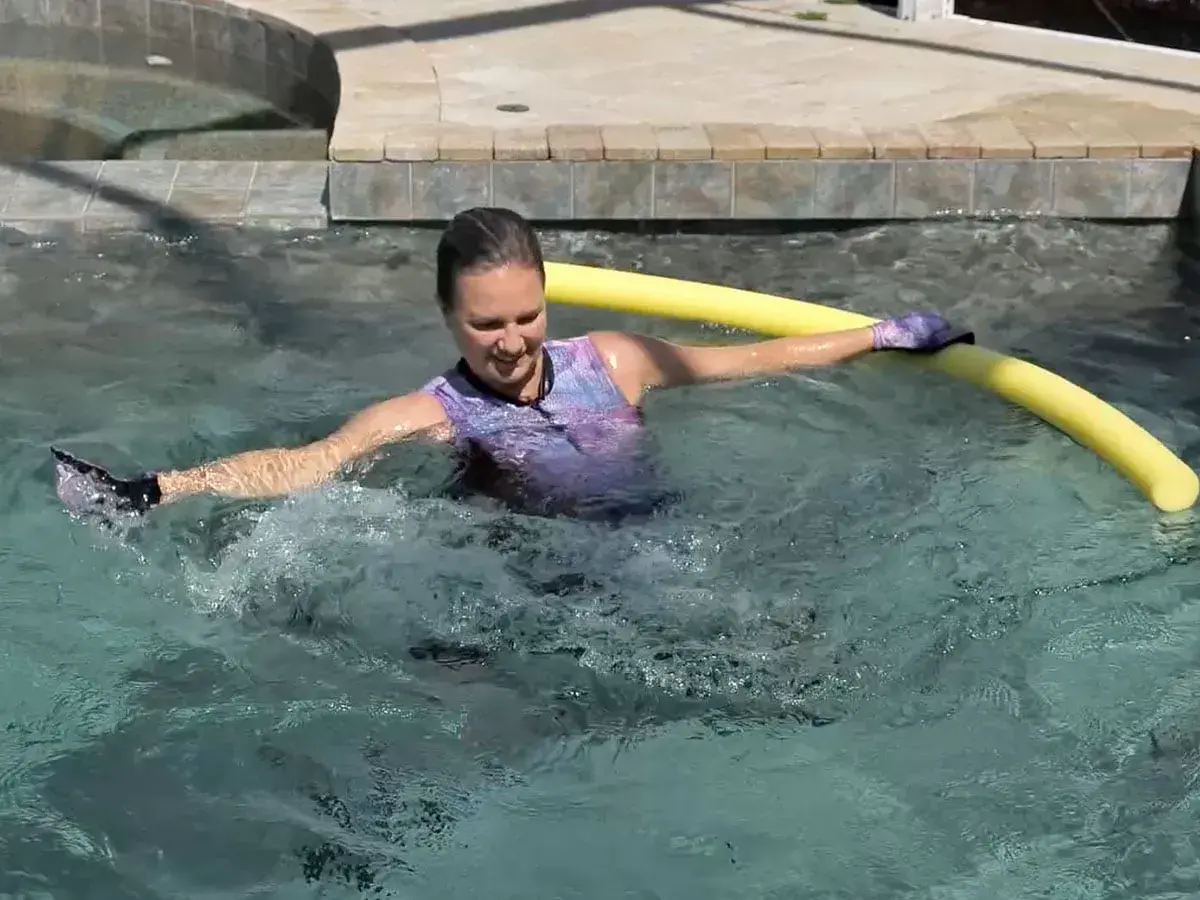
Pool training gives your arms two things most land workouts struggle to combine: continuous resistance and a low-impact environment. That makes it useful whether you want better swim-specific strength, a joint-friendly conditioning session, or just a cleaner way to build upper-body endurance without pounding your shoulders and elbows. This guide breaks down pool exercises for arms, explains which movements actually matter, and shows how to turn them into a session that feels structured instead of random.
The essentials you need before you start moving water against your arms
- Water adds resistance in every direction, so even simple arm lifts become real work.
- The best pool drills for arms usually train the shoulders, triceps, biceps, and upper back together.
- Foam dumbbells, hand webs, and resistance gloves are the most useful pieces of gear for most people.
- Ten to 15 reps per exercise is a practical starting range, with 2 to 3 rounds for a solid session.
- Technique matters more than speed, because sloppy movement just creates splash, not tension.
- Pool work is excellent for conditioning and recovery, but it does not fully replace heavy land-based strength training.
Why the pool is such a good place to train your arms
I like pool work for arm training because the water makes you earn every rep without forcing the same impact you get from dumbbells, cables, or push-ups. The resistance is there the moment you move, and it stays there through the lift, the turn, and the return, which means your muscles have to control the motion instead of just throwing weight around.
That combination matters. The buoyancy of water supports the body, which can make training more comfortable for people with cranky shoulders, sore elbows, or a history of impact-heavy workouts. At the same time, the water still pushes back hard enough to challenge the shoulders, triceps, forearms, and upper back. In practical terms, pool arm work often feels easier on the joints but harder on the control side.
This is also why pool training is so useful for swimmers. The movements are not random fitness filler. They reinforce the same patterns you need for stroke stability, catch strength, and better body position in the water. Once you understand that, it becomes much easier to choose exercises that actually deserve a place in your workout. The next step is deciding which arm movements are worth doing in the first place.

The arm moves I would start with in the water
I would not try to turn the pool into a cable room. The better approach is to pick a small set of movements that cover pushing, pulling, lifting, and stabilizing. Mayo Clinic's aquatic-exercise guidance points to hand webs, water weights, resistance gloves, foam dumbbells, and kickboards, and that is a useful place to start because those tools let you change resistance without changing the whole workout.
| Exercise | Main muscles | How to do it | Why I use it |
|---|---|---|---|
| Front arm lifts with foam dumbbells | Shoulders, triceps, upper arms | Stand in chest- to shoulder-deep water, hold the dumbbells at your sides, lift both arms forward to the waterline, then lower slowly. | Simple, easy to control, and good for building basic shoulder endurance. |
| Lateral arm lifts | Side shoulders, upper arms | Stand tall, start with hands by your sides, raise the arms out to the sides until they are level with the water, then return under control. | Useful for shoulder stability and for swimmers who need better lateral control through the stroke. |
| Forearm curls and pressdowns | Biceps, triceps, forearms | Keep the elbows close to your body, curl the forearms up against the water, then push the hands down until the arms straighten again. | One of the cleanest ways to train both elbow flexion and extension in a pool. |
| Kickboard pull-push work | Triceps, chest, shoulders | Hold a kickboard with one hand, brace the body, and pull or press the board through the water with control. | Good for adding resistance without needing heavy gear, and it feels more like a real athletic pattern. |
| Water walking with strong arm drive | Arms, upper back, core | Walk through waist- to chest-deep water and swing the arms actively instead of letting them hang passively. | Easy to scale, good for warm-ups, and more useful than many people expect. |
| Deep-water treading with sculling | Shoulders, forearms, upper back | Stay upright in deep water and sweep the hands in quick, small figure-eight motions while treading. | Excellent for endurance, shoulder endurance, and swim-specific control. |
The point is not to isolate one tiny muscle and pretend the pool is a machine room. The best drills create useful tension across the whole upper body, which is why a session built around a few simple patterns usually works better than a long list of random motions. Once those movements make sense, the real value comes from putting them into a session you can repeat.
How to turn those moves into a 20-minute session
For most people, a strong pool arm workout does not need to be long. I usually think in three parts: warm up, work, and cool down. If the session drags on for 45 minutes, the form usually slips before the muscles get the right kind of work.
- Warm up for 3 to 5 minutes with easy water walking, shoulder rolls, and light arm swings.
- Choose 4 exercises and do 2 to 3 rounds of 10 to 15 reps each.
- Rest for 20 to 40 seconds between exercises, then about 60 seconds between rounds.
- Finish with 2 to 4 short intervals, such as 30 to 60 seconds of deep-water treading or brisk arm-driven water walking.
- Cool down for 2 to 3 minutes with easy movement and relaxed shoulder motion.
If your goal is swim performance, I would keep the work crisp and leave plenty of room for technique practice in the same session. If your goal is general fitness or recovery, start with 2 rounds and keep the tempo steady instead of chasing speed. For strength-endurance, the win is not a frantic pace. The win is being able to keep the same quality from the first rep to the last. That naturally leads to the next question, which is whether the equipment you use is actually helping or just making the session look more complicated.
Which equipment is worth using and what it changes
Most pool arm sessions work best with just one or two pieces of gear. If you overload the setup, the workout gets awkward fast. I would usually start simple, then add resistance only when the movement pattern is stable. The gear should help you create more useful tension, not force you to fight the water in a sloppy way.
| Gear | What it changes | Best use | When to skip it |
|---|---|---|---|
| Foam dumbbells | Adds resistance through flotation and drag | Front lifts, lateral lifts, curl-and-press work | Skip only if your shoulders feel unstable or the pool is too crowded for controlled movement. |
| Hand webs | Increases the surface area of the hand | Biceps and triceps work, deep-water treading, strong pulls | Skip if you are new and cannot keep your elbows under control. |
| Resistance gloves | Gives a lighter, more natural feeling than webs | Technique-focused upper-body work with moderate added resistance | Skip if you want the hardest possible load right away. |
| Water weights | Turns the pool into a predictable push-pull resistance tool | Curls, pressdowns, and upright arm work | Skip if you are already fatigued and your form is breaking down. |
| Kickboard | Creates a simple lever to push or pull against | Controlled presses and stability drills | Skip if it makes your wrists or shoulders feel pinched. |
| Buoyancy belt | Keeps you afloat in deep water so your hands stay free | Deep-water intervals and treading-focused arm work | Skip in shallow sessions where you can stand comfortably. |
If I had to choose the first add-on, I would pick foam dumbbells or hand webs. That order keeps the session simple while still giving you enough load to matter. The next problem is not gear. It is usually technique. A lot of pool workouts fail because the movement looks active but never really loads the muscles in a clean way.
The mistakes that make pool arm work feel busy instead of effective
The biggest mistake is moving too fast. Water rewards control, not flailing. If every rep turns into a splashy sprint, the shoulders stop working through a full range and the arms never get a clean resistance pattern.
- Using momentum instead of control, which turns the set into cardio noise.
- Letting the elbows drift away from the body during curl and press movements.
- Choosing too much resistance before the movement pattern is stable.
- Cutting the range of motion short, especially on the lowering phase.
- Training only for fatigue and never tracking reps, rounds, or tempo.
- Ignoring shoulder discomfort until it becomes a bigger problem.
Another common mistake is treating every session like a swim sprint. That can make sense for conditioning, but not for arm strength. If the goal is stronger, more durable upper-body work, I want the last few reps to stay controlled, not become a survival drill. Once those errors are cleaned up, the session becomes much easier to repeat and progress without guessing.
A simple pool arm routine you can repeat this week
If you want something practical, I would use one of these two templates and stick with it for a few weeks before changing anything. The goal is not novelty. The goal is repeatable progress.
- Session A: 5 minutes of water walking, front arm lifts, lateral arm lifts, forearm curls and pressdowns, then a 1-minute deep-water tread finisher.
- Session B: 5 minutes of water walking, hand-web arm work, kickboard push-pulls, deep-water sculling, then a short cool-down.
- Weekly rhythm: 2 sessions for general fitness, 3 sessions if you are recovering well and also swimming on separate days.
- Progression rule: add a round, slow the lowering phase, or choose a tool with more surface area before you chase faster reps.
For swimmers, this kind of work fits best after technique practice or on a separate conditioning day, because it supports arm endurance without stealing too much energy from the parts of training that improve stroke quality. For anyone else, it is simply a clean way to train the upper body in water without turning the pool into a guessing game. If you keep the movements controlled, the resistance honest, and the volume realistic, the pool becomes one of the most practical places to build stronger arms without beating yourself up.