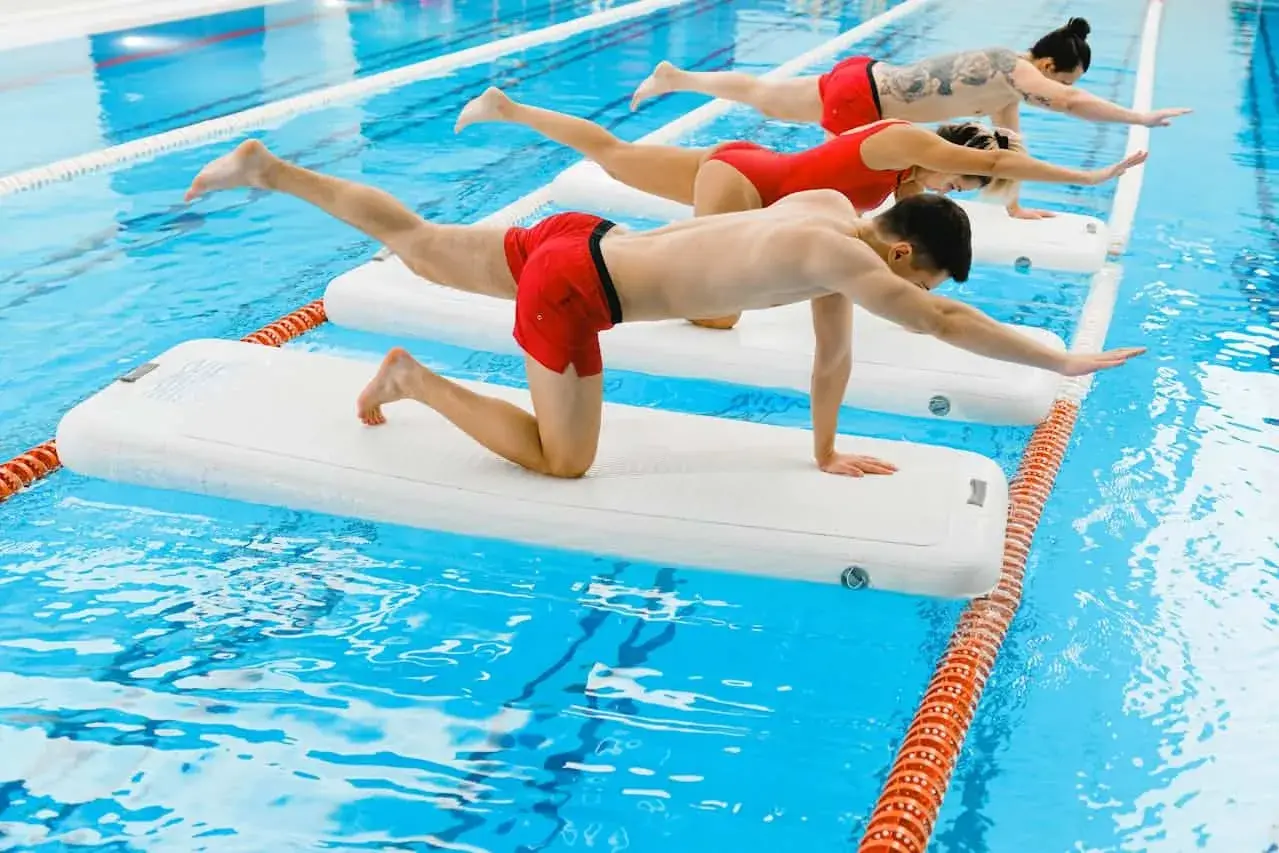
Pool-based training works best when it has a clear purpose: build fitness without hammering the joints, improve endurance, and support better swimming mechanics. I treat aqua gym less like casual water exercise and more like a structured session with a warm-up, a main set, and a real recovery phase. In this article I break down what it covers, which routines transfer to swim training, and how to build a safer, more effective week in the pool.
What matters most before you start
- Water reduces impact, so you can usually train longer with less joint stress than on land.
- The best pool routines mix cardio, resistance, and mobility instead of repeating the same move.
- For general fitness, the useful baseline is still about 150 minutes of moderate weekly activity and 2 strength days.
- Pool work can support swim performance, but it does not replace stroke practice if faster swimming is the goal.
- Equipment helps, but pacing, posture, and progression matter more than fancy gear.
How I define aqua gym for swim training
In practical terms, I see it as any pool-based conditioning session that uses the water as both support and resistance. That includes shallow-water aerobics, deep-water running, interval sets, mobility drills, and exercises that challenge the arms, legs, and trunk against constant drag. For a swimmer, the value is not just that it feels easier than land work. The real advantage is that you can keep moving for longer while loading the body in a different, often more joint-friendly way.This difference matters because water changes both the load and the way you should pace the work, which is why the next question is not “what is it?” but “why does it work so well?”
Why water changes the training effect
Water supports part of your body weight, so the joints are not taking the same pounding they would on a treadmill or court. At the same time, every movement has to fight drag from multiple directions, which means even simple actions like marching, side-stepping, or arm sweeps can become real conditioning if the effort is honest. I like that combination because it gives you aerobic work, muscular endurance, and stability practice in one place.
- Lower impact: useful for knees, hips, feet, and anyone coming back after a break.
- High resistance without heavy load: muscles work continuously, especially in longer sets.
- More core demand: the body has to stay aligned while the water pushes back.
- Better tolerance for volume: many people can train longer in water than they can on land.
I also pay attention to effort perception in the pool. Water can make a workout feel gentler than it really is, so I rely on breathing, posture, and recovery time instead of splash alone. Once that is clear, the next step is building a session that actually earns the session title.

A pool workout that actually transfers to swimming
If the goal is fitness, I build the session around intent, not novelty. Different pool formats do different jobs, and the wrong one can leave you tired without creating the adaptation you wanted. This is especially important for swimmers, because general pool fitness is useful, but it is not automatically the same thing as swim conditioning.
| Session style | Best for | Example work | Main limitation |
|---|---|---|---|
| Shallow-water cardio | General conditioning and calorie burn | Water jogging, lateral steps, jumping jacks | Less specific to stroke mechanics |
| Deep-water running | Low-impact endurance | Intervals with a flotation belt | Needs enough depth and comfort in deep water |
| Resistance circuit | Muscular endurance and trunk control | Push-pull arm patterns, kickboard presses, noodle work | Shoulders can fatigue quickly if volume climbs too fast |
| Swim-hybrid session | Fitness plus technique carryover | Short swim repeats with pool drills between sets | Requires basic swim skill and lane access |
Read Also: Katie Ledecky Training - Swim Faster, Avoid Burnout
A simple 30-minute pool template
- 5 minutes: easy walking, gentle leg swings, arm circles, and breathing control.
- 10 minutes: cardio intervals, such as 30 seconds brisk movement and 30 seconds easy recovery.
- 10 minutes: resistance work, such as kickboard presses, water jogs, and side shuffles.
- 5 minutes: slower movement and relaxed breathing to cool down.
For most people, I would start with 20 to 30 minutes and build from there instead of chasing a long, exhausting first session. If your goal is swim performance, keep at least part of the workout specific to swimming, because pool aerobics improves fitness, but it does not fully replace stroke practice. Once the structure is in place, the gear you choose decides how comfortable that work becomes.
Equipment and cues that make it better
I do not think extra equipment is necessary, but a few simple tools make pool training more precise. The point is to increase resistance, support body position, or help you hold a better pattern for longer. I prefer tools that solve a clear problem rather than gadgets that just make the water feel busy.
- Flotation belt: best for deep-water running because it unloads the joints and keeps the body upright.
- Kickboard: useful for lower-body endurance, but it can irritate the shoulders if you overuse it.
- Water dumbbells: add drag for upper-body endurance, though they are not a substitute for real strength training.
- Noodle: good for beginners, balance work, and longer mobility drills.
- Fins: help with speed and ankle demand, but I keep the sets short if calves or feet cramp.
The cue I keep coming back to is simple: clean movement beats noisy movement. More splash does not mean more work. Smaller, controlled actions with stable posture usually produce better resistance and less junk stress on the shoulders and lower back. Even so, the biggest mistakes are rarely about gear. They are usually about how people dose the work.
Common mistakes that limit results
The most common problem I see is treating a pool session like unstructured play. That may feel active, but it rarely gives a clear training signal. The second problem is going too hard too soon, especially with upper-body drills that load the shoulders in awkward positions.
- Starting too fast: the body floods with fatigue before technique settles in.
- Using only one pattern: endless kicking or endless arm work creates imbalance.
- Ignoring progression: if the session never changes, the body adapts and the benefit drops.
- Confusing discomfort with effectiveness: a good workout is demanding, but it should not feel chaotic.
- Skipping swim-specific work: if faster swimming matters, pool fitness alone is not enough.
If I had to name one simple fix, it would be this: time the intervals and track the effort. Water makes it easy to drift into a hard, unfocused middle ground, and that is where results slow down. That leads naturally to the other side of the equation, which is who benefits most and when caution matters.
Who it suits and when to be careful
Pool-based exercise is a strong fit for people who want lower-impact conditioning, especially beginners, older adults, and anyone managing joint discomfort. It is also useful for swimmers in a rebuilding phase because it lets them maintain fitness while easing the load on tendons and joints. In my experience, it becomes most valuable when consistency matters more than chasing a peak workout.
That said, I would not treat the pool as automatically safe in every situation. New chest pain, dizziness, severe shortness of breath, open wounds, active skin infections, or uncontrolled medical symptoms are reasons to pause and get medical guidance first. In public pools, I also want clear depth markings, clean water, and normal safety supervision. A good session is only useful if the setting is trustworthy enough for you to repeat it week after week.
Once those guardrails are in place, the last decision is how to slot the work into a week so it supports both fitness and swimming without crowding everything else out.
The weekly pattern that keeps pool work effective
If I were building a simple week from scratch, I would use two pool sessions. One would lean aerobic, with steady movement and short intervals. The other would lean toward resistance and control, using deeper water, directional changes, or longer sets with simple tools. That alone can improve conditioning without making the pool the only thing you do.
For readers who also want better swimming, I would pair those sessions with at least one lane workout and two short land-based strength sessions. The land work matters because the pool does not fully cover hip stability, posterior-chain strength, or heavier loading for the lower body. That balance is usually better than trying to force every adaptation out of the water.
The simplest rule I use is this: keep the pool work consistent, progress it slowly, and make every session clear enough that you know what it is trying to improve. In 2026, that is still one of the most practical ways to turn water time into real fitness instead of just time spent moving around.
