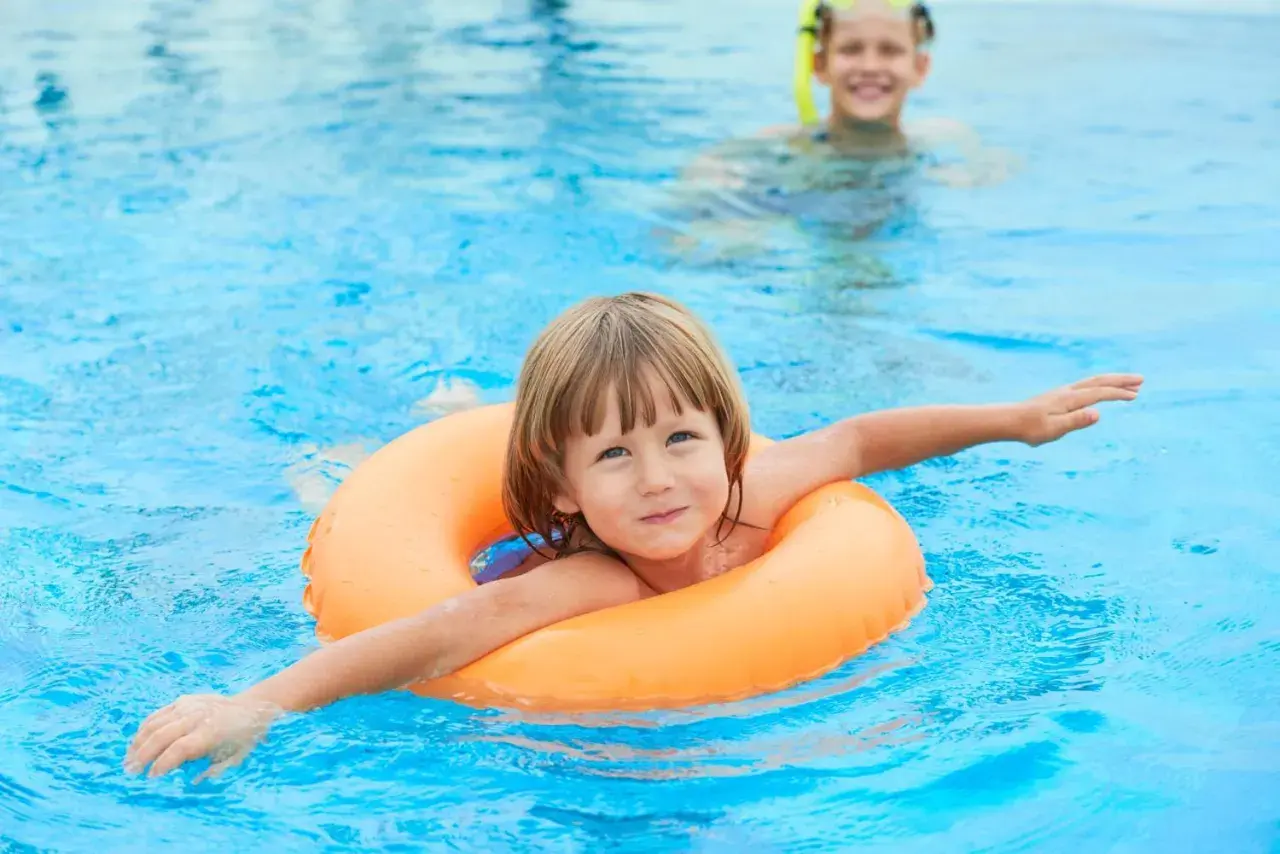
The real issue behind when to stop swim lessons is not the birthday on the calendar; it is whether the swimmer can move, breathe, and recover with control. I care most about repeatable safety skills, not one good lap on a calm day. This article breaks down the signs that a child or adult is ready to move on, when to keep going, and how to step away without losing confidence.
The safest exit point is skill mastery, not a calendar date
- There is no universal age when swim lessons should end.
- Readiness shows up in repeatable skills, calm breathing, and safe choices in the water.
- A good instructor should be able to explain exactly what still needs work.
- Pool comfort is not the same as open-water readiness.
- Stopping is often smarter as a gradual taper than as a hard cut.
There is no single age when lessons should end
I do not use age as the exit rule. The American Academy of Pediatrics says swim lessons can begin for many children around age 1, but it also makes clear that readiness depends on emotional maturity, physical coordination, and comfort in the water.
That matters because a child can be old enough for lessons and still not be ready to stop them. By age 4, many children are ready for basic water survival skills, and by age 5 or 6, many can master the front crawl, but neither milestone means the learning is finished.
Age gives me a rough frame, not a decision. I move on only when the swimmer shows the skills, consistency, and judgment to make the next stage reasonable. That leads to the more useful question: what should they actually be able to do?

The skills that usually signal readiness to move on
When I evaluate whether formal instruction can taper off, I look for reliable performance, not a perfect performance on a perfect day. A swimmer does not need to look like a competitive athlete, but the basics should hold up without panic or constant correction.
| Skill | What I want to see | Why it matters |
|---|---|---|
| Controlled breathing | Exhales underwater, keeps the face calm in the water, and recovers after a splash | Breathing control is usually the first thing to disappear when a swimmer is unsure |
| Independent travel | Can swim at least 25 yards without grabbing the wall, standing up, or stopping to reset | This is a practical baseline for basic water competency |
| Self-rescue | Can tread water or float for about 60 seconds and regain composure | If something goes wrong, the swimmer has a way to buy time |
| Safe entry and exit | Gets in and out of the water safely using steps, ladder, wall, or pool edge | Many accidents happen around entry, exit, and transitions |
| Consistency | Repeats the skill on different days without losing form completely | One lucky attempt is not the same as dependable ability |
| Safety habits | Waits for permission, stays in the right area, and does not chase risky challenges | Technique matters, but judgment matters just as much |
If a swimmer can do all of that only when fresh, only in one lane, or only with the instructor hovering inches away, I treat the skill as incomplete. The next section is about whether the instructor sees that clearly too.
What a good instructor should be checking
A solid instructor does not just hand out praise or move a swimmer because the session ended. In a mastery-based class, each level builds on the last, and the swimmer advances only after the skill is reliable enough to stand on its own. That is how the better Red Cross-style programs work, and it is the standard I like to see in any serious lesson track.
What I want from the instructor is plain language. I want to hear exactly what is ready, what is shaky, and what the next target should be. If the feedback is only “she did fine,” that is too vague to make a good decision.
- Clear progress notes after class.
- Specific next-step goals, not generic encouragement.
- Enough repetition to make the skill stick.
- Corrections for body position, breathing, and safety habits.
- A direct answer on whether the swimmer is ready to move up or needs more time.
When the teaching is mostly play with very little evaluation, I would not use that as proof that the swimmer is finished. I would treat it as a sign to find a sharper class, because the next stage depends on honest assessment. That is especially true when the swimmer starts moving beyond the sheltered pool environment.
Reasons to keep lessons going even after the basics click
Some swimmers look “done” in a warm, familiar pool and then fall apart the moment the conditions change. That is why I keep lessons going when any of these remain true:
- The swimmer is comfortable in shallow water but uneasy in deeper water.
- The swimmer can complete one lap but tires quickly.
- The swimmer needs reminders about stopping, looking, and asking before entering water.
- The swimmer has never practiced with clothes on or in colder water.
- The swimmer has no open-water experience and may be heading toward lakes, beaches, or boating.
- The swimmer is learning strokes but still loses form under light fatigue.
That last point matters more than people expect. A child who can cross the pool with sloppy breathing and poor body position may be able to “swim” in a loose sense, but not yet well enough for less forgiving conditions. When the environment changes, weak technique shows up fast.
For adults, I use the same logic. If the goal is casual comfort, I want calm breathing, a stable float, and enough endurance to repeat the skill. If the goal is fitness or open-water events, I keep coaching until the stroke is efficient under light fatigue, not just fresh at the start of the lane.
That is why the next question is not only whether to stop, but whether to taper in a smarter way.
How to step away without losing the gains
I rarely think in all-or-nothing terms. In many cases, the cleaner move is to taper instruction instead of ending it abruptly, especially for younger swimmers or anyone who is still building confidence.
| Approach | Works best when | Main tradeoff |
|---|---|---|
| Stop formal lessons now | The swimmer meets the core safety benchmarks and keeps practicing in real life | The family must stay intentional about maintaining the skills |
| Step down to periodic refreshers | The swimmer is close, but still benefits from a tune-up every few weeks or before a new season | Slower progress, but less risk of backsliding |
| Keep regular lessons | Confidence, technique, or safety habits are still uneven | More time and money, but a stronger skill base |
My preference is usually to taper rather than disappear completely. A monthly private lesson, a summer refresher, or a short skills reset after a long break often preserves more than a hard stop, especially when the swimmer is still young or still growing into the body control the sport demands.
- Keep at least one supervised swim session in the routine when possible.
- Review entries, exits, floating, and treading water, not only strokes.
- Use a properly fitted life jacket for boating and open water.
- Recheck skills after a long break, a growth spurt, or a confidence dip.
If the swimmer stays in the water but the habits stay sharp, a pause becomes much less risky. That sets up the final check I use before I actually end a lesson cycle.
A simple exit checklist I use before ending a lesson series
Before I tell a family or swimmer to stop formal lessons, I ask whether most of these are true in a normal pool setting, not just on a very good day.
- The swimmer can move at least 25 yards without grabbing the wall or panicking.
- The swimmer can tread water or float calmly for about a minute.
- The swimmer can get in and out safely without help.
- The swimmer can recover after an unexpected splash, slip, or face-full of water.
- The swimmer follows pool rules without constant reminders.
- The swimmer keeps decent form when tired.
- The swimmer understands that swimming alone is not a safe option.
If I cannot check most of those boxes, I keep the swimmer in lessons for another round and use that time to close the gaps. That is the cleaner decision, and in swimming, clean decisions matter more than fast ones.
