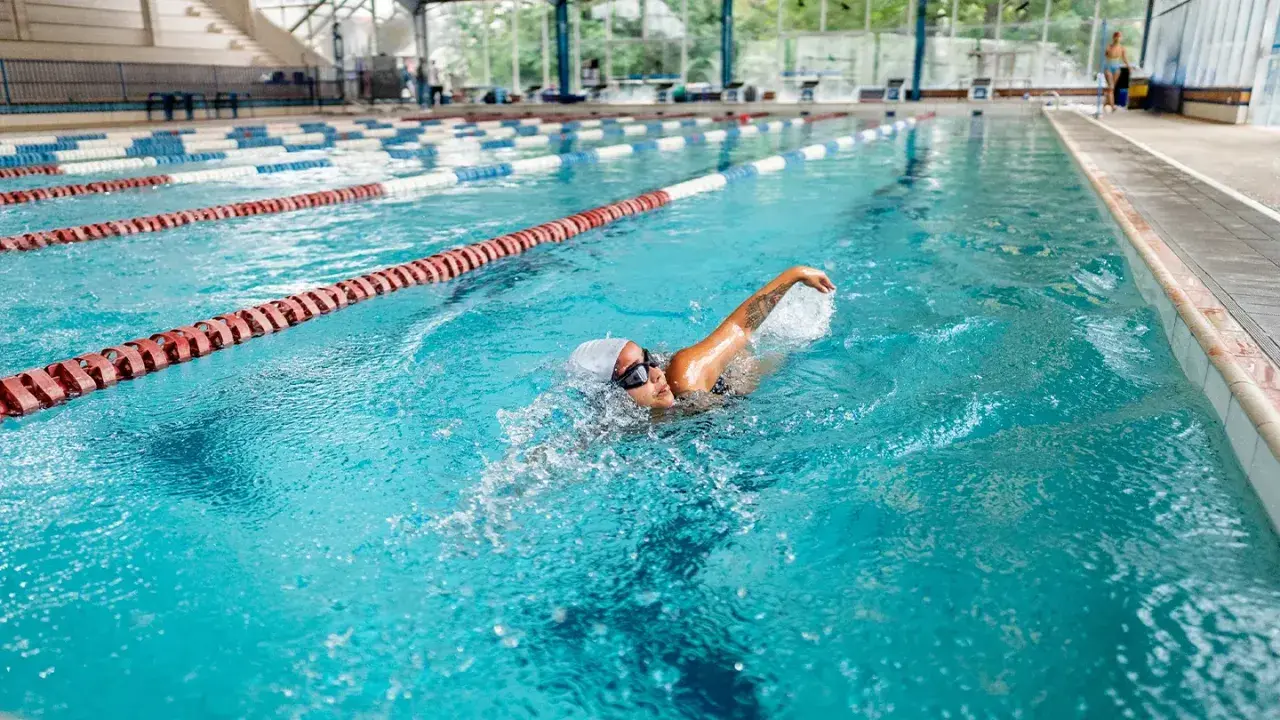
A 30-minute pool workout works best when every minute has a job: warm up the body, sharpen the stroke, then push the main set hard enough to matter. I like this format because it gives you real training value without demanding a long session or a complicated plan. In this article, I’ll show how to structure the half hour, how hard each block should feel, how to scale it to your level, and which mistakes usually waste the time.
The fastest way to make thirty minutes count in the pool
- Start with 5 to 6 minutes of easy swimming before you ask the body for speed or power.
- Use short repeats and controlled rest instead of swimming randomly from one wall to the next.
- Build the middle of the session around a clear effort target, usually around 6 to 8 out of 10.
- Keep the session time-based so it works in both 25-yard and 25-meter pools.
- Beginners should shorten the main set first, not the warm-up or cooldown.
- A few technical cues and the right tools can improve the workout more than extra yardage.
Why thirty minutes works so well in the pool
In the water, 30 minutes can disappear fast if you start too hard, rest too long, or drift from one length to the next without a purpose. I treat the clock as a guardrail: it forces me to warm up, work, and recover in a sequence that actually changes fitness. The key idea is interval training, which simply means you alternate effort and rest instead of trying to swim nonstop at one pace.For a short session like this, I like to think in effort zones rather than exact yardage. RPE, or rate of perceived exertion, is the simplest way to do that: 1 means almost no effort, 10 means all-out. A well-built half-hour swim usually moves from easy work to moderate work, then ends with a small burst of quality before cooldown.
| Block | Time | Effort | Purpose |
|---|---|---|---|
| Warm-up | 5 to 6 minutes | 3 to 4/10 | Raise temperature, loosen shoulders, settle breathing |
| Drills | 5 to 6 minutes | 4 to 5/10 | Improve body line, breathing, and catch mechanics |
| Main set | 12 to 14 minutes | 6 to 8/10 | Build aerobic fitness, pace control, or speed endurance |
| Quality finish | 3 to 4 minutes | 8 to 9/10 | Train speed without turning the whole session into a sprint test |
| Cooldown | 2 to 3 minutes | 2 to 3/10 | Lower the heart rate and leave the pool feeling controlled |
That structure gives the workout a clear shape, and once you can read that shape, the next step is turning it into a session you can actually swim.

A 30-minute swim session I would use for most swimmers
This version is time-based, so it works whether the pool is 25 yards, 25 meters, or something less standard. I would rather have you swim this cleanly than chase a fixed distance target and let your form fall apart halfway through.
| Minute range | Set | What to focus on | Rest |
|---|---|---|---|
| 0 to 5 | Easy swim, mostly freestyle with a little backstroke if you need it | Long exhale, relaxed shoulders, smooth push-offs | Continuous |
| 5 to 10 | 4 x 25 drill, 4 x 25 easy swim | Choose one drill and keep it simple: catch-up, fingertip drag, or side-kick drill | 15 to 20 seconds between repeats |
| 10 to 22 | 6 x 50 at moderate pace | Hold the same stroke count or slightly improve it as the set goes on | 15 to 20 seconds between repeats |
| 22 to 27 | 4 x 25 fast | Speed first, but only if the line stays clean | 30 to 40 seconds between repeats |
| 27 to 30 | Easy cooldown | Relax the breathing and lengthen the stroke again | Continuous |
If 50s feel too demanding, change the main set to 8 x 25 and keep the same rest pattern. If you are stronger and want more endurance, swap the 6 x 50 for 4 x 75 or 3 x 100 at the same controlled effort. The point is not to suffer through the clock; the point is to give each minute a clear job.
How I scale the same session for different levels
The best thing about a short swim session is that it adapts cleanly. I do not change the whole workout when someone is newer or fitter; I change the repeat length, the rest, and the target effort. That keeps the session honest without making it feel like a different sport.
| Level | Main set | Rest | Focus |
|---|---|---|---|
| Beginner | 8 x 25 at easy-moderate effort | 20 to 30 seconds | Breathing control, relaxed body position, finishing each repeat with calm form |
| Intermediate | 6 x 50 at moderate effort | 15 to 20 seconds | Pace consistency and clean push-offs |
| Advanced | 3 rounds of 4 x 50 or 8 x 25 | 10 to 15 seconds | Hold speed without letting the stroke shorten or rush |
If continuous swimming still feels shaky, I would split the middle of the workout into two blocks of 6 minutes with one easy minute between them. That usually helps newer swimmers stay calm while still building the endurance they need. Once that feels manageable, the next gain comes from technique, not just from doing more lengths.
The technique cues and gear that make the workout pay off
I am picky about four things in a short swim set: body line, breathing, the catch, and the quality of the push-off. A clean streamline after every wall push saves more energy than most swimmers realize; streamline means a tight, narrow body position that reduces drag before the first stroke. The catch is the part of the pull where the hand and forearm start holding water, and if that moment is weak, the rest of the stroke usually leaks effort.
- Exhale underwater instead of holding your breath until the last second.
- Keep the head still on easy swimming so the hips do not sink behind it.
- Count strokes on one repeat to check whether you are getting more efficient or just faster and sloppier.
- Finish the pull with a firm, controlled exit instead of slapping the water on every stroke.
- If breathing breaks your position, slow down before you try to swim harder.
| Tool | Best use | When I would skip it |
|---|---|---|
| Snorkel | Drill work and body-line practice | When you start relying on it to hide poor breathing mechanics |
| Fins | Kick sets and technique work | When the kick gets wild or your calves feel overloaded |
| Pull buoy | Upper-body focus and alignment | When it makes your hips drop or you are protecting a sore shoulder |
| Paddles | Catch awareness and strength | When shoulders are tender or the stroke is already unstable |
I do not think every short workout needs tools. In fact, the more broken the stroke looks, the less gear I use. Once the mechanics are under control, the next trap is usually simple but costly.
The mistakes that waste the half hour
A short session becomes expensive when the swimmer makes the same errors over and over. These are the ones I see most often, and they are easy to fix once you spot them.
| Mistake | Why it hurts | Better move |
|---|---|---|
| Starting the first lap too hard | The warm-up turns into survival mode, and the rest of the session never settles | Build pace gradually over the first 5 minutes |
| Skipping drills | You miss the easiest chance to fix breathing and body line | Keep at least 5 minutes for simple, repeatable drills |
| Resting too long | You cool down between repeats and lose training density | Use short, intentional recovery instead of drifting at the wall |
| Using paddles to force speed | Shoulders and form usually take the hit | Keep the tool choice small until the stroke stays stable |
| Chasing distance instead of quality | The workout becomes random, and the best work gets hidden in fatigue | Track effort, stroke count, or repeat consistency instead |
| Swimming every repeat at the same tempo | There is no real training stimulus, so progress stalls | Separate easy, moderate, and fast work on purpose |
If the stroke falls apart, the workout has already stopped being productive. I would rather cut the main set short and finish with a clean cooldown than force junk volume for the sake of staying in the water.
How I would progress it over four weeks
The easiest way to improve is to keep the structure and change one variable at a time. I usually adjust either rest, repeat count, or pace, never all three at once.
| Week | Change | Goal |
|---|---|---|
| 1 | Swim the base session exactly as written | Learn the rhythm and keep the stroke clean |
| 2 | Reduce the rest on the main set by 5 seconds | Build fitness without making the repeats much harder |
| 3 | Add one extra repeat to the main set or one extra fast 25 | Increase workload while protecting form |
| 4 | Keep the same rest and make the moderate work slightly faster or smoother | Prove that you can hold better pace under the same time cap |
If the shoulders feel beat up, I would make week 4 easier instead of harder. Progress in the pool is usually steadier when the body can recover well enough to repeat the effort, and that matters more than one aggressive week.
Small adjustments that keep the workout useful in real life
Real pools are not always calm, empty, or perfectly set up for training. These are the adjustments I use when the session has to fit around the lane, the clock, or the body on that day.
- If the lane is crowded, use time-based rounds instead of fixed lengths.
- If you do not have a pace clock, use a swim watch or a simple interval timer on deck.
- If your shoulders feel tired, replace fast paddled work with backstroke, kick, or easy drill swimming.
- If the day feels rough, keep the warm-up and cooldown, then cut the main set by about 20 percent rather than skipping the workout.
- If your goal is endurance more than speed, make the middle block longer and keep the effort around 6/10.
The best 30-minute pool workout is the one you can repeat next week without feeling wrecked, because repeatable quality beats one heroic session that leaves your stroke flat. I would keep the format simple, keep the cues honest, and let the clock do the work.