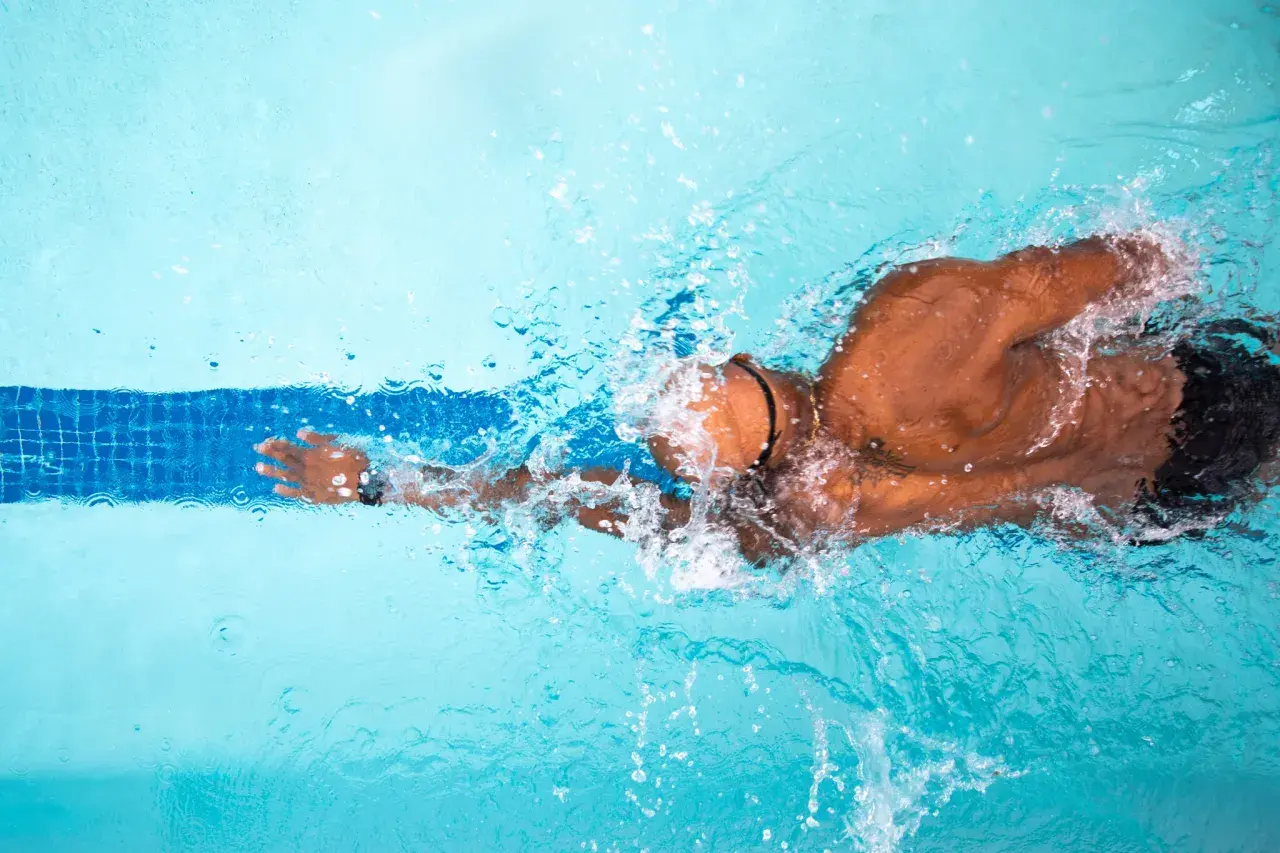
Swimming is one of the best low-impact ways to build cardio fitness, leg drive, shoulder endurance, and breathing control in one session. The real question is how long to swim for exercise without wasting time or digging yourself into fatigue. I’ll break down the best range for beginners, regular lap swimmers, and anyone trying to turn pool time into real conditioning.
Key takeaways for choosing the right swim duration
- Most beginners should start with 15 to 20 minutes of actual swimming inside a 20 to 30 minute session.
- For general fitness, 30 to 45 minutes in the pool is the most practical target for many adults.
- If your goal is stronger conditioning, 45 to 60 minutes works well once your technique and recovery are solid.
- Rest breaks count, especially in interval sessions, so total session time matters more than nonstop laps.
- For health goals, consistency matters more than one long workout.
- When form falls apart, extra minutes usually add fatigue, not better training.
What a useful swim session length actually looks like
I usually think about swim time in terms of purpose, not ego. If you are swimming for general health in the United States, the CDC’s weekly activity target gives a useful frame: adults need about 150 minutes of moderate-intensity activity or 75 minutes of vigorous work each week. Swimming can fit either category, but the right duration changes with pace, rest, and stroke efficiency.
That is why the answer is rarely a single number. A relaxed technique session, a steady aerobic swim, and a hard interval workout can all be valuable, even when they last very different amounts of time. The question is not just how long you stay in the pool, but how much useful work you can repeat week after week.
| Goal | Good session length | Best weekly frequency | What it should feel like |
|---|---|---|---|
| Return to exercise | 20 to 30 minutes | 2 to 3 swims | Easy, controlled, plenty of breathing room |
| General fitness | 30 to 45 minutes | 3 to 4 swims | Steady effort, mild fatigue, clean technique |
| Cardio improvement | 40 to 60 minutes | 3 to 5 swims | Structured sets with short recovery |
| Endurance or performance | 45 to 75 minutes | 4 to 6 swims | Purposeful volume, pacing discipline, recovery built in |
If you only remember one thing from this section, make it this: the right duration is the shortest one that still lets you train with quality. Once that is clear, the next step is matching the session to your current level.
Adjust the time to your current fitness level
Beginners usually need less continuous swimming and more recovery. A new swimmer can get plenty out of 15 to 20 minutes of actual swimming inside a 20 to 30 minute session, especially if breathing, turns, and pacing still feel awkward. Once you can finish a set without your stroke breaking down, it makes sense to extend toward 25 to 35 minutes in the water.
If you are just starting out
Keep sessions short and repeatable. Two or three swims a week is enough to build confidence without turning the pool into a grind. I would focus on easy freestyle, backstroke, simple kick sets, and enough rest to keep your technique tidy. The goal at this stage is not to prove toughness; it is to teach your body that swimming is a pattern it can recover from.
If you already train regularly
Thirty to 45 minutes is often the sweet spot. That gives you room for a warm-up, a main set, and a cool-down without rushing. At this stage, you can let session length rise slowly if your breathing stays controlled and your shoulders feel normal the next day. If you need to stop every lap to recover, the workout is probably too ambitious for the day.
Read Also: Fun Swim Drills - Improve Technique & Make Every Lap Count
If you are building endurance
Forty-five to 60 minutes is useful when you want more aerobic load, but only if your form holds together. The extra time should come from structured volume, not from drifting through tired laps. I prefer longer swims to be deliberate: one steady block, one interval block, then a controlled cool-down. That keeps fatigue from swallowing the session.
Once the duration matches your level, the next question is how to use those minutes so they actually improve fitness.

How to make 30 minutes in the pool count
Thirty minutes sounds short until you break it into a proper workout. I have found that a well-built half-hour swim can do more for conditioning than a sloppy 60-minute drift session. The trick is to divide the time into warm-up, main work, and cool-down so each minute has a job.
- Warm up for 5 to 10 minutes. Swim easy and settle your breathing. This is where your shoulders, hips, and kick pattern wake up.
- Main set for 10 to 20 minutes. This is the part that drives adaptation. Use steady laps, intervals, or mixed strokes depending on your goal.
- Add 5 to 10 minutes of technique work. Drills, sculling, or controlled kicking help you improve efficiency, which makes every future session more productive.
- Cool down for 3 to 5 minutes. Easy swimming helps bring your heart rate down and leaves you less wrecked for the next workout.
Here is the part many swimmers miss: rest is not wasted time. In interval work, the recovery between repeats is what lets you keep form and intensity high enough to matter. A set like 8 x 50 yards with short rest often teaches more than a straight swim of the same total distance because you stay focused, not just busy.
A simple example for a 30-minute session would be 5 minutes easy, 10 to 12 minutes of 50-yard repeats at a steady pace, 5 minutes of drills, and 5 minutes easy to finish. That is enough for a meaningful aerobic stimulus without turning the pool into a punishment zone. From there, frequency matters just as much as the structure of one workout.
How often to swim each week for real fitness gains
ACSM’s broad adult guidance lines up well with swimming: roughly 30 minutes of moderate activity on five days a week, or 20 minutes of vigorous work on three days a week. In swim terms, that usually means you do not need one giant session. You need a rhythm you can repeat.
For most people, I like these weekly patterns:
- 2 swims per week for maintenance, recovery, or a gentle return to exercise.
- 3 swims per week for solid fitness gains without overwhelming recovery.
- 4 swims per week if you want stronger cardio adaptation or more serious body composition work.
- 5 swims per week if swimming is your main training mode and your shoulders tolerate the volume.
There is one important catch: a shorter, higher-quality swim can be better than a longer session if you are tired, rushed, or technically sloppy. I would rather see someone swim 3 x 35 minutes every week than chase a single 90-minute session and then disappear for ten days.
The next thing to watch is not motivation, but recovery. That is where a lot of swimmers accidentally overdo it.
When to shorten the workout instead of forcing more laps
Swimming is low impact, but it is not zero strain. Shoulders, neck, and lower back can all complain if you keep extending sessions after your technique has already fallen apart. I shorten the workout when the cost of the next lap is no longer training and starts becoming survival.
- You start gasping every length instead of controlling your breathing.
- Your hand entry gets sloppy or crosses the midline more often.
- Your hips sink and you have to kick hard just to stay level.
- Your shoulders or lower back feel sharp, not just tired.
- Your pace drops hard after every repeat and never comes back.
If that happens, cut the set, cool down, and come back fresh next time. Pushing through bad mechanics rarely builds better fitness; it usually just reinforces bad movement and leaves you too sore to train again soon. The better move is to stop while the session is still productive.
That approach also makes it easier to build a plan you can actually stick to, which is the real point of exercise in the first place.
A four-week build I would actually use
If you want a practical starting point, here is the framework I would use for most adults who are healthy enough to swim but do not want to overdo it on day one. Keep the pace easy enough that your breathing stays controlled and your form stays tidy.
- Week 1: 2 sessions of 15 to 20 minutes in the water.
- Week 2: 2 to 3 sessions of 20 to 25 minutes, with one slightly harder set.
- Week 3: 3 sessions of 25 to 30 minutes, adding a few more repeats or a longer steady segment.
- Week 4: 3 sessions of 30 to 35 minutes, or 30 minutes plus a short technique block.
I usually tell swimmers to add only one variable at a time: either a few more minutes, or a few more repeats, not both. That keeps progress predictable and keeps your shoulders from becoming the limiting factor. For most adults, 30 to 45 minutes three times a week is the most realistic sweet spot for fitness, while newer swimmers should stay shorter until the pool feels smooth rather than stressful. The best swim workout is the one you can repeat next week without dreading it.
